Whether you’re a karaoke enthusiast, a church vocalist, a wedding entertainer, or a classroom presenter, a reliable wireless microphone can elevate every performance. This guide highlights five strong options optimized for singers, with practical notes on range, ease of use, and compatibility. Each product is described with who it’s best for and why it stands out, plus a quick caution when relevant. Use this comparing framework to choose the best fit for your voice, venue, and setup.
Summary of chosen products:
| Product | Best For | Key Benefit |
|---|---|---|
| HUACAM Wireless Microphone | Live performers needing long range | 200 ft range, strong anti-interference |
| JBL Wireless Two Microphone System | Two-person duets or small stages | Dual-channel, seamless pairing |
| KUKIHO 2-Pack Lavalier | On-camera or mobile creators | Plug-and-play, long range for mobile shoots |
| Phenyx Pro PTU-71-2H | Small venues needing reliable auto-scan | Auto scan, multiple frequencies |
| ECHOMUSSY Metal Dynamic Dual | Karaoke and party rooms | All-metal build, clear DSP voice |
HUACAM Wireless Microphone System

Best for: Singers needing long-range freedom in dynamic venues. This system promises up to 200 feet of line-of-sight operation with a reliable signal that minimizes audio dropout during performances.
Why selected: It emphasizes stable transmission and anti-interference performance, addressing common wireless issues like stuttering or dropouts in crowded spaces. The plug‑and‑play setup works with 6.35 mm or 3.5 mm jacks, broadening compatibility with PA systems, karaoke machines, and amplifiers.
Caution: The AUX interface is not applicable; verify your device has a compatible mic input before purchasing.
JBL Wireless Dual-Channel Microphone System
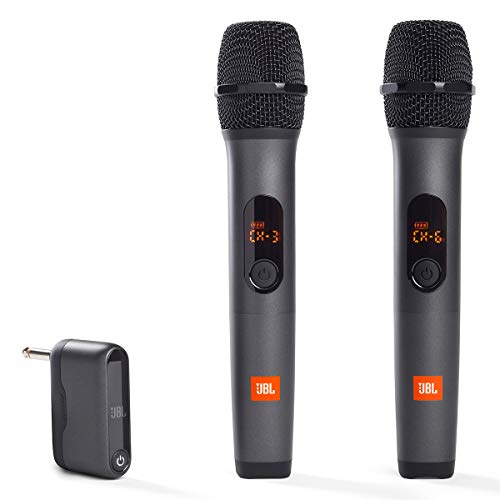
Best for: Duets, small stage hosts, or presenters who want two voices mixed through a single system. The dual-channel receiver provides convenient, ready-to-use operation with JBL Original Pro Sound.
Why selected: It offers a straightforward Plug and Play setup and up to six hours of playback on rechargeable receivers, ensuring consistent performance for longer events. Clear voice quality helps vocalists avoid fatigue caused by distortion or latency.
Caution: Battery life and charging specifics are not stated here; plan for regular recharging during longer shows.
KUKIHO 2-Pack Wireless Lavalier Microphone

Best for: Mobile creators, interview setups, or on-camera presenters needing hands-free operation. The two-pack setup supports multi-person shoots or back-to-back performances without swapping devices.
Why selected: It uses plug-and-play pairing with virtually no Bluetooth dependency, offering stable transmission up to 66 feet in open space. The included noise reduction helps retain vocal clarity in noisy environments.
Caution: Designed for iPhone, Android, and computer recording with adapters; verify adapter compatibility for your device before buying.
Phenyx Pro PTU-71-2H Dual System

Best for: DJs and small venues that need a dependable fixed-frequency system with quick setup. The auto-scan feature reduces time spent finding clear channels.
Why selected: This dual-channel system uses multiple fixed frequencies to minimize interference, with a long range estimate around 260–328 feet line of sight. It includes an LCD display for frequency and volume control, aiding quick balancing during performances.
Caution: Fixed-frequency designs can be less flexible in very crowded RF environments; if your venue has many wireless devices, consider a system with auto-scan options.
ECHOMUSSY Metal Dynamic Dual Microphones

Best for: Karaoke nights, family parties, and church settings where a sturdy, all-metal build supports frequent handling and sharing among performers.
Why selected: The two handheld microphones feature durable metal housings with a one-to-one chip connection and a long 40-hour battery life, making them suited for extended sessions without frequent recharging.
Caution: Not compatible with devices that lack a dedicated 6.35 mm or 3.5 mm mic input; verify your setup before purchasing.
Buying Guide: How to Choose The Right Wireless Microphone For Singers
- Venue and range: If you perform outdoors or across large rooms, prioritize models advertising long-range capability and robust anti-interference technology.
- Channel setup: Duo-mic systems are ideal for duets or two speakers. For solo acts, a single-mic system with solid wireless stability may be sufficient.
- Device compatibility: Check mic input types on your mixer, PA, or karaoke machine (6.35 mm or 3.5 mm). Some lavalier mics require adapters for smartphones or computers.
- Power and battery life: Rechargeable batteries with long life minimize interruptions during events. Consider models offering quick charging if you perform frequently.
- Interference handling: Auto scan and fixed-frequency options help in RF-dense environments. Look for features like PLL frequency synthesis and DSP noise reduction for clearer vocals.
- Durability and handling: For frequent handling, metal housings and simple on/off controls reduce the risk of wear and tear during performances.
- Price-to-performance balance: Evaluate whether you need lavalier, handheld, or dual-mic configurations based on your act, rehearsal space, and audience size.
Frequently Asked Questions
- What should I consider before buying a wireless microphone for singing?
Answer: Consider range, channel options, device compatibility, and noise reduction features to ensure clear, synchronized sound with minimal interference. - Are lavalier mics good for singing?
Answer: Lavalier mics are excellent for hands-free use and duets, but they can pick up clothing rustle or handling noise if not positioned properly. - Is it better to choose a fixed-frequency system or an auto-scan system?
Answer: Fixed-frequency systems offer stability in known RF environments, while auto-scan systems adapt to interference in dynamic venues. - Do I need two microphones for a duo performance?
Answer: If you have two performers singing simultaneously, a dual-channel or two-microphone system is recommended to prevent competition for the same signal path. - Can these systems work with standard PA equipment?
Answer: Yes, most listed systems are compatible with 6.35 mm or 3.5 mm mic inputs on mixers, amplifiers, and speakers. Some lavalier kits require adapters for phone or computer use. - Do wireless mics require special maintenance?
Answer: Regular battery charging, proper antenna seating, and keeping transmitters within line-of-sight of receivers help maintain stable performance.