Answer: If you want reliable wireless in-ear monitoring, choose systems that balance low latency, stable RF, and clear sound across multiple channels. This guide highlights five solid options suited for live performances, rehearsals, studios, and worship teams. Best for solo performers, best for small bands, best for multi-performer setups, best for practice rooms, and best for rack-mounted needs.
| Product | Best For | |
|---|---|---|
| Xvive U45 | Live band or studio with strong channel scanning | 5.8 GHz true diversity; Channel Scan mode |
| LEKATO MS-02 | Small to medium stages; multi-device use | Mono option; Up to 4 receivers |
| POGOLAB | Worship teams, stage bands with long range | UHF, 7 channels; 1 ms latency |
| Xvive U4 | Travel-friendly setups; casual venues | 2.4 GHz; 90 ft range; 6 channels |
| Phenyx Pro Quad-Channel | Four-performer stages or church worship | 4×25 UHF; 4 independent mixes |
Xvive U45 Wireless In-Ear Monitor System

The Xvive U45 offers 5.8 GHz true diversity with a robust 100 ft / 30.5 m operating range. Channel Scan mode helps find the best channel, then you manually align the transmitter. It supports a broad 20 Hz–20 kHz frequency range with a high-resolution 24-bit/48 kHz audio and a 110 dB signal-to-noise ratio. Best for performers who need reliable RF in crowded stages and quick channel optimization. A potential limitation is dependence on unobstructed line of sight for maximum range in complex venues.
Who it’s best for: Solo artists, small bands, or studio users who value reliable wireless stability and straightforward setup. Channel scanning helps reduce interference during quick soundchecks. Choose this if you want strong, consistent sound with a simple workflow.
Selected features: 5.8 GHz true diversity, Channel Scan mode, 20 Hz–20 kHz, 24-bit/48 kHz, 110 dB SNR.
LEKATO MS-02 Wireless In-Ear Monitor System

The LEKATO MS-02 uses upgraded 2.4G with ultra-low latency, offering <4.5 ms latency and a 24-bit/48 kHz sampling rate for clean, realistic sound. It supports mono operation and a One TX to Many RX setup, useful for small to medium stages where multiple performers monitor from a single transmitter. Battery life runs up to roughly 6–8 hours with LED indicators for battery and volume. Limitation: the 2.4 GHz band can be more prone to interference in very crowded environments than dedicated UHF bands.
Who it’s best for: Small to mid-sized bands or worship teams needing multi-receiver capability, straightforward pairing, and longer battery life. Choose this if you want a compact system with reliable latency under typical stage conditions.
Selected features: <4.5 ms latency, 24-bit/48 kHz, One TX to Many RX, up to 6–8 hours, 5-level volume control.
POGOLAB Wireless In-Ear Monitor System

POGOLAB provides a UHF system with 7 selectable channels and 164 ft range, designed for stable, interference-free performance in busy live environments. It delivers 48 kHz/24-bit hi-fi audio with a 35 Hz–16.5 kHz frequency response and a dynamic range over 106 dB. The transmitter features an XLR input with an AUX/LINE switch and a receiver with a 3.5 mm headphone output. Best for worship teams and multi-performer setups where channel management and versatile input options matter. Limitation: as a UHF system, it may require RF planning in extremely dense RF environments.
Who it’s best for: Worship teams, bands, and stage setups needing reliable channel separation and multiple input options. Choose this if you value professional-grade sound with flexible inputs and clear channel signaling.
Selected features: 7 selectable channels, 164 ft range, 48 kHz/24-bit, XLR input, AUX/LINE switch.
Xvive U4 Wireless In-Ear Monitor System Set
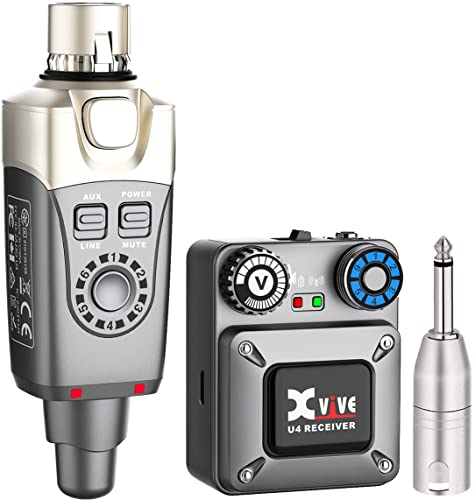
The Xvive U4 operates in the 2.4 GHz band with a reported 90 ft range and less than 5 ms latency across up to 6 channels. This makes it suitable for smaller venues and rehearsal spaces where portability and quick setup are important. Best for travel-friendly setups or casual venues where you want dependable wireless transmission without complex configuration. Limitation: 2.4 GHz systems can be more susceptible to household Wi-Fi and other 2.4 GHz devices in dense environments.
Who it’s best for: Players and engineers who need a compact, travel-friendly system with reliable low-latency performance for smaller stages. Choose this if you prioritize portability and simple operation over maximum RF separation.
Selected features: 2.4 GHz, 90 ft range, 6 channels, latency under 5 ms, portable design.
JOYO Wireless In-Ear Monitor System JW-07

JOYO JW-07 uses 2.4 GHz wireless with under 5 ms latency and features new-player friendly practice and monitoring capabilities. It emphasizes real-time feedback and anti-interference through frequency hopping. Best for beginners and practice environments where quick pairing and stable performance help learning. Limitation: 2.4 GHz devices may experience greater interference in congested RF spaces compared with dedicated UHF options.
Who it’s best for: Beginner musicians, guitarists, DJs, and small studio users who want a simple entry into wireless in-ear monitoring with low latency. Choose this if you value easy pairing and affordable setup for practice or casual performance.
Phenyx Pro Quad-Channel Wireless In-Ear Monitor System

Phenyx Pro Quad-Channel offers four independent monitor mixes with 4×25 UHF frequencies for minimal interference and a long line-of-sight range of 140–164 ft. It includes IR sync for quick linking of multiple receivers and a rack-mount friendly design. Best for bands or church meetings where multiple performers require separate mixes. Caution: the system is mono in its basic configuration and may require careful setup to avoid phase issues when daisy-chaining signals.
Who it’s best for: Four-member bands, church worship teams, and venues needing four distinct monitor mixes with flexible rack integration. Choose this if you need robust four-channel monitoring with modular rack compatibility.
Buying Guide: Key Purchase Considerations
- Frequency band: UHF systems generally offer better long-range stability in crowded RF environments, while 2.4 GHz systems are portable and inexpensive but can suffer more interference in busy spaces.
- Latency: Look for sub-5 ms latency for real-time monitoring during performance and practice.
- Channel options: Multi-channel setups are essential for ensembles. Check how many receivers can be used simultaneously and how easy it is to pair them.
- Inputs and mixes: Transmitter input options (XLR, 1/4″ line, AUX) determine how you connect to mixers or interfaces. Receiver output features (headphone, line out) impact monitoring flexibility.
- Range and line of sight: Consider the venue size and potential obstacles. Longer range matters for larger stages or multi-room setups.
- Battery life and indicators: Battery duration and clear LED indicators help with stage monitoring and on-the-fly adjustments.
- Interference management: Channel scan, auto-pairing, and anti-interference technologies reduce on-stage dropouts.
FAQ
- What is the typical range for wireless in-ear systems?
Ranges vary by model, but many systems offer 90 ft to over 164 ft line-of-sight ranges. Actual range depends on venue layout and obstacles.
- Do I need a rackmount kit?
Rackmount kits are included with some models or available as accessories. They help organize multiple receivers and transmitters in a control rack.
- Is mono or stereo monitoring better?
Mono monitoring simplifies signal routing and can be sufficient for performers who only need their own mix. Stereo can provide more cues but requires more careful setup.
- Which wireless frequency should I choose for a crowded venue?
UHF systems (like 470–700 MHz ranges) are typically less congested in crowded RF environments than 2.4 GHz, but availability varies by region and local regulations.
- Can I use multiple receivers with one transmitter?
Many systems support One TX to Many RX configurations, but confirm the exact channel capacity and pairing process for each model.
- What should I consider for on-stage reliability?
Channel scanning, infrared synchronization, battery indicators, and robust build quality all contribute to reliable performance.