Wireless heating controls simplify climate management, cut energy waste, and keep rooms at a steady, comfortable temperature. This guide highlights five reliable options ideal for different needs—from plug‑in outlets for space heaters to dual‑relay controllers for heating and cooling devices. Best for renters, small offices, or anyone wanting easy, adjustable temperature control without rewiring.
The following table summarizes the five selected products, focusing on who they’re best for, key strengths, and notable limitations.
| Product | Best For | Key Strengths | Limitations / Cautions |
|---|---|---|---|
| DIGITEN Wireless Thermostat Outlet 1800w for Space Heater, Fan, AC | Anyone needing high wattage support for space heaters or portable ACs | High load capability (1800W); simple plug‑and‑play; ℃/℉ switch; space‑saving design | Remote control range not specified; FCC certified but verify compatibility with your device |
| WTC100 Wireless Temperature Controller Digital Plug-in Thermostat Outlet | Homes or small offices seeking versatile heating and cooling control | Heats and cools automatically; 3‑prong grounding; easy two‑step setup | Includes built‑in temp sensor; may require pairing with compatible devices |
| bayite BTC211 Temperature Controller 1650W 15A | Users needing dual‑relay control for simultaneous cooling and heating | Dual relay outputs; simple plug‑and‑play; °C/°F display | Limited to 1650W; no separate cooling/heating device specifics |
| DIGITEN WTC100 Wireless Thermostat Outlet Plug-in | Anyone prioritizing remote control over a standard outlet | Remote control via included receiver; long range in open area; ℃/℉ switching | Manufacturer notes on range; ensure power rating matches device |
| Inkbird ITC-306T Pre‑Wired Electronic Heating Thermostat | Gardeners, hatchery setups, or hobbyists needing day/night cycling | Digital day/night cycle timer; easy plug‑in design; dual display | Heating‑only control; not a cooling mode; lower load rating than some others |
DIGITEN Wireless Thermostat Outlet 1800w

The DIGITEN model offers a straightforward user experience with quick setup. It supports a maximum load of 15A/1800W and uses a separate input/output socket design to reduce current temperature rise. It includes a human‑centered manual and enables easy switch between Celsius and Fahrenheit. Best for users needing strong power handling for space heaters, fans, or portable ACs. Caution: verify that your device power requirements stay within the 1800W limit to avoid overloading the outlet.
WTC100 Wireless Temperature Controller

This model uses a built‑in temperature sensor and provides automatic control for both heating and cooling devices, maintaining stable room temperature. It supports ℃/℉ switching and offers high/low temperature alarms for safety. Best for environments where temperature stability is crucial, such as small living rooms or workspaces. Choose this if you want automatic mode with audible or visible alarms. Limitation: relies on a 3‑prong grounded outlet for optimal safety.
bayite BTC211 Temperature Controller
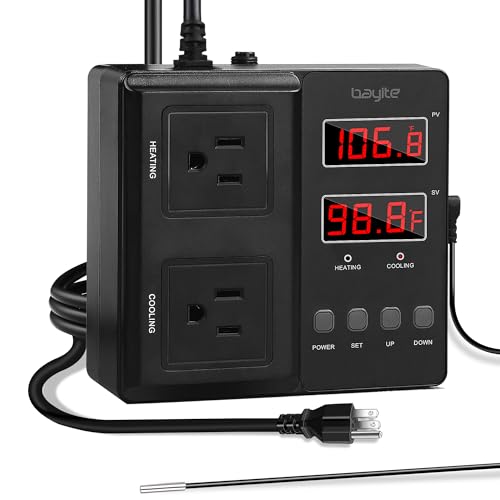
The bayite BTC211 provides a dual‑relay output, letting users control heating and cooling devices simultaneously. It supports up to 1650W and has a clear dual display for real‑time and set temperatures. Best for setups that require independent control of two devices or zones. Better for users who want clear, immediate feedback. Limitation: the total load must stay under 1650W for safety and performance.
DIGITEN WTC100 Wireless Thermostat Outlet

DIGITEN’s WTC100 adds wireless remote control and a straightforward plug‑and‑play design. It supports long range operation in open areas and allows seamless switching between Celsius and Fahrenheit. It’s best for users who want to control heaters or coolers from a distance with a simple setup. Limitation: some users may need to verify compatibility with non‑standard outlets or devices.
Inkbird ITC-306T

The Inkbird ITC‑306T is a pre‑wired thermostat with a dual display and day/night cycling capability. It’s designed for heating control with a robust timer function, making it suitable for seed germination, reptile enclosures, or hatcheries. Best for users needing precise day/night scheduling and a straightforward, heating‑only control. Limitation: does not provide cooling control and has a 10A/1200W maximum rating, which may be limiting for some high‑power devices.
Buying Guide: Key Considerations for Wireless Heating Controls
- Power handling: Check maximum wattage and current ratings to ensure compatibility with your heater, fan, or air conditioner.
- Control method: Decide between remote control receivers, mobile apps, or simple plug‑in outlets based on desired convenience.
- Temperature features: Look for Celsius/Fahrenheit switching, precise setpoint control, and high/low alarms for safety.
- Dual vs single relay: Dual‑relay devices can manage heating and cooling simultaneously; single relays are simpler and often cheaper.
- Power reliability: Consider devices that retain settings after power loss, if most of your use is during outages or outages are common in your area.
- Safety and compatibility: Ensure grounding (3‑prong) and that the device is suitable for the intended environment (indoor/outdoor, humidity, etc.).
- Mounting and space: Some units mount on outlets without covering adjacent outlets; consider space if you have dense outlets nearby.
Frequently Asked Questions
- What is a wireless thermostat outlet?
It is a plug‑in device that measures temperature and automatically turns connected equipment on or off to maintain a target temperature without complex programming. - Can these controls save energy?
Yes. By turning devices off when the room reaches the target temperature, they reduce unnecessary electricity use. - Do these require smart home hubs?
Most do not; many operate via RF remotes or simple plug‑in receivers, but some models support apps or hubs for broader control. - Are these safe for high‑power heaters?
Choose models rated for the heater’s wattage (e.g., 1800W max for space heaters) and ensure proper outlet wiring. - What maintenance is needed?
Keep sensors unobstructed, avoid extension cords, and periodically test the unit to ensure reliable operation. - Do they work with cooling devices?
Some models support cooling as well as heating; verify dual‑mode capability before purchase.