Get reliable, low-latency wireless guitar transmission tailored to practice, stage performance, and studio work. This guide highlights five top options, with clear guidance on who each system is best for, common limitations, and practical buying considerations. Perfect for players seeking freedom from cables without sacrificing tone or timing. The top picks cover 5.8GHz and 2.4GHz bands, portable charging solutions, and versatile compatibility for electric guitars, basses, and acoustic electronics.
| Product | Best For | Key Benefit |
|---|---|---|
| JOYO JW-06 | Home practice, small gigs | Long battery life, low latency |
| LEKATO 5.8G | Live stage, studio | Strong interference resistance |
| JOYO JW-03 | Budget setups, practice | Multiple channels, decent range |
| Xvive A58 | Professional stage | Two full charges with case |
| Fender Telepath | Broad compatibility | 5.8GHz reliability, universal use |
JOYO JW-06 5.8GHz Wireless Guitar System

- 5.8GHz digital transmission with 48K/24Bit audio.
- Low latency under 6ms for responsive practice and performances.
- Up to 18 hours total battery life with a portable charging case.
- 65-100 ft open-area range; shorter through obstructions.
- 4 selectable channels to reduce interference.
Best for: Musicians who practice at home, rehearse in small studios, or perform at small gigs where reliability and long battery life matter. The built-in charging case makes it a strong pick for on-the-go players. A potential limitation is performance in highly obstructed venues where range may drop.
LEKATO 5.8GHz Wireless System
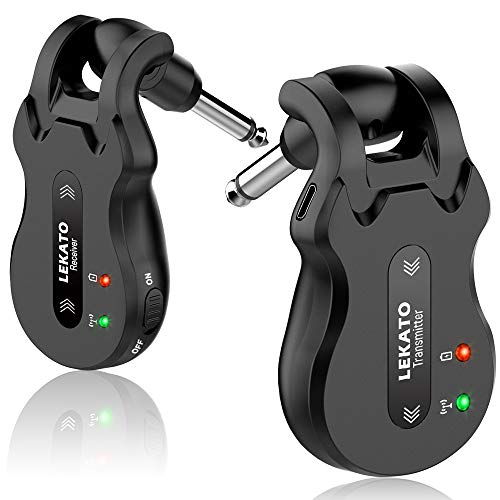
- 5.8GHz transmission with 24-bit/48kHz audio.
- Approx. 100 ft range with high interference resistance.
- Rechargeable transmitter/receiver with USB charging; up to 5 hours per charge.
- 44 lb-like off-axis performance, engineered for stage and studio use.
Best for: Players seeking solid stage reliability and good battery life in a 5.8GHz system. The built-in recharge option is convenient for gigs, but the runtime under heavy use may be shorter than some competitors.
JOYO 2.4GHz Wireless System JW-03
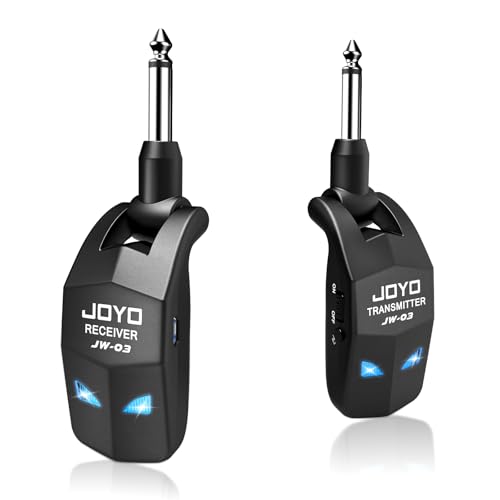
- 2.4GHz system with < 5ms latency and up to 65 ft open-area range.
- Up to 8 hours of operation with dual USB charging for transmitter and receiver.
- 1/4-inch plug rotates 220 degrees for hard-to-reach jacks and crowded pedalboards.
- Suitable for electric guitars, basses, and some acoustic-electrics.
Best for: Home studios and small venues where a compact, affordable wireless option with simple plug-and-play setup is desired. Avoid this in Wi‑Fi-dense environments or large stages where interference may be higher.
Xvive AC58 Wireless System with Charging Case

- 5.8GHz true diversity system with 24-bit/48kHz audio.
- Charging case supports up to two full charges for transmitter and receiver.
- Reliable on-stage performance with minimal interference.
- Broad compatibility for onstage and home use without signal sacrifice.
Best for: Professionals needing reliable, long show runs and easy recharging between sets. The charging case is a notable convenience for touring or multi-gig days.
Xvive AC58 Wireless System 5.8GHz Transmitter & Receiver

- 5.8GHz wireless operates to minimize interference with 2.4GHz devices.
- 100 ft working range suits larger stages and rooms.
- Less than 5ms latency supports real-time playing without noticeable delay.
- Supports up to four concurrent systems in professional setups.
Best for: Musicians needing wide range and low latency on larger stages or venues with potential wireless crowding. Consider if you require multiple systems on the same stage at once.
Fender Telepath Wireless System

- 5.8GHz digital transmission reduces interference from crowded 2.4GHz band.
- 70-foot range and 4ms low latency for live performances.
- Universal compatibility with active and passive instruments; versatile use.
Best for: Players who need broad instrument compatibility and strong reliability on stages or in studios. The Telepath system is notable for its universal plugs and flexible usage across instrument types. Potential limitation is dependence on stable 5.8GHz signal in heavily shielded venues.
Buying Guide: Key Purchase Considerations
- Frequency band: 5.8GHz systems generally offer less interference than 2.4GHz, ideal for stages with Wi‑Fi and Bluetooth devices. However, 5.8GHz performance depends on line-of-sight and venue layout.
- Latency: Look for latency under 6 ms for most live and practice needs. Lower latency reduces perceived timing gaps with your playing.
- Range: Consider the venue size. Larger rooms require longer range and sometimes multiple channels to avoid interference.
- Battery life and charging: Charging cases and longer battery life reduce downtime during gigs or long practice sessions.
- Channel selection and interference management: Systems with multiple channels let you switch to the clearest channel in crowded spaces.
- Instrument compatibility: Ensure the system supports your guitar type (electric, bass, or acoustic-electric) and jack compatibility.
- Setup simplicity: Plug-and-play designs save setup time and reduce potential connection issues on stage.
FAQ
- What should I choose for a small rehearsal space? Choose a 5.8GHz system with low latency and good battery life, such as the JOYO JW-06 or Fender Telepath, for reliable sound with minimal setup hassle.
- Is 2.4GHz wireless better than 5.8GHz? Generally, 5.8GHz offers less interference in crowded environments, but 2.4GHz can be sufficient for home practice in calmer spaces. Consider your venue and nearby devices.
- How many systems can I run at once? Some models support multiple concurrent units; check the product specifics. If you work with multiple guitars on stage, consider a system that allows several paired channels.
- Will these systems work with passive as well as active guitars? Most modern 5.8GHz and 2.4GHz systems are designed to work with both, but verify instrument compatibility for your setup.
- Do wireless systems affect tone? A well-designed system preserves tone, but always test in your environment to confirm there is no noticeable color or drop in signal quality.
- What about durability for touring? Look for solid build quality, a reliable charging solution, and clear channel-switching capability to handle frequent set changes.