If you’re looking to monitor wildlife in your garden, these trail cameras are suitable for different yard sizes, budgets, and tech preferences. This guide highlights five options that balance image quality, power options, and ease of use. Best for, respectively: casual backyard watchers, property owners seeking solar power, compact concealment, non-cellular setups, and cellular remote access.
Summary of selected products
- MAXDONE Solar Trail Camera: Best for long-term backyard surveillance with solar power, non-cellular setup.
- WOSPORTS Mini Trail Camera: Best for discreet garden monitoring on a budget with easy setup.
- KJK Trail Camera: Best for clear day and night 2.7K capture with wide angle.
- GardePro E5S Trail Camera: Best for rugged outdoor use and non-cellular operation with high resolution.
- Punvoe Trail Camera: Best for app-based control and 4K/64MP detail with included 64GB card.
MAXDONE Solar Trail Camera Review
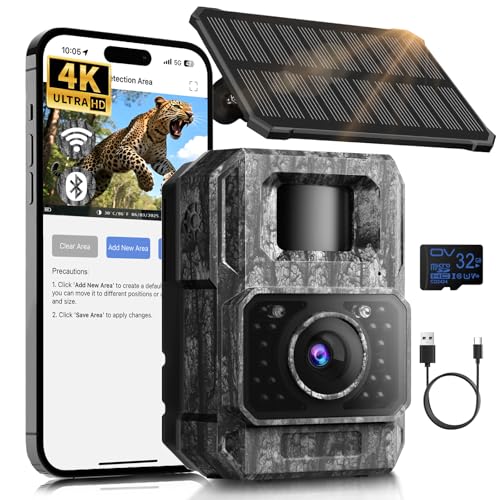
MAXDONE’s Solar Trail Camera emphasizes long-term, wireless-free operation. It features a high-capacity 6000mAh battery and three charging modes: solar, Type-C, and rechargeable power. The camera is marketed as non-cellular with a self-contained hotspot for setup and file download. With a 32GB SD card included, it supports extended surveillance without ongoing service fees. This model is best for buyers who want continuous backyard monitoring without monthly subscriptions and who can position it in a sunny spot for optimal solar charging.
Best for: homeowners seeking energy-efficient, subscription-free monitoring in fenced yards or farms. Choose this if you prefer a self-contained camera that minimizes maintenance and doesn’t rely on home Wi-Fi.
Limitation: It does not support real-time motion alerts or push notifications, and it lacks cellular or real-time remote access features. Plan to review footage locally after visits to the site.
WOSPORTS Mini Trail Camera Overview

WOSPORTS offers a compact, lightweight option with 30MP photos and 1080P HD videos. The 850nm infrared LEDs provide night vision, and the camera is designed for easy garden monitoring and property surveillance. Its small form factor makes concealment simple and installation flexible in tight spaces. It runs on AA batteries, so users should consider battery life for extended outdoor use.
Best for: gardeners who want a small, unobtrusive camera for basic wildlife observation or family property monitoring without heavy hardware or ongoing costs.
Limitation: Battery-powered operation means more frequent maintenance. The camera does not include built-in Wi-Fi or cellular connectivity, which limits remote access.
KJK Trail Camera: Clear Day/Night Capture

KJK emphasizes ultra-clear 36MP photos and 2.7K video with a 130° wide-angle view. The 0.1s trigger time helps capture fast-moving wildlife, and the 850nm low-glow LEDs balance night visibility with minimal disturbance. The integrated 2.0” LCD screen aids on-site setup and review. This model is a solid choice for users who want detailed daytime and nighttime footage and quick, on-device previews.
Best for: wildlife observers and amateur researchers who want high-resolution stills and quick footage playback on-site. Choose this if you value a broad field of view and fast triggering.
Limitation: SD card not included, so additional purchase is necessary to store media. Night images rely on low-glow LEDs that may still be perceivable at very close range.
GardePro E5S Trail Camera Review
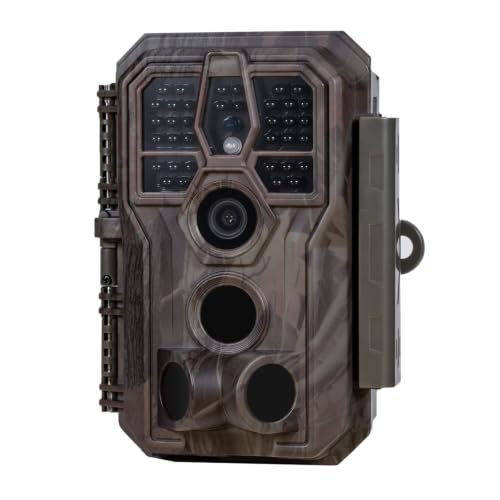
GardePro’s E5S focuses on high resolution with 64MP photos and 1296P video. It is described as non-cellular and non-WiFi, prioritizing low power usage and minimal disturbances while delivering sharp imagery. The rugged, IP66-rated housing supports outdoor use in challenging weather, and a standard mounting thread enables flexible placement. It’s best for those who want a durable, set-it-and-forget-it camera with long battery life and no network features to manage.
Best for: property owners and wildlife watchers who prefer a sturdy, low-maintenance camera with excellent still image quality and reliable operation in harsh outdoor conditions.
Limitation: No cellular or Wi-Fi connectivity means remote viewing is not possible; you must retrieve the SD card to access footage.
Punvoe Trail Camera: App-Controlled 64MP 4K

Punvoe combines WiFi and Bluetooth app control with high-resolution capture. It includes a 64GB SD card and runs on 8×AA batteries, offering multiple shooting modes and fast 0.1s trigger speed. The 4K UHD video with audio delivers detailed footage, and adjustable PIR sensitivity helps reduce false triggers from wind. This option is well-suited for users who want remote preview and download without removing the camera from its setup.
Best for: garden watchers who want real-time control and footage transfer via a mobile app, with robust 4K video and a generous included memory card.
Limitation: App-based control depends on stable Wi-Fi/Bluetooth connectivity and may require ongoing setup for remote access.
Buying Guide: Key Considerations for a Garden Wildlife Camera
- Power source: Choose solar-powered or battery-operated models based on yard location and maintenance tolerance. Solar options excel for long-term setups; batteries suit flexible placements without sun exposure.
- Connectivity: Decide between non-cellular (local review), Wi-Fi/Bluetooth (short-range setup), and cellular (remote access). Cellular cameras enable real-time alerts but may incur service costs.
- Resolution and image type: Higher MP and 4K video provide clearer footage, especially for identifying wildlife. Consider whether you prioritize stills, video, or both.
- Trigger speed and detect range: Quick 0.1s triggers and wide detection angles improve the chance of capturing fast animals. Note that night vision quality depends on LED power and wavelength.
- Durability and weather sealing: Look for IP ratings and sturdy housings if cameras will face rain, dust, or extreme temperatures.
- Memory and data handling: Confirm SD card capacity and whether the camera ships with a card. Some models require you to supply your own card and format.
- Field placement and concealment: Camouflage finishes and compact form factors help hide cameras in gardens, trees, or shrubs without drawing attention.
FAQ: Wildlife Cameras for Garden Use
- What’s the best camera for a beginner gardener?
CEYOMUR and WOSPORTS offer easy operation and compact designs, making them suitable for first-time users or casual observers.
- Do I need cellular connectivity for backyard monitoring?
No. Non-cellular cameras work well for basic surveillance and will save on ongoing costs; cellular models suit remote monitoring if you need alerts away from home.
- Which camera provides the best night vision?
Models with 850nm low-glow LEDs generally balance bright night images with minimal wildlife disturbance, such as KJK and Misstech variants.
- How important is trigger speed for garden wildlife?
Very important for capturing fast or sudden movements. Look for rates around 0.1 seconds to minimize missed activity.
- Is solar power reliable for year-round use?
Solar can sustain operation with enough sun exposure and a good internal battery. Solar-assisted or hybrid models often perform best in yards with seasonal changes.
- What should I consider about storage?
Ensure a compatible SD card size is supported and check if the camera includes a card. Larger cards reduce the need for frequent data retrieval.