Answering the question “which weighted keys keyboard is best for me,” this guide highlights five top weighted 88-key options for beginners and progressing players. Each product targets different needs—compact practice, authentic feel, connectivity, or bundled value. Read on to find the best fit for students, hobbyists, and aspiring performers. A quick buyer’s table is included to compare key aspects at a glance.
| Product | Best For | Key Feature |
|---|---|---|
| Ngdgtt Digital Piano | Beginners seeking semi-weighted feel with features | Semi-weighted 88 keys + Bluetooth and MIDI |
| Yamaha P71 | Players wanting authentic acoustic feel | Weighted action with 10 Voices |
| Yamaha P145BT | Home practice with Bluetooth and travel-friendly | 88 weighted keys, built-in speakers |
| Alesis Recital Play | Budget learners who want a broad sounds library | 88 full-size keys, 480 sounds, 160 rhythms |
| Ensemble practice with multiple pedals | Full-weighted 88 keys, 238 tones, 128 polyphony |
Ngdgtt Digital Piano 88 Key Semi-Weighted Keyboard Bundle

The Ngdgtt digital piano uses 88 semi-weighted keys to approximate the feel of an acoustic piano while still offering modern digital features. This model emphasizes accessibility for beginners with 200 rhythms, 200 sounds, and 70 demo songs to aid practice, plus Bluetooth for streaming lessons. It supports MIDI to connect to computers or external devices and accepts a sustain pedal, MP3 input, microphone, headphone, and USB connections for flexible practice sessions. Best for: beginners who want a feature-rich entry point with easy connectivity. Limitation: semi-weighted keys aren’t as authentic as hammer action for advanced pianists.
Yamaha P71 88-Key Weighted Action Digital Piano

The Yamaha P71 offers true acoustic piano feel with weighted action across 88 keys and dynamic control. It includes a selection of ten Voices and an uncomplicated control layout, keeping the focus on expressive playing. Best for: players seeking genuine hammer-action feel without added complexity, ideal for home practice and skill development. Caution: the design emphasizes performance over expansive on-board features, which may suit players who practice with external devices rather than built-in lessons.
Yamaha 88-Key Digital Piano with Weighted Keys (P145BT)
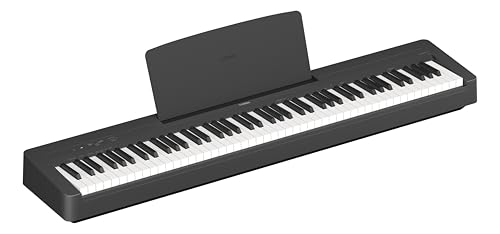
This model provides authentic weighted keys and a rich grand-piano-like sound. It supports Bluetooth connectivity and compatibility with apps like Smart Pianist for guided practice, plus a built-in speaker system for convenient practice anywhere. Best for: home players who want a realistic piano touch and modern connectivity. Limitation: compact design may limit advanced stage setups or extensive external gear integration.
Alesis Recital Play 88-Key Bundle

The Alesis Recital Play bundle provides 88 full-size, touch-sensitive keys with a sizeable 480 sound library and 160 rhythms. It’s a practical choice for beginners who want a broad palette for exploring genres and practice with built-in speakers. Best for: learners who enjoy a wide sound assortment and easy song creation. Caution: the included bundle may be heavier and less portable than smaller setups.
Donner DEP-20 Full-Size 88-Key Keyboard

The Donner DEP-20 features 88 full-weighted keys with hammer-action feel and a robust polyphony of 128 notes, supporting 238 tones. It offers dual-tone modes for blending two sounds, along with a sustain pedal and other I/O options for music arrangement. Best for: players who want a studio-like setup with multiple tone options and pedal controls. Limitation: some users may find the interface less intuitive than consumer-grade models.
Buying Guide: Key Purchase Considerations
- Key action: Choose weighted or semi-weighted keys based on playing level and goals. Hammer-action is closest to a real piano, while semi-weighted suits beginners transitioning from keyboards.
- Polyphony and tones: Higher polyphony (128–256 notes) handles complex chords and sustain. A broad tone library supports experimentation across genres.
- Connectivity: Bluetooth, MIDI, USB, and headphone outputs enable lessons, recording, and silent practice. Consider whether you need app compatibility for guided learning.
- Amplification: Built-in speakers are convenient for practice, but consider external amps or headphones for late-night sessions or stage use.
- Bundled accessories: Stands, pedals, carrying cases, and power adapters add value, especially for beginners setting up a dedicated practice space.
- Portability vs. features: Slim, compact keyboards are easier to move; feature-rich models may offer deeper learning tools and better sound.
FAQ
- What is the difference between weighted and semi-weighted keys?
– Weighted keys simulate piano hammer action with heavier touch; semi-weighted keys provide a lighter, more forgiving feel suitable for beginners. - Is Bluetooth on a digital piano useful for learning?
– Yes, Bluetooth allows streaming lessons, connecting to apps, and easier music practice with external devices. - Should I choose a bundle or buy accessories separately?
– Bundles are convenient for beginners, offering essential accessories in one package, often at a lower upfront cost. - How many keys are needed for serious practice?
– 88 keys are standard for full-range piano practice; many models use weighted 88-key keyboards to replicate acoustic piano feel. - Does higher polyphony matter for beginners?
– Moderate polyphony (128 notes) is usually sufficient for beginners; higher polyphony becomes beneficial for complex arrangements and sustained chords. - Can these keyboards connect to a computer for music editing?
– Many models support MIDI connections for music editing, recording, and external devices; check each model’s input/output options.