Answering the need for precise, location-specific weather data, this guide reviews top weather forecast apps and home weather stations. The best picks suit different buyers: casual users who want quick forecasts, homeowners seeking hyper-local data, and tech enthusiasts who want app control and alerts. Use the table below to compare the five chosen products at a glance.
| Product | Best For | Key Benefit |
|---|---|---|
| Weather (MacroPinch) | Casual users needing geo-positioned conditions | Current location weather with manual location option |
| Tempest Weather Station (WeatherFlow) | Hyper-local outdoor monitoring | Very broad sensor suite, real-time updates |
| Ambient Weather WS-2902 | Homeowners seeking a complete station | All-in-one sensor array with remote access |
| Newentor Weather Station | Budget-friendly home monitoring | Color display with multiple sensors |
| BaldrTherm WiFi Weather Station | 2.4GHz WiFi home setup | Multi-day forecast on a large display with alerts |
Weather by MacroPinch: Localized Forecasting at Your Fingertips

This app specializes in geo-positioning to retrieve the latest conditions for your current location, with an option to add multiple locations for tracking. It is best for casual users who want quick, location-aware updates without extra hardware. A limitation is that some users may prefer more robust customization or historical data beyond basic forecasts.
Local Weather – Live Radar 2023

This app emphasizes a seven-day forecast, wind speed and direction, and humidity. It’s better for users who want a longer forecast horizon in one view and are comfortable interpreting wind and humidity data for outdoor plans. A potential drawback is a simpler interface that may lack deeper customization for professional-grade analysis.
The Weather Channel
This option is best for users who want live TV or on-demand clips in addition to local forecasts. It helps you stay informed about broader weather stories that could affect plans. Choose this if you value media integration alongside weather data, but avoid if you want a lean weather-only experience.
Tempest Weather Station (WeatherFlow)
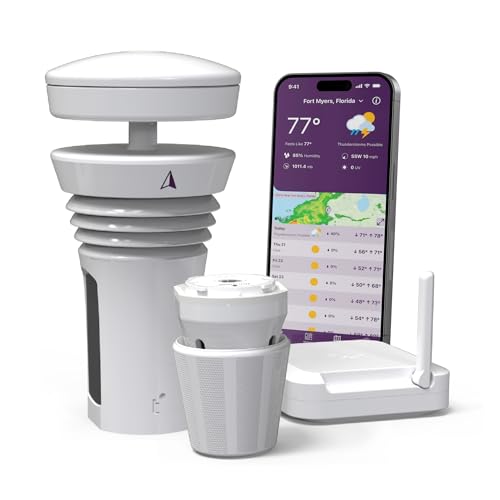
Best for hyper-local monitoring, this station measures temperature, humidity, barometric pressure, wind, dew point, solar radiation, UV index, lightning, rainfall, and more from remote sensors. It is ideal for serious weather enthusiasts or homeowners who rely on precise, real-time data across multiple parameters. A caution: setup and maintenance can be more involved than simpler meters.
Smart WiFi Weather Station With App Control

Best for remote monitoring via Tuya app, this station offers real-time readings, historical trends, customizable alerts, and a 5-day forecast. It’s well-suited for tech-savvy users who want cloud-based access and a single interface to track conditions. Limitation: it supports 2.4GHz WiFi, which may exclude some networks and requires power to operate the core features.
BaldrTherm WiFi Weather Station

Best for stable 2.4GHz WiFi setups with a large display, BaldrTherm provides a 5-day forecast and remote app alerts. It’s suitable for users who want a bigger screen and straightforward alerts for daily planning. A potential limitation is the note about 2.4GHz compatibility, which may affect some dual-band networks.
Buying Guide: Key Purchase Considerations For Weather Data
- Purpose: Are you after a simple forecast app, or a full home weather station with multiple sensors and real-time data?
- Location needs: Do you want geo-positioned data for your current location or multi-location tracking?
- Data depth: Is dew point, UV index, wind metrics, or rainfall measurement important to you?
- Display and access: Do you prefer a large physical display, a mobile app, or cloud-based access?
- Connectivity: Will your network support 2.4GHz or 5GHz, and is constant power available for devices?
- Alerts: Do you need push notifications for thresholds like temperature, humidity, or rainfall?
- Ease of setup: Are you comfortable installing external sensors and configuring an app?
- Budget: How do you balance upfront costs with long-term monitoring needs?
Practical Comparisons
- Best for quick forecasts: Weather by MacroPinch in mobile use cases, thanks to geo-positioning and multiple locations.
- Best for deep data: Tempest Weather Station offers a wide sensor range and real-time updates, ideal for serious weather tracking.
- Best all-in-one: Ambient Weather WS-2902 combines sensors with remote access for home monitoring.
- Best on a budget: Newentor provides essential features with a color display and multiple sensors.
- Best for WiFi-centric homes: BaldrTherm and the Smart WiFi Weather Station provide app-based control and alerts over WiFi.
FAQ
- What is the advantage of a home weather station versus a weather app?
Answer: A home weather station provides real-time, hyper-local data from multiple sensors, while a weather app offers forecasts and location-based data without hardware. - Can I use multiple locations with a single weather station app?
Answer: Yes, several apps support multi-location tracking, useful for properties or travel planning. - Is 5-day forecast enough for outdoor planning?
Answer: For many activities, a 5-day forecast provides sufficient planning data, but some users may want longer-range forecasts for travel. - Do these devices require continuous power?
Answer: Most stations require a power adapter for core features; some can operate on batteries with limited display time. - Is 2.4GHz WiFi a limitation?
Answer: Some devices require 2.4GHz networks and may not connect to 5GHz-only routers. - Which product is easiest to set up for beginners?
Answer: Apps with simple installation steps and fewer external sensors tend to be more beginner-friendly.