When choosing a water filter for outdoor use, you want reliability, portability, and clear guidance on what each option protects you from. This guide highlights five top picks that balance filtration performance with ease of use for hikers, campers, and emergency preparedness. Best for backpackers, RV travelers, and survival-minded individuals, these picks emphasize safety from bacteria, parasites, and microplastics while remaining practical for real-world outdoor scenarios. Read on to compare performance, capacity, and suitability for different outdoor activities.
| Product | Best For | Capacities | Why It Stands Out |
|---|---|---|---|
| LifeStraw Personal Water Filter | Backcountry travelers | Per-use | High filtration, tested for bacteria and parasites; compact and lightweight |
| Waterdrop Gravity Water Filter Straw | Solo campers | Up to 1.5 gal bag; 1,400 gallons life span with straw | Low effort with gravity feed; 0.1 micron filtration |
| Camco Tastepure RV Water Filter | RV owners and campers | Sized for inline use | 6-step filtration, lead-free, multi-layer filtration |
| Sawyer SP128 Mini Water Filtration System | Emergency kits and travel | Filters to 0.1 micron | Ultra-portable; attaches to multiple containers |
| Practical Survival Reusable Emergency Water Filter Straws | Disaster prep and travel | 2-pack; up to 0.1 micron and 99.99% bacteria/parasites | Lightweight, compact backup option |
LifeStraw Personal Water Filter For Hiking

Best for lightweight backpackers who need on-the-go filtration. This LifeStraw uses a microfiltration membrane to remove 99.999999% of waterborne bacteria and 99.999% of parasites, including E. coli, Giardia, and Cryptosporidium. It also reduces turbidity to 0.2 microns and removes microplastics down to 1 micron. A trusted option for emergency kits due to its simplicity and verified lab testing. Limitation: it is for point-of-use filtration and does not treat water as a standalone bottle system with long-term storage.
Waterdrop Gravity Water Filter Straw
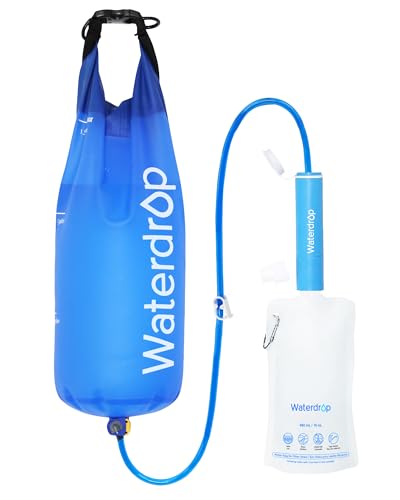
Better for solo campers who want a gravity-fed option and substantial filtration without pumping. It uses a 0.1 micron ultrafiltration membrane and offers a 1.5-gallon gravity bag, capable of meeting all-day drinking needs. The straw can filter up to about 1,400 gallons (5,300 liters) over its life and provides a flow rate up to 700 ml per minute. Caution: Gravity-fed setups require a stable bag or reservoir and may be less convenient in windy or uneven terrain.
Camco Tastepure RV Water Filter

Ideal for RV and campground setups that rely on in-line filtration. Featuring Hex-Flow technology and a 6-step filtration process, it targets tastes, odors, chlorine, and sediment. It is independently tested to NSF/ANSI standards and lead-free per NSF/ANSI 372, aligning with compliance-focused buyers. Best for users who want steady, home-like water quality while camping or on the road. Limitation: inline filters have a finite life based on water quality and usage, so replacement timing is essential.
Sawyer SP128 Mini Water Filtration System

Best for ultra-portable filtration needs. The 0.1 micron absolute inline filter fits in the hand and weighs about 2 ounces. Compatible with pouches, bottles, or hydration packs, making it a versatile option for hikers and travelers. Independent testing to performance standards ensures reliability for field use. Caution: requires compatible containers or attachments, which may add setup steps compared to bottle-integrated systems.
Practical Survival Reusable Emergency Water Filter Straws

Best as a lightweight backup option for disaster preparedness. A 2-pack that removes over 99.99% of waterborne bacteria and parasites, filtering down to 0.1 micron and removing microplastics. Each straw weighs about 2 ounces and fits into pockets or kit pouches for quick access. Choose this if you want redundant filtration in a compact form. Limitation: long-term use in heavy contamination might require additional treatment steps for best taste and clarity.
Buying Guide: Key Considerations for Outdoor Water Filters
- Filtration target: Do you mainly need bacteria, parasites, microplastics, or chemical tastes? Match the filter’s micron rating and certified standards to your needs.
- Usage scenario: Is the device designed for solo use, group water, RV hookups, or emergency preparedness? Capacity and compatibility matter for your planned activities.
- Weight and pack space: Lightweight, compact options suit long treks, while gravity-fed or multi-stage systems suit basecamp or RV use.
- Maintenance and lifespan: Consider filter lifespan, ease of cleaning, and whether replacement parts or filters are readily available where you travel.
- Certifications and testing: Look for NSF/ANSI certifications or EPA-standard testing to verify claimed performance.
- Ease of use in the field: Consider setup time, compatibility with bottles, pouches, and hydration packs, and whether you need to pump or wait for gravity.
Frequently Asked Questions
- What level of filtration is essential for backcountry use? A: Filters that remove bacteria, parasites, and microplastics (0.1 to 1 micron range) provide strong protection for most outdoor water sources.
- Are gravity-fed water filters better for camping? A: They are convenient for basecamp setups or family use, as they require less manual effort and can filter larger volumes.
- Should I carry multiple types of filters? A: For risk minimization, consider a primary filter plus a lightweight backup straw or mini filter for emergencies.
- Can these filters remove chemical tastes and odors? A: Some filters target chlorine and taste improvements; check the product’s certification and membrane specifications.
- How do I know when a filter needs replacement? A: Review the manufacturer’s lifespan guidance and monitor signs such as reduced flow, unusual taste, or visible clogging.
- Are these filters safe for international travel? A: Filters with robust certifications and tested performance are suitable, but always follow local guidance and carry reliable backups.