Answer: Ultralight sleeping pads offer compact packs, low weight, and strong support tailored for hikers, ultra-light backpackers, and minimalist campers. The top picks below emphasize portability, insulation, and ease of setup. Each product is suitable for solo travelers who prioritize packing light without sacrificing comfort. The following table summarizes key details to help you compare quickly.
| Product | Weight | Insulation | Best For |
|---|---|---|---|
| Gear Doctors Ether 17.5oz | 17.5 oz | Basic comfort with durable 20D nylon | Ultralight backpackers seeking compact comfort |
| Gear Doctors ApolloAir 5.2 | 17 oz | R-Value not stated here; insulated design | Cold-weather, multi-season hikers |
| TREKOLOGY Ultralight | 26.5 oz | Standard inflation, good support | Budget-conscious backpackers |
| Myxslop Ultralight 50D | varies by model | Heavy-duty 50D nylon with TPU | Rugged terrain lovers prioritizing durability |
| Elegear 4” Thick Sleeping Pad | Not listed | 9 R-Value insulation | 4-season use in extreme cold |
Gear Doctors Ether 17.5oz Ultralight Pad

The Ether pad compresses to the size of a water bottle and weighs 17.5 oz, inflating to a generous 76” x 25” with ErgoCushion contours. It is designed for backpacking and can support up to 440 lb. Best for ultralight hikers who want a compact pad without sacrificing long-length comfort. The detachable foot pump and Anti-Leak Valve simplify inflation and deflation, and the 20D nylon with TPU coating offers lasting durability. A lifetime replacement policy is included. Caution: check the included pump system if you expect extremely quick inflation on very cold mornings.
Gear Doctors ApolloAir 5.2 Ultralight Pad

ApolloAir folds to a compact 8.5″ x 3″ and inflates to 72.8″ x 22″ with a 3.2″ thickness. It includes a Pump Sack and a repair kit, making it suitable for hikers who value packability and quick inflation. Best for backpackers who want a lighter, simple setup and a compact carry. Limitation: the data emphasizes portability; insulation level is not specified as an R-value here, so use in very cold conditions should be evaluated separately.
TREKOLOGY Ultralight Backpacking Pad
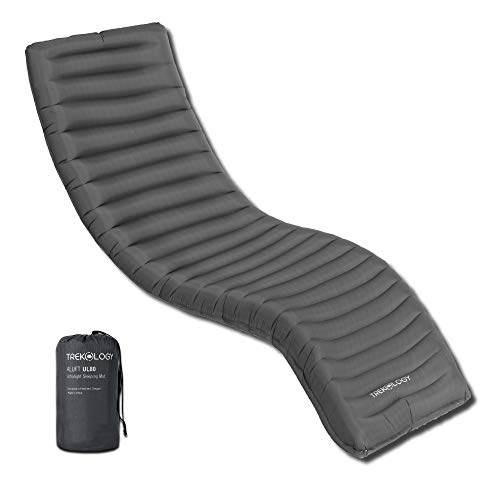
With a 4-inch thickness, TREKOLOGY offers raised sides and S-curve channels to keep sleepers centered, keeping you about 4 inches off cold ground. At 75.2 inches long and 22.4 inches wide, it suits most adults up to 6.1 ft. It inflates by mouth in minutes or can use a standard pump. Weighing about 26.5 oz, it balances weight and comfort for backpackers who want a proven, simple setup. Choose this if you want a straightforward, no-fruss pad with reliable padding.
Myxslop Ultralight 50D Sleeping Pad

This pad uses rugged 50D nylon and reinforced TPU, offering higher resistance to tears and moisture. It features a built-in neck pillow and a fast 30–60 second foot-pump inflation, plus a 24-hour air keep and a no-leak valve design. It supports up to 400 lbs and aims at campers who need durability on rocky terrain. Best for heavy-use environments. Limitation: heavier than truly minimalist options, which may affect ultralight travelers who push every gram.
Elegear 4” Thick Sleeping Pad

Elegear offers a real 9 R-value insulation with a 4-inch thickness, certified by SGS and ASTM F3340-22, designed for extreme cold down to -40°C. It’s geared toward four-season use and backpacking with a packable design that includes a pump sack for fast inflation. Best for hikers facing high altitude and winter conditions. Caution: cooler, heavier option may not suit ultra-light travelers who hike in milder seasons.
Buying Guide
What matters most: weight, packability, and warmth
When choosing an ultralight sleeping pad, prioritize total pack weight, packed dimensions, and insulation. If you hike during shoulder seasons or cold nights, a higher R-value is beneficial. For hot or warm environments, comfort and weight may trump insulation.
How to choose by sleeping style
- Back sleepers: look for pads with wider surfaces and adequate thickness to prevent hip sag.
- Side sleepers: seek pads with more contour and edge support; a built-in pillow can improve alignment.
- Stomach sleepers: a slightly firmer pad reduces pressure points under the chest and hips.
Practical considerations
- Inflation method: built-in pumps offer quick setup but add weight; external pumps or foot pumps balance weight and speed.
- Durability: higher denier fabrics resist tears but may add weight. Consider your terrain and expected wear.
- Repairability: some pads include repair kits or lifetime replacement; factor in maintenance plans.
Comparison snapshot
- Best for ultra-light travelers: Gear Doctors Ether, ApolloAir variants.
- Better for cold-season use: Elegear, ApolloAir (insulated concept).
- Budget-friendly options: TREKOLOGY Ultralight, Myxslop 50D.
FAQ
- What is the lightest ultralight sleeping pad?
– Several options around 17–27 oz fit this category, including Gear Doctors Ether and ApolloAir, depending on configuration. - Do these pads require a pump?
– Many models include a foot pump or built-in pump; some can be inflated by mouth or with an external pump. - Is a higher R-value always better?
– Higher R-values provide more warmth in cold ground; choose based on expected temperatures and camping conditions. - Are ultralight pads durable on rocky terrain?
– Durability depends on fabric (40D–50D) and TPU coatings; heavier options with thicker materials tend to resist tears better. - Can I use these pads with a sleeping bag?
– Yes; most pads are designed to be used with standard sleeping bags and tents, forming a complete sleep system. - Do these pads come with repair kits?
– Some include repair kits or offer lifetime replacements; verify each product’s included accessories.