Answering the need for reliable multi-room TV reception, distribution amplifiers help maintain signal quality when splitting to several TVs. This guide highlights five top options, detailing who they’re best for, why they were chosen, and potential limitations. Ideal buyers include homeowners building a multi-room setup, apartment dwellers with multiple TVs, and DIY enthusiasts seeking better over-the-air (OTA) or CATV performance.
Summary of selected products:
- Channel Master TV Antenna Booster 4-4-Port – Best for small homes and indoor/outdoor versatility
- Antennas Direct ClearStream JUICE4 – Best for ATSC 3.0 and multi-TV indoor use
- Reliable 8-Port TV Antenna Signal Splitter – Best value for many rooms with good per-port boost
- 4-Port Cable TV/Antenna/HDTV Booster (LSA84) – Best for mixed antenna/cable environments
- Channel Master TV Antenna Booster 8-8-Port – Best for larger homes with eight rooms
Channel Master 4-Output Antenna Booster
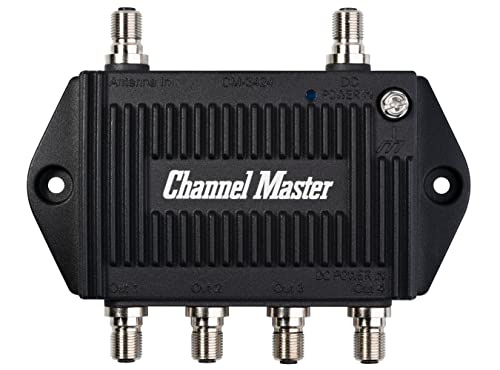
Best for: small homes needing four-room coverage with indoor/outdoor flexibility. This model provides 7.5 dB gain and includes a built-in LTE filter, supporting non-amplified antennas while helping reduce interference and signal loss across four outputs. It replaces standard four-way splitters and is built for weatherproof use, making it suitable for both attic and outdoor installations.
Why chosen: The four-port design balances affordability with expanded reach for multiple rooms. The LTE filter helps maintain signal integrity in dense RF environments, and the compact housing supports a variety of installation scenarios.
Limitation: Not all locations will see dramatic improvements if the incoming signal is already weak; the device amplifies existing signals rather than creating them.
Antennas Direct JUICE4 Distribution Amplifier

Best for: homes needing reliable distribution to four TVs with future-ready capabilities. The JUICE4 supports ATSC 3.0 NEXTGEN TV and 4K/8K UHD, with a compact indoor-friendly footprint. It’s designed to maintain signal strength while distributing to up to four devices and works with both HDTV and legacy digital setups when properly cabled.
Why chosen: Its compatibility with NEXTGEN TV and broad frequency handling helps future-proof a multi-TV setup. Weather-ready options allow outdoor use with appropriate caps and boots, giving versatility for various installation environments.
Limitation: Outdoor use requires weatherproofing accessories; improper weather sealing may impact performance in harsh conditions.
Reliable 8-Port TV Antenna Signal Splitter

Best for: larger homes needing high-port distribution with a modest per-port boost. This model ties eight devices to one antenna with +4 dB per port, aiming to minimize signal loss across multiple rooms. It supports OTA reception and standard/digital cable services but is not compatible with amplified antennas or pre-amplified systems.
Why chosen: The eight-output design offers strong scalability for multi-room setups without compromising overall signal quality, making it a practical choice for bigger homes or entertainment areas.
Limitation: The product is not compatible with systems that already include an amplifier; in such cases, consider a passive return or alternative distribution method.
Reliable Cable Products 4-Port Booster/Splitter (LSA84)

Best for: users needing a straightforward four-output booster for mixed antenna and cable TV use. This device provides one input and four outputs, designed to prevent signal loss across multiple devices. It supports standard and digital cable services and OTA reception but is not suitable for satellite systems or MoCA networks.
Why chosen: It’s a versatile option for households with both antenna and cable connections, offering a straightforward boost to multiple TVs without complexity.
Limitation: Not compatible with pre-existing amplifiers and not intended to fix a weak signal; it boosts signals that are already strong enough for distribution.
Channel Master 8-Output TV Antenna Booster

Best for: bigger homes or multi-room setups requiring eight outputs with robust signal handling. This model provides 4.5 dB gain across eight outputs and includes filters for 4G/5G LTE interference to help maintain signal integrity in RF-dense environments. It is designed for indoor/outdoor use with a weatherproof housing.
Why chosen: The eight-port configuration is ideal for expansive living spaces or multi-room entertainment systems, offering strong coverage with built-in filtering to reduce external interference.
Limitation: Not compatible with cable and satellite signals, and it focuses on distributing antenna signals rather than integrating with other services.
Buying Guide: Key Considerations for TV Distribution Amplifiers
- Number of outputs vs. number of TVs: Choose a model that matches the number of rooms or TVs you plan to connect, avoiding excess ports that won’t be used.
- Gain and interference: Look for products with adjustable or rated gain per output and built-in filters to reduce LTE/4G/5G interference in busy RF areas.
- Indoor vs. outdoor use: Consider weatherproof housings for outdoor or attic installations, and ensure the unit fits your mounting space.
- Compatibility: Verify compatibility with your existing antennas (amplified vs. non-amplified) and with OTA, CATV, or mixed systems to avoid compatibility issues.
- Signal quality vs. distance: Greater gains help with longer cable runs, but over-amplification can introduce noise if the source signal is weak.
- Future-proofing: If you expect ATSC 3.0 deployment or 4K/8K content, prefer models that explicitly support NEXTGEN TV and modern standards.
FAQ: Quick Answers for TV Distribution Amplifiers
- What is a distribution amplifier used for?
It distributes a single antenna signal to multiple TVs while boosting the signal to minimize loss. - Do I need a power supply for all distribution amps?
Most models require a power supply to provide amplification to all ports; check the included hardware. - Can I use a distribution amplifier with cable TV?
Some models support both OTA and cable inputs, but not all are compatible with satellite or MoCA networks. - Will more ports always improve reception?
Not necessarily; improved reception depends on the incoming signal strength and cable length. - What should I avoid when selecting an amplifier?
Avoid models not compatible with your current system or those intended to boost weak signals without a solid source. - Is outdoor installation safe for these devices?
If the unit is weatherproof and rated for outdoor use, it can be installed outdoors; otherwise, indoor installation is safer.