For landscape photography, the right tripod stabilizes heavy lenses, supports long exposure shots, and helps maintain perfect framing in wind or uneven terrain. The top picks below are best for different needs: tall reach, versatile height, monopod conversion, or superb portability. This guide targets outdoor photographers, travel shooters, and hobbyists who want crisp horizons without wobble. The table below summarizes the five selected tripods and their key strengths to match varied shooting scenarios.
| Product | Strength | Best For |
|---|---|---|
| Victiv 74” Tripod | High reach, robust 3-way head | Wide landscapes, telephoto setups |
| SMALLRIG 71″/180cm CT-10 | 3-in-1 tripod/monopod, versatile angles | Backpacking, macro, low-angle |
| XXZU 75″ Camera Tripod | Long height, 3-in-1 center column | Travel shoots, low-angle to tall portraits |
| K&F CONCEPT Light Stand | High stability, wide compatibility | Studio-to-field, lighting combos |
| Manfrotto 290XTRA | Durable aluminum, flexible leg angles | DIY landscapes, rugged terrain |
Victiv 74” Tripod for Camera and Phone
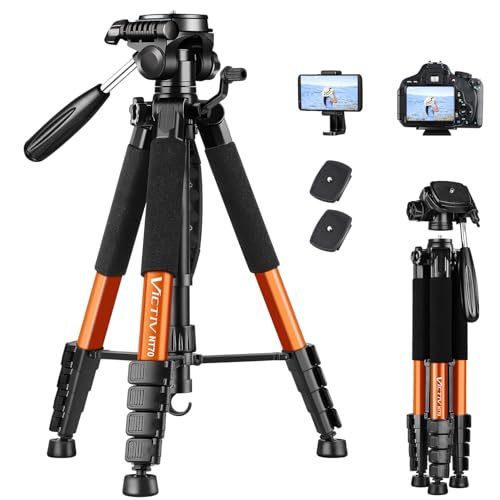
This Victiv model offers a tall 74-inch height with a compact carry option. It uses a standard 1/4″ and 3/8″ screw mount compatible with most cameras, DSLRs, and some accessories, plus a 360° phone mount for modern smartphones. The included 3-way pan head supports panoramic, tilt, and portrait orientations, making it suitable for wide landscape panoramas or architectural compositions. Best for outdoor photographers who need quick height adjustments and a stable base in varied terrain.
Who it’s best for: photographers who shoot tall landscapes or use phone photography in tandem with a DSLR. Why selected: the combination of tall reach, universal mounts, and a smooth head provides reliability in windy or uneven conditions. Caution: weight distribution matters; avoid using the weight hook with overly heavy bags in strong gusts if stability is marginal.
SMALLRIG 71″/180cm Aluminum Tripod & Monopod CT-10

This 2-in-1 system converts from a tripod to a monopod, offering flexible shooting on hikes or flights. Its 36mm metal ball-head allows 360° rotation, enabling level pan and tilt for cityscapes or nature scenes. The design supports both vertical and horizontal compositions, plus low-angle shots when inverted. Best for travelers who need a compact, adaptable setup that can transition to a monopod for reach. Caution: balance with heavy lenses may require additional counterweight or careful height management on uneven ground.
XXZU 75″ Camera Tripod with Center Column

This 75-inch tripod features a detachable 3-in-1 center column that can convert into a monopod or selfie stick, plus option to shoot upside down for low-angle macro work. The ball head and center column include built-in level indicators, helping ensure level shots in uneven terrains. Best for travelers and outdoor creators who require macro options or flexible height without carrying multiple supports. Caution: ensure secure locking at each joint to prevent drift at full extension.
Manfrotto 290XTRA Aluminum Tripod

The Manfrotto 290XTRA offers durable aluminum construction with flexible leg angles and a rapid center column for quick height changes. It supports a variety of shooting angles and terrains, making it a strong all-around option for landscape work. Best for photographers who value long-term durability and a stable base across many landscapes. Caution: some users may prefer a lighter option for long treks; consider a compact bag in that case.
Buying Guide: Key Considerations For Landscape Tripods
Stability vs. portability: Weigh the tripod’s weight against the height and load it can support. For heavy telephoto lenses, look for higher load capacity and stronger leg materials (aluminum or carbon fiber).
Height range and center column: A tripod that reaches over tall horizon lines helps in cityscapes and wide vistas. Consider models with a reversible or detachable center column for low-angle shots.
Head type and movement: A reliable 3-way pan head provides precise control for panoramic landscapes. Some users may prefer a ball head for quicker adjustments, but a pan head offers fine-tuned composition.
Mount compatibility: Ensure the standard 1/4″ screw is present, with 3/8″ for larger cameras or accessories. Check whether the top plate supports quick release plates for faster setup.
Portability features: Carrying bags, quick-release legs, and compact folded sizes improve field usability. For hikers, weight and bulk are critical.
Frequently Asked Questions
- What tripod height is best for landscape photography?
– A height around 60–70 inches is common for standing shots, with the option of a center-column extension for higher viewpoints or a lower stance for ground-level macro work. - Should I choose carbon fiber or aluminum?
– Carbon fiber is lighter and dampens vibrations better, but aluminum is typically cheaper and very durable. Choose based on budget and travel needs. - Is a 3-way pan head better than a ball head for landscapes?
– A 3-way pan head offers precise tilting and panning for panoramas, while a ball head acts faster for quick framing. For many landscapes, a 3-way head is preferred. - Can a tripod convert to a monopod help in rugged terrain?
– Yes. A tripod-monopod hybrid provides flexibility on uneven ground and can reduce setup time during hikes or climbs. - What features reduce wind wobble?
– A wide leg spread, low center of gravity, and a weight hook (with a bag full of gear) improve stability in breezy conditions. - Do I need a built-in level?
– A built-in bubble level simplifies alignment on uneven terrain and helps ensure straight horizons in landscapes.