Answering the question “which trail camera is best for security?” this article highlights five reliable choices suited for property protection, perimeter monitoring, and remote surveillance. The selections cover cellular and non-cellular options, varying in ease of setup, battery life, and data transmission. Best for: homeowners seeking hands-off security, hunters wanting property protection, and small business monitoring without constant on-site presence. The table below summarizes the five recommended models.
| Product | Best For | Connectivity | Note |
|---|---|---|---|
| SPYPOINT Flex-M Twin Pack Cellular Trail Cameras | All-around security with cellular upload | LTE with dual-SIM support | Free photo plan; multi-camera setup |
| TACTACAM Reveal X 3.0 Cellular Trail Camera | Remote monitoring with GPS and long battery life | Auto-connect multi-carrier LTE | No SD card needed for photos |
| GardePro E5S Trail Camera | Rugged, weather-ready security | Non-cellular option (no WiFi) | High-resolution photos and videos |
| 4G LTE Cellular Trail Camera by VOOPEAK | Easy setup and solar-assisted security | LTE with pre-included data plan | Solar charging capability |
| Moultrie Edge 3 Cellular Trail Camera (2-Pack) | Deer and property monitoring with real-time alerts | 4-carrier auto-connect | AI buck detection reduces false alerts |
SPYPOINT Flex-M Twin Pack Cellular Trail Cameras

Best for users who want cellular updates without carrier management. This model supports cross-carrier performance, ensuring connectivity in challenging locations. It includes a free photo transmission plan and options for paid plans, which makes budgeting straightforward. The hands-free setup and mobile activation simplify field deployment. Caution: a microSD card is required but not included, so plan accordingly for on-camera storage and formatting.
TACTACAM Reveal X 3.0 Cellular Trail Camera

Choose this for best-in-class battery life and automatic carrier selection. The auto-connect feature uses the strongest available network, reducing dead zones. A built-in GPS logs location in the app, and photos can stream directly to a phone without a microSD card. Limitation: reliance on cellular coverage in remote areas may affect transmission speed and availability.
GardePro E5S Trail Camera
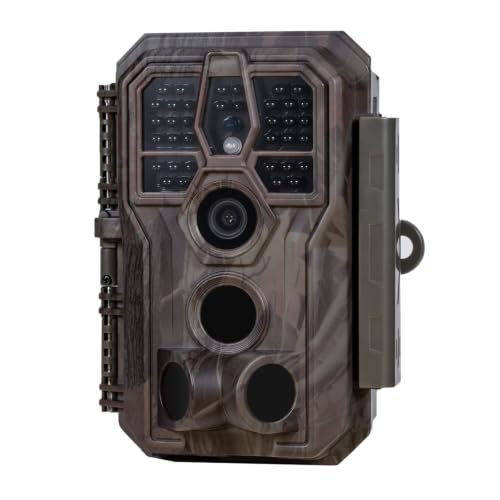
Best for rugged outdoor security. The E5S offers high-resolution 64MP photos and 1296P HD video, paired with weather resistance (IP66). It operates efficiently with non-cellular options, which can be advantageous in power conservation and long-term deployments. Caution: non-cellular models require manual data retrieval unless paired with an external network solution.
4G LTE Cellular Trail Camera by VOOPEAK

Best for easy setup and immediate testing with a pre-inserted SIM card and complimentary data. This model emphasizes simple monitoring via a mobile app and includes solar charging capabilities to extend operation without frequent battery changes. Limitation: data plans are camera-specific; upgrades require in-app purchases and monitoring is per-camera.
Moultrie Edge 3 Cellular Trail Camera
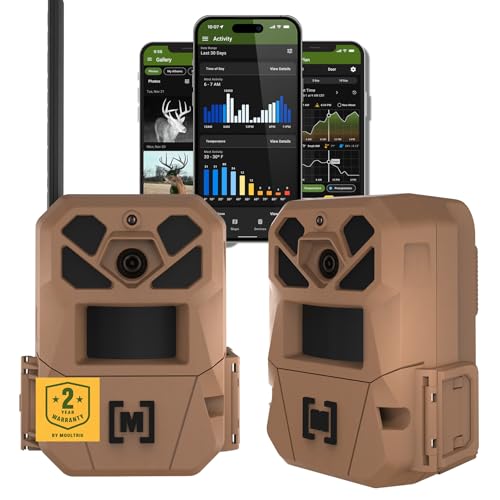
Best for real-time deer activity and property surveillance with AI buck detection and automatic four-carrier auto-connect. It provides robust network reliability and fast triggering to capture events as they happen. Caution: the AI features focus on deer activity and may produce false positives on other wildlife in high-traffic areas.
Buying Guide
What to consider when choosing a trail camera for security
- Connectivity: Cellular (LTE) options provide remote updates; non-cellular models rely on local storage and manual retrieval.
- Battery life and power: Look for longer battery endurance or solar compatibility for continuous operation in remote sites.
- Image quality: Higher megapixels and video resolution improve identification, especially for security use.
- Weather resistance: IP ratings indicate durability against rain, dust, and temperature swings.
- Storage and data plans: Some cameras include free data or SIMs; others require separate plans or SD cards.
- Ease of setup: Models with auto-connect, GPS features, and straightforward mounting are preferable for security-focused deployments.
Common buyer questions
- What is the advantage of a cellular trail camera for security?
– It provides remote updates and real-time alerts, helping you monitor premises without on-site visits. - Do I need a data plan to use cellular trail cameras?
– Most cellular models offer a plan; some provide free transmission up to a limit, but higher usage requires a paid plan. - Are non-cellular cameras suitable for security?
– Yes, for locations with constant power, where on-site retrieval is feasible, or where budgets require offline storage. - What should I consider for installation height and placement?
– Position cameras at a height that reduces tampering, angle toward entry points, and ensure they’re shielded from direct weather when possible. - How important is GPS in trail cameras?
– GPS helps locate cameras in large properties and simplifies management in multi-camera setups. - Can these cameras operate in extreme conditions?
– Most rugged models are rated for varied weather; always check IP rating and operating temperature ranges.