Looking for a reliable speaker switch box to share one amplifier across multiple rooms or sets of speakers? This guide highlights five top options that balance ease of use, sound performance, and safety. Each choice serves different buyer needs—from simple A/B comparisons to full multi-zone control for home theaters or workshops. The top picks are ideal for: casual music lovers with two speakers, home theater enthusiasts needing multi-room distribution, and small offices seeking independent zone control. Below is a quick comparison of the selected products.
| Product | Zones / Inputs | Best For | Key Benefit |
|---|---|---|---|
| Pyle 4-Channel High Power Stereo Speaker Selector – A/B/C/D | 4 zones | Multi-room setups with up to 4 speaker pairs | High power handling (per channel) for 8 Ohm systems |
| SOLUPEAK P2 2 Way Amp/Speaker Switch | 2 inputs / 1 output or 1 input / 2 outputs | Side-by-side amp or speaker comparison | Simple one-button A/B switching |
| PROZOR 2-Zone Passive Speaker Switch Box | 2 zones | Two-zone home theater or patio setups | Independent A/B control with passive design |
| TENEALAY 2-Way Audio Stereo Switch | 2 speakers | Two-speaker comparison for a stereo system | Compact, straightforward two-speaker distribution |
| PROZOR 4-Zone Passive Speaker Selector | 4 zones | Multi-room audio with separate zones | Independent zone controls with built-in safety |
Pyle 4-Channel High Power Stereo Speaker Selector – A/B/C/D

The Pyle 4-Channel High Power Speaker Selector supports up to four separate speaker pairs from a single stereo system. It handles up to 100 watts per channel with 8-ohm minimum impedance, making it suitable for home theater or multi-room setups where multiple rooms need independent listening. Best for: households with four zones that want reliable power distribution without extra amplification equipment. Caution: ensure your speakers meet the 8 Ohm impedance requirement to avoid distortion or thermal issues.
SOLUPEAK P2 2 Way Amp/Speaker Switcher
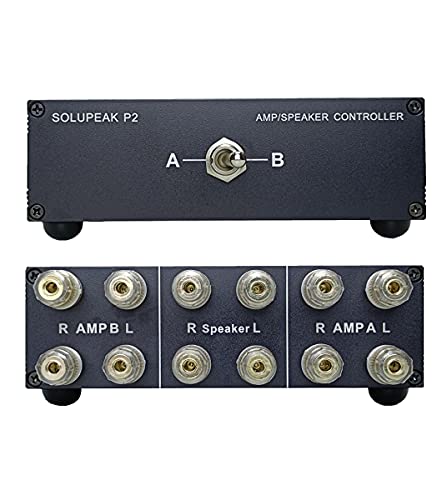
The SOLUPEAK P2 offers flexible 2-IN-1-OUT or 1-IN-2-OUT configurations, allowing two amplifiers to share one speaker pair or one amp to two pairs. It’s a passive, plug-and-play device with easy one-press A/B switching. Best for: users who want quick A/B comparisons between two amplifiers or two speaker sets. Limitation: it does not run both outputs simultaneously; switching is single-path at a time.
PROZOR 2-Zone Passive Speaker Switch Box

PROZOR’s 2-Zone design enables one amplifier to power two speaker pairs or two amplifiers to one pair, with independent A/B controls for each zone. It’s passive, requiring no power supply, and uses spring-clip terminals for quick setup. Best for: small living rooms or offices where two zones are enough and wiring simplicity is a priority. Caution: only one input should be active at a time to prevent short circuits and potential damage.
PROZOR 2(1)-In-1(2)-Out Amp/Speaker Switch

This 2(1)-in-1(2)-Out selector supports two amps to one pair of speakers or two speaker sets to one amp. It clarifies that only one input plays at a time, reducing potential interference when testing gear. Best for: users evaluating two amplifiers or two speaker sets without simultaneous output. Limitation: not designed for continuous dual-play across both outputs.
Pyle 8 Channel Speaker Selector Switch – A/B/C/D/E/F/G/H
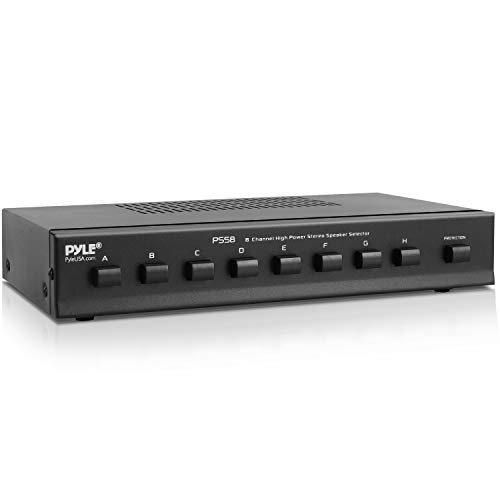
The Pyle PSS8 supports up to eight speaker pairs across eight zones, allowing expansive multi-room audio without frequent re-plugging. Best for: larger homes or studios needing robust multi-zone distribution and independent on/off control. Caution: ensure the total load remains within the amplifier’s per-channel rating to avoid overload.
PROZOR 4-Zone Passive Speaker Selector

PROZOR’s 4-Zone design provides independent A/B/C/D controls, enabling one amplifier to power four speaker pairs with a built-in AMP master switch for quick overall muting. It’s passive with no external power, promoting a clean, simple setup. Best for: multi-room configurations where zone-by-zone control and a master mute are beneficial. Limitation: only one input path can be active at a time, which is typical for passive switch boxes.
Pyle 4 Channel Speaker Selector Switch with Independent Volume
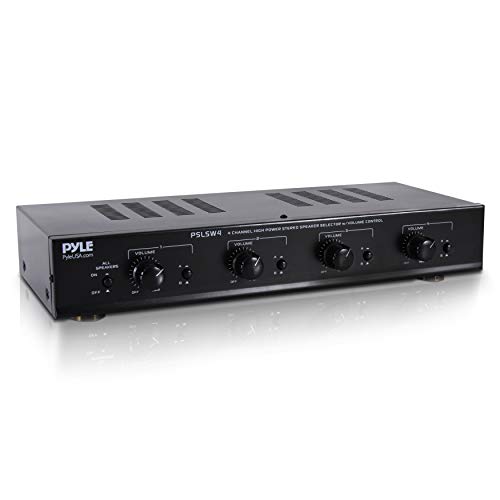
This Pyle model supports up to four speaker pairs with independent volume controls per channel. Its compact design fits easily into living rooms or media centers while maintaining robust power handling up to 100W per channel for 8-ohm speakers. Best for: users who want zone-specific volume tuning in a multi-room setup. Caution: ensure uniform impedance across zones to maintain consistent volume levels.
Buying Guide
What should you consider when choosing a speaker switch box?
- Number of zones: Determine how many rooms or speaker pairs you need to manage. If you only need two zones, a 2-zone model may suffice; for larger homes, a 4- or 8-zone option may be better.
- Impedance and power handling: Most amplifiers and speakers use 8 Ohms. Verify each switch’s per-channel power rating and impedance compatibility to avoid overloading or distortion.
- Passive vs powered: Passive switches require no power but can limit features like master mute or power boosting. Powered or master-enabled models provide more control and safety features.
- Independent zone control: If you want different rooms playing different content simultaneously, prefer models with independent A/B/C/D controls.
- Ease of setup: Spring-clip terminals and simple plug-and-play design speed up installation and reduce wiring mistakes.
- Safety features: Look for notes on one-input-at-a-time operation or amp protection to prevent short circuits and speaker damage.
- Future expansion: Consider whether you might expand to more zones or integrate with a larger home audio system in the future.
FAQ
What is a speaker selector box?
A speaker selector box routes audio from one amplifier to multiple speaker pairs or zones, allowing independent or shared listening across rooms.
Do I need a powered selector box?
Not necessarily. Passive boxes work without power but may lack master controls. Powered models add features like individual zone muting or amplifier protection.
Can I run two amplifiers with a selector box?
Some models support 2-in/1-out or 1-in/2-out configurations. Check the product specs to confirm compatibility and one-input-at-a-time operation if needed.
Will a speaker selector affect sound quality?
Quality and impedance matching influence sound. Choose a model that maintains stable impedance and provides clean, reliable switching to minimize tone changes.
How do I calculate power requirements?
Sum the wattage per channel for the connected speakers and ensure the amplifier’s per-channel power rating is adequate for the total load without overheating.