Find the right solar setup for off-grid adventures. This guide highlights five portable solar panel kits and power solutions ideal for camping, RV trips, and emergency backups. Each option is evaluated for portability, compatibility, and power output to help campers choose what best fits their needs. Best for lightweight backpacking, car-camping crews, or full off-grid rigs, these picks balance efficiency with rugged outdoor use.
Buyer types covered include: hikers needing compact panels, RV and van lifers requiring higher wattage, campers seeking reliable charging on cloudy days, and emergency-prep enthusiasts wanting durable, weatherproof options. A quick comparison table follows to aid quick scanning of core specs and intended use.
| Product | Best For | Key Power | Notes |
|---|---|---|---|
| Renogy 200W Portable Solar Panel | RVs, Off-Grid Campers | 25% efficiency, foldable 200W | Lightweight with magnetic closure; strong for limited space |
| SOKIOVOLA 200W Foldable Solar Panel | Heavy-duty Outdoor & RV use | 25% efficiency, IP68 waterproof | Durable ETFE coated, rugged for harsh weather |
| TWELSEAVAN 200W Portable Panel | Power Station Users | 24% efficiency, MC4 8-in-1 kit | High compatibility with multiple power stations |
| CTOLITY 400W Portable Panel | Emergency Power & Base Camps | 23% efficiency, IP65 waterproof | High wattage in a foldable package |
| Jackery Solar Generator 1000 v2 Bundle | All-in-One Power On-the-Go | 1500W AC, 1070Wh battery | Integrated generator with solar panel option |
SOKIOVOLA N-Type 200W Portable Solar Panel
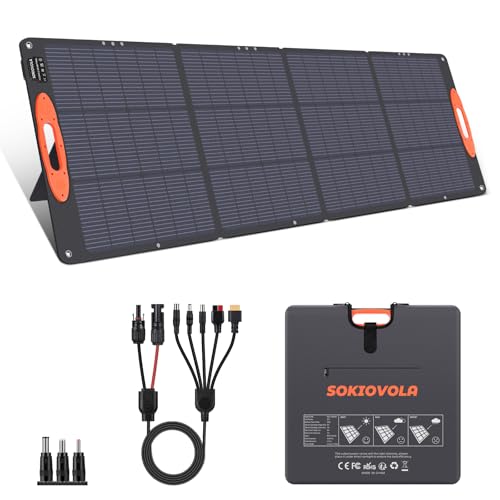
The SOKIOVOLA 200W panel is designed for RVs, campers, and off-grid use with a foldable build and a robust IP68 waterproof rating. It uses high-efficiency A+ monocrystalline cells and folds to a compact footprint for transport. Best for: campers who prioritize weather resistance and reliable daily charging in challenging environments. Caution: weight (~16.3 lb) may be heavy for long backpacking trips or hikers who need ultra-light gear.
ZeroKor Portable Solar Generator with 60W Panel

This set includes a portable power station paired with a 60W solar panel. It offers multiple charging outlets (AC, DC, USB) and a built-in flashlight. Best for: campers who want an all-in-one charging solution for small devices and mid-range camping equipment. Caution: power output limits mean it’s less suited for high-wattage appliances like coffee machines or hair dryers.
Renogy 200W Portable Solar Panel

Renogy’s 200W foldable panel uses 16BB N-Type cells for up to 25% efficiency, delivering strong performance in limited spaces. Its lightweight design and magnetic closure simplify setup in camp settings. Best for: RVs, trailers, or vans needing reliable, daylight-to-power conversion with easy storage. Limitation: still a sizable panel for backpackers, though lighter than many competitors.
FlexSolar 40W Foldable Solar Panel Charger

FlexSolar offers a compact 40W foldable charger with USB-C PD and USB-A outputs, suitable for charging phones, tablets, and small power banks. Best for: hikers and ultralight campers who need instant charging for devices on the move. Caution: no built-in energy storage; rely on external power banks or a larger system for sustained power.
TWELSEAVAN 200W Portable Solar Panel

TWELSEAVAN’s 200W panel emphasizes high efficiency (24%) and wide compatibility with 8-in-1 MC4 connectors, plus USB-C PD60W and USB-A ports. Best for: campers who want flexible charging across multiple power stations and devices. Limitation: some setups may require compatible adapters for older power stations.
Buying Guide
How to choose the right solar setup for camping
- Power needs: Estimate daily watt-hour usage. For light device charging and small electronics, 40–100W panels may suffice. For power stations and multiple devices, 200–400W panels or integrated generators are preferable.
- Portability: Consider folded dimensions and weight. Backpackers benefit from lighter panels, while RV and van users can tolerate heavier, higher-output units.
- Compatibility: Check MC4 connectors, power station inputs, and whether the system includes USB-C PD, USB-A, and DC outputs for versatile device charging.
- Durability: Look for IP ratings (IP65/IP68), ETFE coverings, and rugged frames to withstand weather and rough handling.
- Storage and setup: Magnetic closures, kickstands, and foldable designs speed up deployment and stowaway.
- Reliability in harsh conditions: Panels with robust coatings and weather sealing maintain performance in rain or dust.
- Integrated vs. separate units: All-in-one power stations simplify setup but may limit expansion; modular panels offer upgrade paths but require compatible power stations.
Practical buyer questions
- What panel wattage is enough for off-grid camping? For basic device charging, 100–200W is a practical starting point; for full RV usage or charging power stations, 200–400W or more is better.
- Is IP68 waterproof better than IP65 for camping panels? Higher IP ratings offer better protection against water and dust; choose IP68 when frequent exposure to rain or immersion is likely.
- Can I use a foldable panel with any power station? Most foldable panels use MC4 connectors and output 12–24V; ensure your power station supports MC4, or use an adapter kit if needed.
- Do I need energy storage? Panels alone generate power only when sunlight is available. A power station or battery is essential for 24/7 camping power or cloudy days.
- Is higher efficiency always better? Higher efficiency helps in limited spaces or shade but may come with higher cost. Match efficiency to your space and budget.
- What’s the advantage of an all-in-one generator and panel kit? It simplifies setup and guarantees compatibility, but may limit future expansion if you want to scale up power.
FAQ
- Q: Can these panels charge a typical camping power station? A: Yes, when the panel’s connector and voltage match the station’s input requirements.
- Q: Are foldable panels more weather-resistant than rigid panels? A: Foldable designs offer portability; durability depends on materials and coatings like ETFE.
- Q: How do I protect panels during transport? A: Use the foldable case or pouch and avoid bending panels beyond their fold lines.
- Q: Do any panels include built-in storage for cables? A: Some models have zippered pouches; otherwise store cables separately in a carrying case.
- Q: What maintenance is needed for solar panels? A: Keep surfaces clean, inspect connectors for corrosion, and protect from severe impacts.