Answering the common question “which solar charge controller should I buy?” this guide highlights five reliable options suitable for American buyers seeking efficiency, reliability, and ease of use. The listed models suit a range of setups—from small RV off-grid systems to larger home or commercial installations. The top picks are best for different needs: simple, budget-friendly PWM or feature-rich MPPT controllers, and models that support multiple voltages and battery chemistries. Use the summary table to compare at a glance and then read detailed sections to identify the best fit for you.
| Product | Brand | Best For | Notes |
|---|---|---|---|
| Smart Solar MPPT 100V 50A | Victron Energy | High-output, versatile systems | Strong MPPT with synchronization |
| 100A MPPT with LCD | Depvko | Easy setup, real-time data | Auto-recognition, 99% efficiency |
| SmartSolar MPPT 100V 30A | Victron Energy | Compact MPPT for mid-sized systems | Bluetooth option available |
| Renogy Wanderer 10A PWM | Renogy | Budget and RV/marine use | 4-stage charging, IP32 |
| Upgraded 100A MPPT | ELUSH | Comprehensive features, LCD | Voltage range 12–48V, dual USB |
Victron Energy SmartSolar MPPT 100V 50A

Best for high-output solar setups. This MPPT controller uses synchronized charging to optimize system-wide energy and battery longevity. It excels in shaded conditions due to fast maximum power point tracking, making it ideal for larger off-grid arrays or RV installations where sunlight varies through the day. Suitable for users who want scalable energy management and seamless integration with other Victron SmartSolar units.
Who it’s best for: Home and commercial off-grid systems, or large RV/marine arrays needing robust MPPT with synchronization. Caution: Setup and integration can be more involved for first-time installers; plan for proper wiring and monitoring hardware.
Depvko 100A MPPT Solar Charge Controller

Best for straightforward, high-capacity solar installations with easy plug-and-play. Features include auto 12V/24V recognition and a user-friendly LCD that displays real-time performance. This controller is well-suited for those who want strong efficiency (up to 99%) and simple monitoring without needing Bluetooth or extra apps.
Who it’s best for: Small to mid-size off-grid homes or workshops, and users who value quick setup and visual readouts. Caution: LCD visibility can be reduced in bright outdoor conditions without shading or a hood.
Victron Energy SmartSolar MPPT 100V 30A

A compact MPPT option for mid-sized installations. It uses the same smart charging philosophy as larger Victron units, with rapid tracking and synchronized charging across compatible devices. Best for users who need reliable power optimization in a smaller footprint or Bluetooth-enabled monitoring options.
Who it’s best for: Owners with modest solar arrays or restricted space who still want premium MPPT performance. Caution: May be less suited for very large systems that demand higher current capacity.
Renogy Wanderer 10A PWM Solar Charge Controller
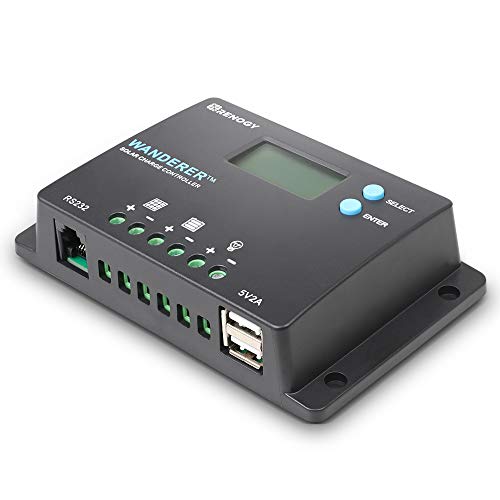
Best for budget-conscious buyers or small RV and marine installations where PWM is acceptable. This model uses a proven four-stage charging profile (Bulk/Boost/Float/Equalization) to extend battery life across various chemistries. It’s compact and straightforward, with strong protection features and an IP32 rating for outdoor use.
Who it’s best for: Weekend campers, small off-grid sheds, or anyone prioritizing cost-effectiveness. Caution: PWM is less efficient than MPPT, especially with high-voltage panels or partial shading.
ELUSH Upgraded 100A MPPT Solar Charge Controller

Best for versatile, feature-rich setups. This controller supports 12–48V systems, multiple protections (over-voltage, over-current, overheat), and a clear LCD with real-time voltage monitoring. It includes dual USB charging and a backlit multi-function LCD for easy tuning and troubleshooting.
Who it’s best for: Enthusiasts building larger off-grid systems who appreciate comprehensive protections and onboard monitoring. Caution: The richer feature set may require a longer setup time and careful configuration.
Buying Guide: Key Purchase Considerations
- System voltage and battery chemistry: Ensure the controller supports your nominal voltage (12V/24V/48V, etc.) and battery types (lead-acid, LiFePO4, etc.).
- MPPT vs PWM: MPPT controllers are more efficient with higher voltage panels and shaded conditions. PWM is cheaper and simpler for small systems.
- Current rating and future expansion: Match or exceed your maximum expected current; consider future panel upgrades.
- Monitoring and connectivity: Bluetooth or LCD displays help with tuning and troubleshooting. Decide if onboard monitoring is essential.
- Protections and safety: Look for over-voltage, reverse polarity, short circuit, and temperature safeguards to protect batteries and panels.
- Size, weight, and installation: Check mounting footprint and enclosure requirements for outdoor use and weather exposure.
Frequently Asked Questions
- What is an MPPT solar charge controller?
An MPPT controller dynamically tracks the maximum power point of the solar array to maximize energy capture, especially in variable conditions and higher voltages.
- Do I need Bluetooth or LCD on my controller?
Bluetooth helps mobile monitoring and setup, while an LCD provides real-time readouts without external devices. Choose based on your preference for on-device vs app-based monitoring.
- Can a MPPT controller handle high-voltage panels?
Yes, MPPT controllers can manage higher panel voltages and convert to the battery voltage efficiently, improving overall energy harvest.
- Is PWM sufficient for small systems?
For very small setups with low panel voltage and tight budgets, PWM can be adequate but is less efficient with higher panel voltages or shading.
- What happens if the battery is dead?
Controllers typically require a base charging voltage. Ensure proper battery conditioning and avoid attempting to charge a deeply discharged battery without supervision.
- Should I choose a 100A controller or smaller?
Choose based on your current requirements and future expansion plans. A 100A unit offers headroom for growth in many off-grid installations.