Looking for a quiet, reliable RV generator to power essentials without excessive noise? The following top picks are designed to minimize sound while delivering clean, stable power for electronics and appliances. This guide helps campers, RV owners, and emergency planners choose the right model based on wattage, fuel type, and portability. The table below summarizes the five highlighted products plus key specs to compare at a glance.
| Product | Watt Range (Surge/Running) | Fuel Type | Approximate Weight | Best For |
|---|---|---|---|---|
| WEN 56477i | 4800 / 4000 | Gasoline | Not specified | Strong power, sensitive electronics |
| AIVOLT 4300W | 4300 / 3450 | Gasoline | 51 lb | Ultra-quiet camping and RV trips |
| WEN DF680iX | 6800 / 5100 | Gasoline / Propane | Not specified | Dual-fuel flexibility for RVs and backup |
| Westinghouse 5000 | 5000 / 3900 | Gasoline | Not specified | Remote start and RV readiness |
| Pulsar PGD40ISCO | 4000 / 3200 | Gasoline | Lightweight | Ultra-quiet, portable power |
Note: All models listed here meet RV-ready and inverter standards to protect electronics. When selecting, consider run time at the load you expect, noise level (decibels), and whether you need dual-fuel capability or electric start for easy starting at campsite.
WEN Quiet 4800-Watt RV Generator With CO Shutdown

The WEN 56477i offers a 224cc engine delivering up to 4800 surge watts and 4000 running watts. It produces clean power suitable for smartphones, tablets, and laptops. ACO shutdown sensor automatically turns off if carbon monoxide levels rise, adding safety for enclosed spaces. Best for campers who need reliable power for laptops and media devices with added CO protection. Limitation: exact weight is not listed, which may affect transport planning.
AIVOLT 4300W Inverter Generator For Camping

Best for: RV trips and camping where ultra-quiet operation matters. The AIVOLT 4300W uses inverter technology with less than 3% THD to protect sensitive electronics. It features a 149cc engine and delivers 4300 starting watts / 3450 running watts. Eco mode boosts fuel efficiency, and at 23 feet the unit operates at about 60 dBA. Weighs 51 pounds, simplifying transport. Limitation: lower running watts compared to larger dual-fuel models, so plan for moderate loads.
WEN DF680iX Dual-Fuel RV-Ready Inverter

The DF680iX provides dual-fuel capability, running on gasoline (6800 surge / 5100 running) or propane (6000 surge / 4500 running). It uses a bonded-neutral 240V configuration, enabling low-power Level 2 charging for EVs. Best for: RV owners who want flexible fuel options and EV charging compatibility. Caution: dual-fuel performance is heavily load-dependent, so verify availability of propane when traveling remote routes.
Westinghouse 5000 Peak Watt Inverter, Remote Start

Westinghouse offers 5000 peak watts with 3900 running watts and a remote start via key fob. It includes multiple outlets (RV-Ready TT-30R, 5–20R) plus USB outlets, making it versatile for travel trailers and home use. Best for: users who value remote start convenience and a robust electrical panel. Limitation: noise level can vary with load; verify decibel rating for your campsite noise restrictions.
Pulsar PGD40ISCO Ultra Light Quiet 4000W

Pulsar PGD40ISCO delivers 4000 peak watts and 3200 running watts with a 1-gallon fuel tank that provides around 4 hours at half load. Notably, it operates at a quiet 59 dB. Best for: light-duty RVing and short camping trips where portability matters. Caution: smaller fuel capacity means more frequent refueling on longer trips.
AIVOLT 8000W Dual Fuel Inverter Generator
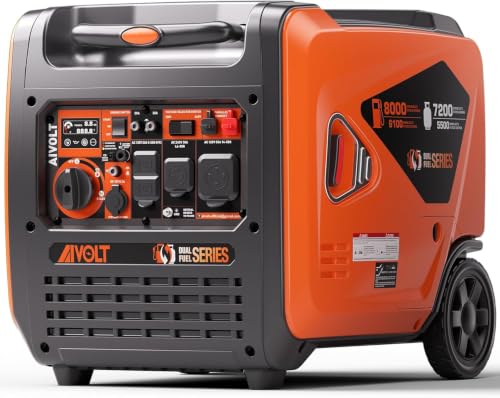
Provides 8000W surge and 6100W running watts with dual-fuel capability and a 62 dBA noise level at 23 feet. Suitable for RVs requiring higher power and longer runtime, with Eco-Mode for efficiency and 10+ hours at 25% load. Best for: larger RVs, job sites, and emergency backup. Limitation: heavier and less portable than smaller models, so transport requires planning.
Oxseryn 4400-Watts Inverter Generator

Offers 4400 peak watts and 3400 running watts with multiple outputs (two 120V AC ports, one RV port, one DC port) and up to 14 hours runtime at 25% load. Eco mode helps optimize fuel use, and the unit is designed for RV readiness and emergency home backup. Best for: moderate loads and long runs away from power sources. Limitation: open-frame design may be less protected in harsh weather than enclosed models.
Oxseryn 4400-Watts Inverter Generator (EPA Compliant)

This model provides 4400 peak watts and 3400 running watts with RV readiness and EPA compliance. It features two 120V outlets, a 30A RV port, and a 12V DC port, with 14 hours runtime at 25% load. Best for: RV users who want reliable, EPA-compliant power with RV-specific outlets. Limitation: check fuel type and availability in remote camping areas to ensure consistent operation.
Buying Guide
- Power needs: Match surge watts to startup loads for appliances and electronics. Higher running watts ensure stable operation for longer loads like air conditioners.
- Noise level: For campgrounds and quiet parks, target units around 50–60 dBA at a practical distance.
- Fuel type and economy: Gasoline units are common; dual-fuel may offer flexibility but consider availability and efficiency in real-world conditions.
- Portability and weight: Lighter models are easier to move around campsites, but larger units may be necessary for heavy loads.
- Safety features: Look for CO shutdown, automatic low-oil shutdown, and proper grounding for safe operation near living spaces.
- Runtime: Consider the expected load and fuel capacity to estimate hours of operation without refueling.
FAQ
- What is the difference between surge watts and running watts?
Surge watts cover startup spikes; running watts are the continuous power level after startup. - Why choose an inverter generator for RV use?
Inverter generators deliver clean power with low THD, protecting electronics, and typically run more quietly than conventional generators. - Is dual-fuel better for RV trips?
Dual-fuel offers fuel flexibility; however, the convenience and efficiency depend on fuel availability and engine tuning. - What should I consider about noise at the campsite?
Check the unit’s decibel rating at a practical distance and compare with campground noise restrictions. - Can these generators run RV air conditioners?
Most 15–20 amp RV circuits require higher wattage; verify each model’s ability to handle air conditioner startup loads before purchase. - How important is CO safety on a generator?
CO sensors and shutoff features improve safety in enclosed or semi-enclosed spaces; such features are strongly recommended.