Answering the top buyer question: which portable power stations deliver reliable off‑grid power across varied uses? This guide highlights five strong options, tailored for hikers, campers, home backup planners, and multi‑device users. Each pick is evaluated for capacity, output, portability, and longevity, so you can compare at a glance and choose confidently.
| Product | Capacity | Output | Best For |
|---|---|---|---|
| Jackery Explorer 300 | 292Wh | 300W rated / 600W peak | Lightweight outings, laptops and cameras, CPAP camping |
| Anker SOLIX S2000 | 2010Wh | 3000W peak | Home backup, fridge runs long, multi‑device power |
| Jackery Explorer 1000 v2 | 1070Wh | 1500W | Outdoor trips with larger appliances, quick recharging |
| ALLWEI 300W | 256Wh | 300W / 600W peak | Road trips, CPAP, small appliances, budget option |
| Anker SOLIX C1000 Gen 2 | 1024Wh | 2000W (3000W peak) | Emergency backup, camping, multi‑device power |
Jackery Explorer 300 Portable Power Station

The Explorer 300 pairs a compact 292Wh LiFePO4 battery with multiple outputs: two AC outlets, a 100W USB‑C PD port, two USB‑A ports, and a 120W car port. It delivers a 300W rated output and up to 600W peak, supporting laptops, cameras, drones, and a CPAP for camping. Its LiFePO4 chemistry promises longevity with over 4,000 charge cycles, supporting a long service life for year‑round adventures.
Best for: Ultralight hikers, weekend campers, and anyone needing a portable generator that won’t weigh down a pack. Better for single‑device heavy use or mixed device charging rather than powering multiple high‑demand appliances for extended periods.
Caution: The 292Wh capacity limits extended deep cycling or running high‑power appliances for long durations without recharging. A solar panel option is possible, but plan for shorter recharges in dim conditions.
Anker SOLIX S2000 Portable Power Station

The S2000 stands out with a large 2,010Wh battery and a 3,000W peak output, making it a strong home backup and multi‑device power hub. It uses high‑drain components and promises long life with a 15‑year LF Battery lifespan and up to 10,000 charge cycles. Its compact size (about 35.7 lbs) and 30% smaller footprint than comparable models help with portability while still supplying significant runtime, including 35 hours for fridge backup in typical scenarios.
Best for: Home backup planning, campers who run multiple devices, and users needing power for longer outages. Better for those who can tolerate several dozen pounds for extended capacity. Choose this if you require abundant energy and longer service life between charges.
Caution: Heavier than smaller units; not ideal for ultralight backpacking. Consider mobility needs when transporting to remote sites.
Jackery Explorer 1000 v2 Portable Power Station

The Explorer 1000 v2 brings 1,070Wh capacity with a 1,500W continuous output and up to 3,000W surge, supporting multiple appliances such as AC units, fridges, and kitchen devices. It weighs about 23.8 lbs and features a foldable handle for easier carrying. A notable feature is a fast charging option via the Jackery App, with emergency charging that can bring the unit to full in about an hour under specific conditions. The device uses an LFP battery expected to maintain capacity after thousands of cycles, offering longevity for outdoor use.
Best for: Campers and road trippers needing substantial capacity without overwhelming weight. Better for those who want faster charging and a robust power reserve for several devices at once. Avoid if you require the smallest possible form factor.
ALLWEI Portable Power Station 300W
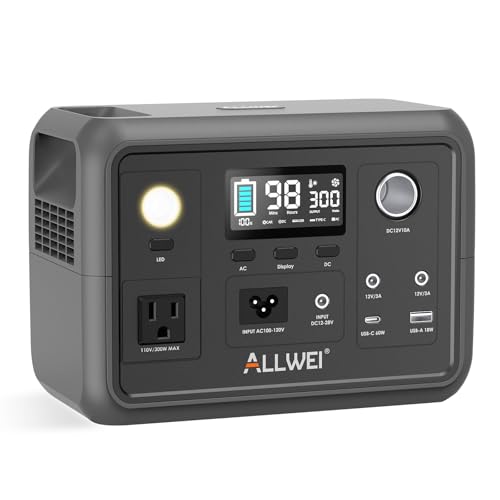
The ALLWEI unit delivers 256Wh with a continuous 300W output and a 600W peak, making it capable of running laptops, small fridges, CPAP machines, and drones. Built with LiFePO4 chemistry for durability, it supports up to 3,000 charge–discharge cycles. A 6‑port system includes AC, DC5521, car port, USB‑A, and USB‑C PD, allowing several devices to charge simultaneously.
Best for: Budget‑minded users needing a compact power station for family trips or emergency backup. Better for moderate‑demand loads than high‑power appliances. Choose this if you want solid value in a smaller footprint and don’t need maximum capacity.
Caution: The total runtime is limited by its 256Wh capacity; plan recharges carefully for longer outages or power‑heavy weekends.
Anker SOLIX C1000 Gen 2 Portable Power Station

The C1000 Gen 2 provides 1,024Wh and 2,000W continuous output (3,000W peak). It emphasizes rapid recharge—UltraFast recharging up to 1,600W—and a compact size for its capacity, highlighting portability without sacrificing performance. Its design supports powering multiple devices, making it versatile for camping, remote work, or emergency backup.
Best for: Those who want dependable energy for several devices with quick recharge capability. Better for users who value speed in recharging and need a reliable all‑around power source. Avoid if ultra‑lightweight carry is the priority; this model is solidly built with more weight than pocket units.
Buying Guide
Key considerations when choosing a portable power station:
- Capacity and power: Match watt‑hour (Wh) and continuous wattage to your essential devices. High‑demand appliances need higher continuous output and burst capacity.
- Battery chemistry: LiFePO4 (LFP) offers longer life and stability, but may add weight. Consider your cycle expectations and warranty terms.
- Portability: Weight and size matter for hikers and travelers. If you’ll carry it in a pack, prioritize lighter models with solid handles.
- Output ports: Ensure the kit has the right mix of AC outlets, USB‑C PD, USB‑A, and car ports for your devices.
- Charge speed: Look for fast charging capabilities and whether you can recharge via AC, solar, or car power. Fast recharge reduces downtime during outages.
- Durability and safety: BMS protections for short‑circuit, over‑current, and over‑voltage help protect devices. A robust build supports long outdoor use.
- Longevity and cycles: Higher cycle counts indicate longer usable life; LiFePO4 often outperformations in long‑term durability.
- Solar compatibility: If you plan to rely on solar, verify panel compatibility and charging efficiency under realistic sun conditions.
FAQ
- Q: How many devices can a portable power station run at once?
A: It depends on the total wattage of the devices. Most models with multiple outlets are designed to support several devices simultaneously within their continuous output limit. - Q: Is LiFePO4 better than standard lithium for power stations?
A: Yes, LiFePO4 cells typically offer longer life (more charge cycles) and stable performance, which can justify heavier weight and cost in some models. - Q: Can I recharge a power station with a solar panel?
A: Many models support solar charging, but check the panel compatibility and charging rate. Fast solar charging may require a higher wattage solar panel. - Q: What’s the difference between peak surge and continuous output?
A: Continuous output is the steady power a unit can deliver, while peak or surge is the temporary higher power available for short bursts to start appliances. - Q: How do I determine which capacity I need?
A: List essential devices and their wattage, estimate daily run hours, and multiply to estimate total Wh needed. Choose a model with margin for growth and recharging intervals. - Q: Do these power stations include warranty or service considerations?
A: Warranty terms vary by brand and model. Review the manufacturer’s coverage for battery and electronics, and consider extended support options if available.