Starting a child on piano can be simple and fun with the right beginner tools. This guide highlights five kid-friendly options that blend visual aids, color-coding, and beginner-friendly layouts to build confidence and skill. Each pick targets a different learner profile—from sticker-centric visual learners to wish-for-no-stickier labels fans—so you can choose the best fit for your child. The top picks below are suitable for early learners ages 3 and up, with gradual difficulty to maintain momentum as skills grow. A quick comparison table follows to help you decide at a glance.
| Product | Best For | Key Benefit |
|---|---|---|
| QMG Rainbow Color Piano and Keyboard Sticker and Kids Piano Learning Book | Visual learners; young beginners | Rainbow stickers plus clear theory explanations |
| COYAHO Piano Keyboard Stickers | All keyboard sizes; quick labeling | Removable, durable, no-residue letters |
| Melissa & Doug Learn-to-Play Piano | Two-octave basics; hands-on playing | Solid wood piano with color-coded songbook |
| 61 Keys Kids Piano Keyboard Toy with Mic | Budding performers; home practice | Multiple sounds, recording, and portable play |
| BEATBIT Piano Note Guide for Beginners | Keyboard-free note learning | Staves and silicone note strips; easy application |
QMG Rainbow Color Piano Learn Kit

The QMG kit combines a beginner-friendly piano book with rainbow color stickers. It aims to help young learners visualize notes and keys, making early practice less intimidating. The book covers easy-to-understand piano theory in simple terms and guides progression from simple to more challenging songs. Best for visual learners and families seeking a structured, progressive approach that builds confidence over time.
Best for: Children who respond best to color cues and stepwise skill growth. The set helps parents monitor progress as songs increase in difficulty. A potential limitation is the reliance on sticker visuals, which may be less ideal for learners who eventually prefer remote note reading without labels.
COYAHO Piano Keyboard Stickers
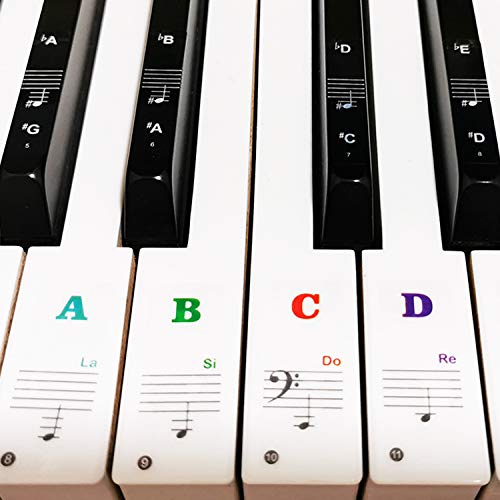
These large, durable keyboard stickers cover both white and black keys with clearly printed letters. They fit most common keyboard sizes (88/61/54/49/37 keys) and are designed to be removable without leaving residue. The backside printing won’t fade with frequent handling. Best for: Quick labeling across a variety of keyboard sizes, especially for families with multiple practice setups. Caution: Some learners may outgrow the sticker labels and prefer to practice without aids as reading improves.
Melissa & Doug Learn-to-Play Piano

This upright piano features a compact two-octave keyboard paired with a color-coded songbook that includes illustrated, English lyrics. The solid wood construction offers durability for active play, and the two-octave range keeps the instrument’s footprint kid-friendly while exposing beginners to a more traditional piano layout. Best for: Young players who benefit from a sturdy setup and an illustrated, kid-friendly songbook. Limitation: Only two octaves, which may require early learners to transition to a larger keyboard later on.
61 Keys Kids Piano Keyboard Toy

This 61-key educational keyboard is designed for young beginners and features eight tones, six demos, five rhythms, and animal sounds. It supports playing, recording, and playback, which can encourage practice by allowing kids to hear their progress. A built-in microphone provides a performance angle that many children enjoy. Best for: Kids who want to imitate performers and practice musical expression at home. Caution: Battery or USB power options require parental setup for ongoing use.
BEATBIT Piano Note Guide for Beginners

The BEATBIT note strip offers a sticker-free approach to learning notes on a keyboard. Made from silicone, the note strips connect in a double-staff layout, mirroring standard treble and bass staves. This allows beginners to locate notes quickly without sticking labels to keys. Best for: Learners who want to focus on reading music without relying on key stickers. Limitation: Requires a flat, clean keyboard surface for best adhesion and readability.
Buying Guide: Key Considerations for Choosing a Starter Piano Tool
- Learning style compatibility: Do you prefer sticker-based visuals, printed songbooks, or note strips? Choose according to how your child learns best—color cues, color-free reading, or staff-based note reading.
- Keyboard size and future-proofing: If your child will grow into a standard full-size keyboard, start with two octaves or a wider range to ease the transition to larger layouts.
- Durability and safety: For younger children, choose sturdy materials and non-toxic finishes. Ensure edges are smooth and the instrument is stable during play.
- Portability and setup: Consider whether you need a compact device for travel or a home-friendly setup with easy storage. Battery or USB power options influence where it can be used.
- Progression potential: Some tools emphasize early fun with songs and stickers; others emphasize reading and theory. A mix can support steady skill growth without plateauing.
FAQ: Quick Answers for Parents and Learners
- What age is best for starting piano learning aids? Most beginner tools suit ages 3 and up, but always follow your child’s readiness and interest level.
- Do sticker-based kits hinder long-term note reading? They can be helpful initially; many learners transition away from labels as confidence grows and reading skills improve.
- Is a full-size keyboard necessary for beginners? Not immediately. Two octaves are often enough to learn basic melodies and finger placement before upgrading.
- Are electronic keyboards worth it for kids? Yes, they offer volume control, built-in demos, and portability, which can encourage regular practice.
- What should I look for in a safe beginner instrument? Look for non-toxic materials, rounded edges, stable stands or cases, and certifications or assurances of standard scales compatibility.
- How do I pace practice effectively? Start with short, consistent sessions (10–15 minutes) and gradually increase duration as interest and focus improve.