Answering the question that traders ask: which desktop PC delivers steady performance for multiple trading platforms while handling charts, data, and web work? The top picks below are best for active traders who need dependable processing, ample memory, and sufficient storage. Each choice targets different buyer needs—from budget-friendly multi-monitor setups to high-capacity, multitasking workhorses.
Overview of selected products (quick reference):
| Product | Best For | Main Strength | |
|---|---|---|---|
| TechMagnet Siwa 6 Trading PC | Budget-minded traders | Balanced CPU, RAM, and storage | i5, 16GB, 120GB SSD + 2TB HDD |
| Dell Trading Optimized PC Bundle | Multi-monitor setups | High RAM, NVMe SSD, multiple peripherals | i5-6th Gen, 32GB, 512GB NVMe |
| TechMagnet Trading Desktop PC (i5-9) | Core trading power | Stronger CPU, large SSD/HDD mix | i5-9th Gen, 16GB, 512GB SSD + 4TB HDD |
| TechMagnet Trading Desktop PC (i5-9, 16GB/512GB+128GB) | Compact yet capable | Balanced two-SSD setup | i5-9th Gen, 16GB, 512GB + 128GB SSD |
| KAMRUI Pinova P2 Mini PC | Space-saving setups | Efficient Ryzen 7330U, 16GB RAM | Ryzen 7330U, 16GB, 256GB SSD |
TechMagnet Siwa 6 Trading PC

The TechMagnet Siwa 6 is a mid-range trading desktop designed for multi-tasking and steady platform performance. It features a Core i5 processor and a dual-drive setup, which helps keep trading software responsive while storing large data files. The system ships with 16GB RAM and a 120GB SSD plus an additional 2TB HDD, balancing fast boot/app load times with ample space for historical data, charts, and logs.
Best for: traders who need a cost-conscious machine with enough RAM for multiple tabs and charts, plus generous storage for data archives. The mixed SSD/HDD configuration supports quick access to recent activity while keeping long-term data accessible.
Caution: the 120GB SSD may fill quickly with chart data and trading software caches; consider adding external storage or upgrading the primary SSD if you anticipate heavy data growth. Note that some listed features emphasize lighting and peripheral extras, which do not directly affect trading performance.
Dell Trading Optimized PC Bundle

This Dell bundle emphasizes a robust workstation for traders who run multiple applications and monitors. It combines a 6th-generation Intel Core i5 processor with a solid 32GB RAM and a 512GB NVMe SSD, delivering fast system responsiveness and ample space for trading platforms, charts, and data feeds. The bundle includes two network-capable peripherals to reduce latency and maintain reliable connectivity during market hours.
Best for: traders who rely on multi-monitor setups and need consistently responsive performance across several platforms and tabs. The large memory capacity helps prevent slowdowns during heavy data crunching.
Caution: as a renewed/bundle option, verify the hardware condition and ensure all required ports and peripherals match your trading workflow before purchase. The description emphasizes performance features over potential software optimizations.
TechMagnet Trading Desktop PC (i5-9)
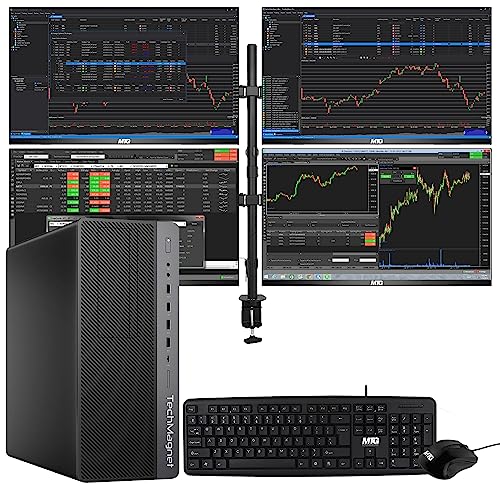
This TechMagnet model uses a 9th-generation Core i5 to deliver stronger per-core performance suitable for trading platforms that benefit from faster calculations and data processing. It comes with 16GB RAM, a 512GB SSD, and a 4TB HDD, optimizing both boot speed and large-scale data storage for charts and logs. It includes dual network cards for wired reliability and reduced trading latency.
Best for: traders needing higher CPU performance and substantial storage for archived data, with a rigorous need for network reliability and low latency. The dual-drive setup helps separate system and data files for smoother operation.
Caution: while the CPU is capable, this model may be overkill for light trading setups; ensure your software stack benefits from the extra CPU power before choosing it.
TechMagnet Trading Desktop PC (i5-9, 16GB/512GB + 128GB SSD)
This variant combines a solid 9th-gen Core i5 with a dual-SSD setup, offering 512GB plus a smaller 128GB SSD for faster access to current-day trading software and scratch data while keeping a larger SSD for archived charts and reports. It maintains 16GB RAM and dual network support for reliable connectivity during trading sessions.
Best for: traders who want a compact, well-rounded machine with a faster, multi-drive configuration to separate working data from system files. The 128GB SSD provides a dedicated cache/working space for quick-throw data.
Caution: ensure the smaller SSD won’t fill quickly due to cache or temporary data needs; consider expanding overall storage if you expect heavy data usage.
KAMRUI Pinova P2 Mini PC

The KAMRUI Pinova P2 mini PC uses an AMD Ryzen 7330U processor with Zen 3 architecture, delivering efficient performance in a compact form factor. It includes 16GB RAM and 256GB SSD with two M.2 slots for potential expansion up to 4TB total storage. Its Radeon integrated graphics handle multiple 4K displays, which can be advantageous for traders running multiple monitors in a small footprint.
Best for: traders who need a space-saving PC that still offers strong multitasking capabilities, multi-monitor support, and easy expansion options. The compact design is ideal for tight desks or travel-friendly setups.
Caution: mini PCs may have thermal limits under sustained load; ensure adequate ventilation and consider external storage if you expect large data loads or long trading sessions.
Buying Guide: Key Considerations for Trading PC Setups
- CPU Power: Look for at least a mid-range modern CPU (e.g., 9th-gen Intel Core i5 or equivalent) to handle multiple charting apps and data feeds without lag.
- Memory: 16GB RAM is a solid baseline for multi-tab trading; 32GB is ideal for heavy multitasking or advanced charting setups.
- Storage: A fast SSD (512GB or 1TB) improves boot times and program responsiveness. Add HDD storage if you archive large historical data.
- Connectivity: Dual network cards or reliable Ethernet/Wi‑Fi support reduces latency and ensures steady data flow during trading hours.
- Monitors: If using multiple displays, ensure ample PCIe/DisplayPort/HDMI outputs and consider a plan that supports your monitor count without bottlenecks.
- Upgrade Path: Favor systems with easy access to RAM/SSD upgrades, especially if data requirements grow over time.
- Thermal Management: Stable builds with good cooling prevent throttling during long sessions; consider ventilation and desk layout.
Frequently Asked Questions
- What should I prioritize for day trading PCs? – Prioritize CPU performance, ample RAM, and fast SSD storage to ensure smooth charting and quick data access.
- Is 32GB RAM necessary for trading? – Not always, but it helps if you run many apps simultaneously or keep large datasets and multiple charts open.
- Are mini PCs suitable for trading? – Yes, for compact setups and lighter multitasking. Ensure adequate cooling and plan for external storage if data usage grows.
- How many monitors can these desktops support? – It depends on the model; many support multiple displays via dedicated ports and networked peripherals. Check the specific ports on each unit.
- Should I buy renewed/bundle options? – Renewed or bundles can offer good value, but verify condition, ports, and compatibility with your software before purchasing.