Answering the most common buyer question—“Which network cable tester should I buy for reliable, straightforward testing?”—this guide highlights five reliable options suitable for IT pros and serious hobbyists. Each pick targets different needs: from portable tone tracing to full data, voice, and coax testing. Read on to compare capabilities, ideal users, and practical caveats to help you decide.
Quick-buying table
| Product | Best For | Why It Stands Out |
|---|---|---|
| Klein Tools VDV501-851 Cable Tester Kit | Comprehensive testing of RJ11/RJ12, RJ45, and coax | Includes multiple remotes for long runs and broad fault detection |
| Klein Tools VDV526-200 LAN Scout Jr | Patch cords and data cables | Backlit display and versatile fault detection |
| TESMEN TLP-123A Network Cable Tester | RJ45/RJ11 testing with portable design | One-button operation and adjustable test speed |
| Klein Tools VDV526-100 LAN Cable Tester | Single-button testing for common RJ cables | Fast, reliable status indicators and broad CAT support |
| NOYAFA NF-8518 Network Cable Tester | Multi-function testing with optical power meter | POE testing and fiber compatibility in one unit |
Klein Tools VDV501-851 Cable Tester Kit with Scout Pro 3
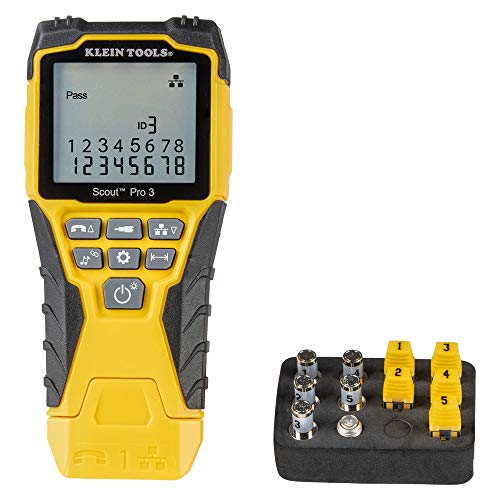
The VDV501-851 supports voice (RJ11/12), data (RJ45), and coax (F-connector) cables. It measures cable length up to 2000 feet and identifies faults such as Open, Short, Miswire, or Split-Pair. Best for field technicians who need a versatile tester across mixed cabling environments. A limitation is that it does not test PoE energization, so Power over Ethernet devices require separate verification.
Klein Tools VDV526-200 LAN Scout Jr Cable Tester

This tester focuses on data cables and patch cords (RJ45), with a large backlit LCD for easy reading in dim workspaces. It detects Open, Short, Miswire, Split-Pair, Cross-over, and Shield faults. Best for technicians working in low-light environments or needing quick, clear results. It’s less oriented toward coax or voice testing compared with multi-purpose kits.
TESMEN TLP-123A Network Cable Tester

The TESMEN TLP-123A supports RJ45 and RJ11 for CAT5/5e/6/6A/7 with LAN and TEL continuity tests. It offers one-button operation and adjustable test speed for flexibility. Best for professionals needing a compact, straightforward tester for routine line fault checks. A potential limitation is its primary focus on continuity and basic faults rather than advanced fiber or PoE analyses.
Klein Tools VDV526-100 Network LAN Tester

Designed for single-button testing of RJ11, RJ12, and RJ45 voice and data cables, the VDV526-100 supports CAT3, CAT5e, and CAT6/6A. It provides fast LED indicators that report Pass, Miswire, Open-Fault, Short-Fault, and Shield status. Best for technicians who need a quick, dependable tester for common office cabling. It may be less suited for coax or non-standard cable types without additional adapters.
NOYAFA NF-8518 Network Cable Tester

This multi-function tester includes nine core features such as cable continuity testing, port flashing, length measurement, POE power testing, and an optical power meter. It supports fiber testing with multiple wavelengths and SNV features, making it a strong choice for mixed Ethernet and fiber environments. Best for IT pros managing both copper and fiber networks. A caveat is that certain fiber connector types (FC/SC/ST) may require separate adapters to fully utilize the optical meter.
Buying Guide
What should you look for in a network cable tester?
- Scope of testing: Do you need RJ11/RJ12, RJ45, coax, and PoE checks, or a simple wiremap? Choose based on the types of cables you encounter most often.
- Portability: If you work on-site or in tight spaces, a compact, one-button tester with a bright display can save time.
- Display readability: A backlit LCD or LED indicators improve usability in dim environments.
- Measurement capabilities: Length measurement, fault detection (Open, Short, Miswire), and shielding tests help pinpoint issues quickly. Consider fiber support if you handle mixed copper/fiber networks.
- POE features: For devices powered by PoE, ensure the tester can verify voltage, polarity, and power delivery where needed.
- Extensibility: Kits with multiple remotes or testers that support a range of cable types provide longer-term value in diverse networks.
FAQ
- What is the primary use of a network cable tester?
A network cable tester verifies connectivity between cable ends, detects faults, and measures cable length to help locate installation issues.
- Do all testers test PoE?
No. Some testers test PoE on specific ports or models. If PoE verification is essential, choose a model explicitly supporting PoE testing.
- Is a backlit display important?
Yes, it improves readability in low-light work areas, reducing misreadings.
- Should I choose a tester for copper or fiber?
For mixed environments, a tester with fiber options or a separate optical tester may be necessary to cover all needs.
- What is a reliable choice for quick office cable checks?
Models with single-button operation and clear LED statuses are ideal for routine office cabling and quick fault identification.
- Can testers detect miswiring and shield faults?
Yes, many models include miswire and shield fault detection to identify common wiring mistakes and shielding issues.