For buyers seeking rugged warmth, modular design, and field-ready durability, a military sleeping bag system can simplify gear while maximizing versatility. This guide highlights five top options, matching each system to different needs—from extreme cold protection to compact, quick-access setups. The top picks are ideal for outdoor professionals, military-style enthusiasts, and strategic backpackers who require reliable insulation, weatherproofing, and adaptable configurations.
| Product | Best For | Key Benefit |
|---|---|---|
| USGI Gear Military Sleeping Bag System | Cold-weather expeditions and modular field setups | Complete 4-piece system for 50°F to -50°F with waterproof bivy |
| OneTigris Bushcrafter’s Sleeping Bags | All-season backpacking and hiking | Lightweight mummy style with water-repellent shell |
| MT Army Military Modular Sleeping Bag System | Extreme temperature scenarios and field use | Multi-layered bivy cover with tough nylon and high-grade insulation |
| MT Modular Sleep System (Front-Zip) | Tactical missions and quick entry/exit needs | Front-zip design with vacuum compression sack |
| Mummy Sleeping Bag for Adults, 36°F | Cool-weather camping and family trips | Compact spring/fall option with snug fit for warmth |
USGI Gear Military Sleeping Bag System
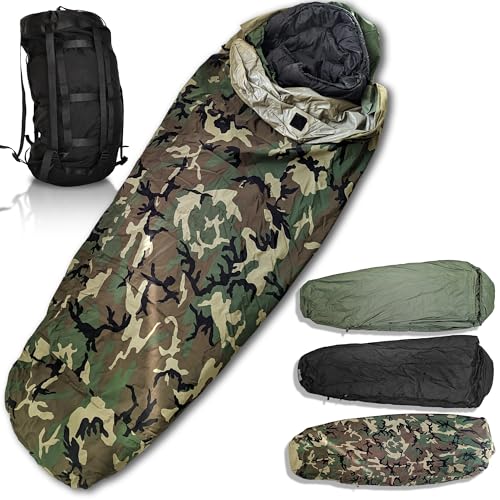
The USGI Gear system is a four-piece modular solution designed to cover a wide range of temperatures. It includes a Patrol Sleeping Bag, an Intermediate Cold Weather Bag, a Waterproof Bivy Cover, and a Compression Stuff Sack. Best for users who need a single kit that transitions from mild to severe cold, offering weather protection and reliable insulation in damp environments. A potential limitation is the bulk of a four-piece setup for light travel, which may be heavier than smaller hybrids.
OneTigris Bushcrafter’s Sleeping Bags

This mummy-style sleeping bag is designed for 3-season use, suitable for spring through fall camping, hiking, and backpacking. It features a water-repellent outer shell, a durable lining, and an insulation fill that balances warmth with compactness. Best for travelers who prioritize light weight and ease of packing. Choose this if you want a dedicated single-bag solution rather than a full modular system. Note that extreme winter use may require additional layers.
MT Army Military Modular Sleeping Bag System

This MT system emphasizes a rugged bivy cover and multiple layers designed for extreme conditions. It uses a wind-resistant outer, a high-fluff Polarguard HV filling, and double-sided heavy-duty zippers. Best for users who expect harsh weather and require a stable, layered approach to warmth. A potential caveat is that it may be bulkier and heavier than lighter-duty packs, suitable for base camps or vehicle support rather than ultra-light trekking.
MT Modular Sleep System (Front-Zip)
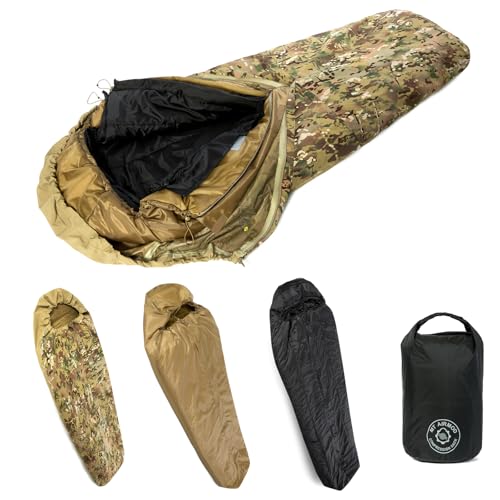
MT’s four-piece system uses a front-zip design for faster entry, better ventilation, and emergency egress. It includes a Patrol Bag, Intermediate Cold Weather Bag, Waterproof Bivy Cover, and a Vacuum Compression Sack. Best for tactical operators who need rapid access and efficient storage. The vacuum sack offers significant space savings but may require careful use to avoid condensation buildup in tight packs.
Mummy Sleeping Bag for Adults, 36°F

This compact mummy-style bag targets cool-weather comfort with a stated 36°F comfort rating and a 25°F lower limit. It is designed for backpackers and family campers who want warmth without hauling a full sleep system. Best for light-to-midweight cool-weather outings. It is not oversized; check body size and height to ensure a proper fit for extended comfort.
Buying Guide
- Temperature range and layering: Evaluate whether you need full cold-weather protection (e.g., down to -50°F) or flexible 3-season use. Modular systems excel in varied climates, while single bags suit lighter trips.
- Weight vs. durability: Heavy-duty materials and multiple layers add warmth but increase weight. For extended treks, balance bulk with insulation performance.
- Weatherproofing: Look for waterproof bivy covers and water-repellent shells to protect against wind and moisture in damp or snowy conditions.
- Access and usability: Front-zip designs can speed up entry and exit in tactical scenarios. Consider how easy it is to ventilate and vent hot spots during rest.
- System compatibility: If you already own some pieces, ensure new bags interoperate with your existing modular system, including compatible zippers and sacks.
- Space and packing: Vacuum compression sacks and multi-piece kits offer space savings but require proper packing technique to avoid moisture entrapment.
- Fit and comfort: Mummy shapes reduce dead air but can feel tight for larger sleepers. Ensure adequate shoulder and hip room based on torso measurements.
FAQ
- What is a modular sleep system? It is a multi-piece setup that includes a base bag, an intermediate or cold-weather bag, a protective bivy cover, and a compression sack. You combine pieces to create suitable warmth for varying conditions.
- Which bag should I choose for extreme cold? Look for a complete four-piece system with nesting insulation and a waterproof bivy cover, designed for subfreezing temperatures or very cold environments.
- Is a front-zip design better than side-entry? Front-zip designs offer quicker access and ventilation control, which can be advantageous in tactical or emergency scenarios.
- Can I use a sleeping bag in wet weather? Yes, if paired with a waterproof bivy cover and moisture-wicking inner layers to minimize condensation and heat loss.
- Are mummy bags suitable for all body types? Mummy bags save weight and heat but may feel tight for taller or broader sleepers. Check dimensions and fit before purchasing.