Finding the right lighting for photography is essential for clear, true-to-life images. This guide highlights five popular lighting kits that suit different buyers—from beginners creating social content to pros needing solid studio lighting. Each option is evaluated for suitability, standout features, and potential limitations to help you decide quickly.
Summary at a glance: the table below compares the five selected products on color temperature options, power options, portability, and ideal use cases.
| Product | Color Temp Options | Power & Portability | Best For | Notes |
|---|---|---|---|---|
| NiceVeedi 2-Pack LED Video Light Kit | 2800K, 4800K, 6500K | USB-C power; portable Tripod up to 60” |
YouTubers and live streamers needing flexible kits | Includes remote dimming |
| Torjim Softbox Photography Lighting Kit | 3000–7500K (CFL bulb) | AC powered; sturdy tripod | Studio-quality soft light for portraits | Larger softbox coverage |
| NiceVeedi Softbox Lighting Kit 16”x16” | Equivalent to 50W CFL; continuous light | Durable tripod; foldable | Compact studio setups | Anti-strobe LED |
| Anautin 1-Pack LED Lighting Kit | 2500K–8500K | USB powered; portable | Content creators on the go | High brightness from 352 LEDs |
| ALTSON 60 LED Portable Selfie Light | 3 modes: 2500–6500K | Clip-on with 180° arm; rechargeable | On-the-go quick fill light | Compact, 160° rotation |
NiceVeedi 2-Pack LED Video Light Kit

What it is: A two-pack LED lighting kit with a 10-inch panel, dimmable brightness from 10% to 100%, and three color temperatures (2800K, 4800K, 6500K). It includes a height-adjustable tripod up to 60 inches and a phone holder for mobile shooting. Best for creators who need a compact, flexible setup for videos or streams.
Who it’s best for and why selected: Ideal for YouTubers and live-streamers who require portable, adjustable lighting with remote control. The kit’s 356 LEDs deliver bright, color-accurate light (CRI 97+) suitable for skin tones and product shots. The dual-light setup helps create balanced scenes from different angles.
Limitations to consider: Power comes from USB-C sources; a compatible charger or power bank is required (not included). The included stand height tops at 60″, which may be limiting for overhead shots in very tall setups.
Key buyer takeaways:
– Best for mobile creators needing versatile color temperature options.
– Better if you value a remote-dimmable, compact lighting solution.
– Choose this if you want a two-pack setup for multi-source lighting.
Torjim Softbox Photography Lighting Kit

A comprehensive softbox lighting kit that focuses on soft, even illumination. It uses a foldable, reflective interior with a silver baffle to maximize light distribution. The included 85W energy-saving bulb ranges from 3000 to 7500K, enabling broad creative control from warm to daylight tones.
Who it’s best for and why selected: Best for portrait work or product photography where shadow control is important. The large softbox and even light help minimize harsh shadows and provide a flattering look. The kit’s durability and reliable stand system make it suitable for small studios or set corners.
Limitations to consider: The CFL bulb produces continuous light with warm-to-daylight shifts, but energy efficiency and long-term bulb life depend on usage. Setup may be larger and heavier than compact options, so space matters.
Key buyer takeaways:
– Best for controlled, studio-quality portraits.
– Better for those who want a softer, wraparound light.
– Choose this if you prioritize even light and reliable stability over ultra-portable design.
NiceVeedi 16″ Softbox Lighting Kit

What it is: A compact 16″ x 16″ softbox kit powered by LEDs with a 60-watt-equivalent brightness and a durable, foldable tripod. The kit emphasizes anti-strobe LED lighting, which helps avoid flicker during 4K/60fps video and regular filming.
Who it’s best for and why selected: Great for creators who need a portable yet reliable softbox setup for consistent video lighting. Its compact footprint makes it ideal for small studios, travel shoots, or desk setups where space is limited but soft, even light is needed.
Limitations to consider: The bulb is designed to replicate higher-watt lighting, but it is still an LED source. If you need extremely high output for large sets, you may want to consider larger panels.
Key buyer takeaways:
– Best for compact studios and travel-friendly setups.
– Better for those who must avoid flicker in high-framerate video.
– Choose this if you want a balance of portability and soft light quality.
Anautin 1-Pack LED Video Lighting Kit
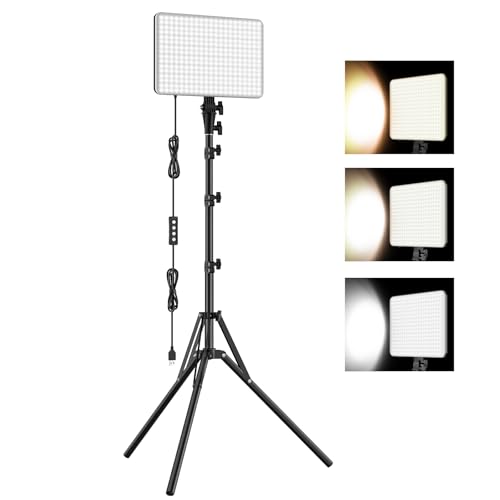
What it is: A 15W LED panel with 352 LEDs delivering up to 1700 lumens, powered via USB. It offers three color temperatures (2500K, 4500K, 8500K) and adjustable brightness from 10% to 100%. This kit is designed for flexible, on-the-go lighting solutions.
Who it’s best for and why selected: Suitable for short-form creators, livestreamers, and remote workers who need reliable fill light without heavy equipment. The USB power option supports travel or desk setups where plugging into a wall outlet is convenient.
Limitations to consider: USB-powered lighting may require a stable power source with sufficient current (5V/3A). Maximum brightness is strong but not as high as larger studio panels, which could affect very bright environments.
Key buyer takeaways:
– Best for mobile creators who work from various locations.
– Better for desk setups or travel kits.
– Choose this if you prioritize USB power and compact design.
ALTSON 60 LED Portable Selfie Light

What it is: A compact selfie light with three color modes (2500K–6500K) and a 180° rotatable head. It runs on a rechargeable 2200mAh battery and includes a ¼-inch thread adapter for compatibility with tripods and cameras. It’s designed for quick, on-the-go fill light.
Who it’s best for and why selected: Best for spontaneous shoots, makeup tutorials, or mobile vlogging when you need a quick, high-CR-lighting option without setup fuss. The clip-and-stand design makes it easy to use alongside smartphones or compact cameras.
Limitations to consider: It’s small and battery-reliant, which can limit runtime on busy shoots. For major studio work, larger panels will outperform it in brightness and coverage.
Key buyer takeaways:
– Best for quick, portable fill light.
– Better for mobile content where setup speed matters.
– Choose this if you value portability over very broad lighting coverage.
Buying Guide: Key Purchase Considerations
What should you consider when choosing photography lighting?
- Portability vs. power: Do you need a compact kit for travel or a larger setup for a fixed studio?
- Color temperature range: Look for flexible temperatures (e.g., 2500K–6500K) to match ambient light and skin tones.
- Color accuracy: A high CRI (90+ or 97+) helps ensure natural color rendering in photos and videos.
- Light quality: Softboxes and diffusers reduce harsh shadows; consider diffusion materials for even light.
- Power options: USB power is convenient for on-the-go use; wall adapters or power banks extend usability in different contexts.
- Mounting flexibility: Tripods, desktop stands, and clip-on designs affect placement and overhead shooting capability.
- Flicker and compatibility: Anti-strobe LEDs and compatibility with camera frame rates help avoid flicker in video.
FAQ
- What color temperature is best for portrait photography?
– A neutral daylight range around 5500K–6500K often provides a natural skin tone under mixed lighting. - Is a softbox necessary for good lighting?
– Softboxes soften shadows and create even illumination, which is advantageous for most portrait and product shots. - Can USB-powered lights replace studio panels?
– For compact setups and on-the-go use, USB-powered lights are convenient. For large scenes, AC-powered panels with higher output may be needed. - How many lights should I start with?
– A two-light setup (key and fill) covers most situations; a third light can act as a background or hair light for separation. - What does CRI mean, and why does it matter?
– CRI (color rendering index) measures how accurately a light renders colors. Higher CRI (e.g., 97+) means more natural color in photos and videos.