Answer: For reliable indoor plant growth, choose full-spectrum LED grow lights that offer adjustable timing, dimming, and multiple spectrum options. This guide highlights five effective options suited for beginners to advanced growers, with who they’re best for and practical caveats. The featured products cover different form factors—from compact clip-ons to longer strip bars—so you can select based on space, plant type, and daily routine.
| Product | Best For | Key Benefit |
|---|---|---|
| Aokrean Grow Lights for Indoor Plants | Small pot setups | soil insert + timer features |
| LEOTER Grow Light | All stages, larger spaces | 80 LEDs, multiple spectra, memory timer |
| Barrina T5 Grow Lights 1ft | Flexible mounting, modular setup | 4-pack, magnetic/clip mounting |
| VIPARSPECTRA 70 Watt Grow Light | Seedlings to vegetative growth | High output in a compact form |
| RWNTAO Grow Lights, 2 Head Clip | Two-plant setups, flexible positioning | Dual head, 10 dimming levels |
Aokrean Grow Lights for Indoor Plants

The Aokrean unit is designed to be inserted into soil or used with a stand, offering stability when placed among potted plants. It features three lighting modes and ten brightness levels to accommodate different growth stages and plant species. A built‑in timer supports 3H, 9H, and 12H cycles, automatically cycling daily when powered. Best for small pots, desk-side seed starting, and compact arrangements. Caution: the stand requires downward pressure from the pot to stay stable, so avoid top-heavy setups.
Who this is best for and why
- Best for compact, soil-insert setups and users who want an inexpensive, plug-and-go option.
- Better for beginners needing a simple timer to maintain routine lighting without manual operation.
Limitations
- Stability depends on pot placement; not a wireless standalone unit.
LEOTER Grow Light for Indoor Plants
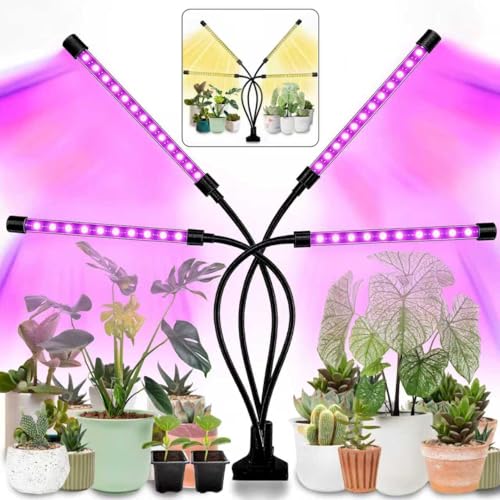
This upgraded model uses 80 LEDs in a mix of red, blue, yellow, and white to support germination, growth, and flowering. It provides full-spectrum coverage (380–800 nm) and a dedicated red/blue mode to optimize blooming and fruiting stages. The circular memory timer automatically turns on/off daily at 3H, 9H, or 12H. Ten dimmable levels let you tailor light intensity to plant needs. Best for versatile indoor gardens and users who want adjustable spectrum alongside timing automation. Caution: The timer must be reset if power is interrupted.
Who this is best for and why
- Best for growers needing a broad spectrum with a robust timer for routine care.
- Better for medium to larger desk setups or shelves with flexible gooseneck positioning.
Limitations
- Timer resets after power loss; plan for occasional manual reset after outages.
Barrina T5 Grow Lights for Indoor Plants (1ft, 4 Packs)

The Barrina 1ft T5 light bars are designed to deliver full-spectrum 5000K light with a compact, modular form. The 4-pack setup supports scalable arrangements and can link up to 16 lights in a series, simplifying larger plant displays. Each fixture uses a black aluminum casing to blend with home decor. Best for seedling to vegetative growth in cabinet or shelf setups. Caution: 5000K white spectrum may be less ideal for flowering without an additional spectrum blend.
Who this is best for and why
- Best for modular, multi-plant arrangements and easy installation.
- Better for replacing or supplementing existing light banks in small rooms or grow cabinets.
Limitations
- Requires compatible power setup; individual switches may be needed for separate control of each bar.
VIPARSPECTRA 70W Grow Light

This 70W grow light delivers a compact solution with a balanced spectrum that includes 660 nm red and white light, designed to support seedlings and vegetative growth. The absence of a fan helps keep noise level low, while large heat sinks aid in dissipation to extend LED life. It provides high PAR with energy efficiency comparable to traditional HPS/MH setups. Best for small to medium vegetative areas and growers seeking strong, efficient performance in a single unit. Caution: Check heat dissipation needs for extended use in confined spaces.
Who this is best for and why
- Best for compact growing areas needing solid PAR output and quiet operation.
- Better for those who want an all-in-one fixture with dependable performance for seedling to vegetative stages.
Limitations
- May require additional lighting for flowering in larger setups.
Grow Lights for Indoor Plants, RWNTAO Upgrade 84 LEDs

The RWNTAO clip-style grow light uses 84 LEDs to deliver a robust full-spectrum light with 6000K white and additional red LEDs. It features a cycle memory timer with 3/9/12 hours and 10 dimmable levels, supporting various growth stages from vegetative to flowering. The dual features include a flexible gooseneck and clip, allowing positioning on desks, shelves, or small plant stands. Best for space-constrained setups needing adjustable light and an auto-timer. Caution: The setup relies on a clip to hold position; ensure a stable mounting surface.
Who this is best for and why
- Best for users who want adjustable brightness and spectrum in a compact two-side design.
- Better for plants in small clusters or on desk-like grow stations.
Limitations
- Clip mount may limit stability on very lightweight fixtures or uneven surfaces.
Hywyimlait Black Grow Lights, 2 Head Clip

This two-head clip system provides an upgraded full-spectrum setup with 60+ LEDs per bar, designed for flicker-free operation and strong PPFD. It includes 4/8/12/18-hour timer options and three spectral modes with ten dimmable levels. The dual head design enables flexible coverage for multiple plants. Best for plant clusters needing directional lighting and the ability to illuminate two separate zones. Caution: Some users may need to reposition to maximize coverage in wider plant groups.
Who this is best for and why
- Best for dual-plant setups or workspaces needing directed lighting for separate plants.
- Better for growers who want multiple timing options and dimming control.
Limitations
- Separate brightness control per head may require careful adjustment for even coverage.
Buying Guide: Key Considerations for LED Grow Lights
- Light Spectrum: Full-spectrum (roughly 400–700 nm) supports all growth stages. Some models include dedicated red/blue channels for flowering or vegetative boosts.
- Light Intensity and Coverage: Look at PAR/PPFD values and recommended coverage area. Larger spaces may need higher wattage or multiple fixtures.
- Timers and Dimming: Auto on/off timers simplify care during work or travel. Dimmability helps tailor intensity to plant needs.
- Mounting and Form Factor: Clip-on, gooseneck, strip bars, or stands each suit different setups. Ensure stable mounting and adaptable positioning.
- Power and Energy Use: Efficiency matters. Compare wattage to output to estimate electricity costs over growing cycles.
- Durability and Build: Aluminum housings and heat management extend lifespan. Quiet operation can be a bonus in living spaces.
Practical comparison questions
- What size space will you light, and how many plants need coverage?
- Do you prefer a single powerful light or several modular, expandable units?
- Is a timer essential for your routine, or do you manually adjust lighting?
- Do you need flexible mounting for shelves, desks, or cabinets?
FAQ
- Q: Do LED grow lights replace natural sunlight? A: They supplement sunlight and provide consistent light cycles for indoor plants.
- Q: Can LED grow lights cause burns to plants? A: Too much intensity can stress plants; start with lower brightness and gradually increase.
- Q: Are timers necessary? A: Timers help maintain regular light cycles, especially during travel or workdays.
- Q: How close should lights be to plants? A: Distance depends on light intensity; follow product guidelines and adjust based on plant response.
- Q: Can I mix multiple lighting brands? A: Yes, but ensure compatible spectrum and timing to avoid conflicting cycles.
- Q: Do these lights require special electrical setups? A: Most plug into standard outlets, but verify power requirements and safety.