Answering the common question “what keyboard should I start with to learn piano,” these beginner-friendly options prioritize learning aids, 61-key layouts, and approachable features. Ideal buyers include kids taking first lessons, adults starting piano for hobby, and students needing a portable practice setup. The list below highlights five keyboards that balance teaching modes, key feel, and value to help you build skills efficiently.
| Product | Why It’s Great For | Key Feature |
|---|---|---|
| RockJam RJ5061 61 Key Keyboard Piano Kit | Best complete starter kit with stand and bench | Includes stand, bench, headphones, notes stickers; pitch bend wheel; 200 rhythms and tones |
| JIKADA 61 Key Portable Keyboard | Best for all-in-one practice with teaching modes | Light-up keys; 3 teaching modes; built-in mic input and speaker |
| KEYIVOX 61-Key Electronic Keyboard | Best value for structured learning | 200 tones, 70 demo songs; built-in teaching modes; piano note stickers |
| MUSTAR 61 Key Piano Keyboard (Black) | Best portability with learning aids | Lighted keys; 255 tones/255 rhythms; 3 teaching modes; LCD/stand options |
| Alesis 88 Key Keyboard Piano | Best full-size piano experience for future versatility | 88 keys; 480 sounds; USB MIDI; built-in lessons and rhythms |
RockJam RJ5061 61 Key Keyboard Piano Kit

The RockJam RJ5061 is a complete beginner kit designed for rapid, guided learning. It pairs a 61-key keyboard with a stand, bench, headphones, and notes stickers for quick setup. The pitch bend wheel and LED panel provide expressive control, while 200 rhythms and 200 tones support a wide practice palette. This kit is best for beginners who want an all-in-one package and a structured start with visual cues.
Best for: absolute beginners who want a ready-to-use practice space and guided lessons. Limitations: lacks a built-in extensive learning system beyond basic lessons; may feel basic for progressing players.
61 Key Portable Keyboard With Lighted Keys – JIKADA

This JIKADA model focuses on visibility and teaching support. Its lighted full-size keys guide finger placement, and the LCD display shows function status clearly. It offers 255 tones and rhythms, 50 demo songs, and three teaching modes, plus a memory function to store tone and rhythm settings. Built-in speakers and an input/output jack allow late-night practice without disturbing others.
Best for: learners who benefit from visual guidance and structured, progressive teaching modes. Caution: heavier on features than high-end realism; sound quality depends on speaker size and room acoustics.
KEYIVOX 61-Key Electronic Keyboard

KEYIVOX emphasizes a practical learning workflow with 200 tones and rhythms, 70 demo songs, and built-in teaching modes. The integrated speaker provides clear audio for home practice, and the included piano note stickers help visualize key positions for early learners. A metronome and recording capability support steady progress tracking for beginners.
Best for: beginners seeking a cost-effective, structured learning path with helpful visual aids. Limitation: not a full-sized piano touch experience, which may matter for advancing players preparing for acoustic pianos.
MUSTAR 61 Key With Lighted Up Keys
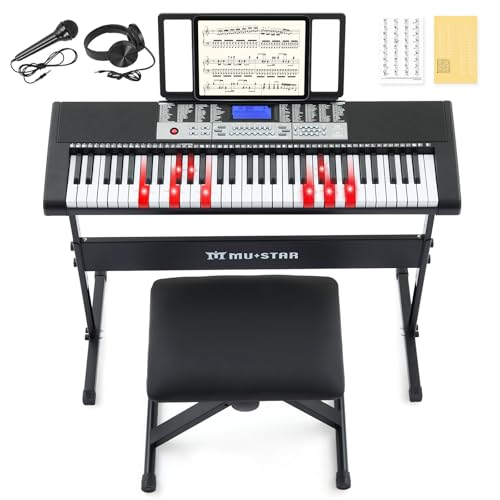
MUSTAR’s 61-key model places emphasis on interactive learning via lighted keys, guided by 255 tones and 255 rhythms, plus 50 demo songs. Three intelligent teaching modes (One Key, Follow, Ensemble) help learners build accuracy and rhythm. An audio input and chord options expand practice possibilities, while portability makes it a strong option for traveling students or compact home spaces.
Best for: learners who want light-guided practice, portable design, and variety in tones and rhythms. Limitation: light guidance may reduce tactile feedback compared with weighted keys on other models.
Alesis 88 Key Keyboard Piano

The Alesis model offers a full 88-key keyboard with a broad sound library (480 sounds) and a range of built-in rhythms, making it closer to a traditional piano experience. It includes USB MIDI, a carry bag, stand, headphones, and a pedal, supporting long-term practice and performance readiness. This option is best for serious beginners who plan to transition toward an acoustic piano or want broad versatility.
Best for: learners aiming for a genuine piano feel and expansive sound options. Limitation: may require more space and investment than 61-key starter kits.
Buying Guide
- Key count and feel: Beginners often start with 61 keys for portability. If you plan to progress to piano, consider 88 keys later. Some models offer semi-weighted or light-touch keys; weigh comfort against realism for your goals.
- Learning features: Look for built-in teaching modes, step-by-step guidance, metronome, and demo songs. Visual aids like light-up keys can speed up initial learning.
- Extras and setup: Starter kits with stands, benches, and headphones reduce setup friction and avoid disturbing others. USB MIDI or audio input allows expansion with software or recording.
- Portability vs. stability: If space is limited or you travel, 61-key portable models are ideal. If you want a practice instrument that mirrors piano ergonomics, a larger, heavier setup may be preferable.
- Future-proofing: For long-term growth, consider keyboards with a broad sound library, recording capabilities, and USB MIDI to interface with learning apps or DAWs.
Frequently Asked Questions
- What is the best keyboard for a complete beginner? A 61-key keyboard with teaching modes and a bundled starter kit is typically best for new players seeking structure and value.
- Should I buy 61 keys or 88 keys? Start with 61 keys for portability; switch to 88 keys if you plan to pursue piano seriously or need authentic feel.
- Do I need a stand, stool, and headphones? If space allows, yes. They improve posture, focus, and private practice without disturbing others.
- Are light-up keys helpful for beginners? Yes. They visually guide finger placement and can accelerate early note-reading skills.
- Can a keyboard replace a piano for a learner? A keyboard with 88 keys and good touch can substitute for practice before moving to an acoustic piano, especially for beginners on a budget.
- Is USB MIDI necessary? USB MIDI is useful if you plan to use learning apps or computer-based lessons, but not mandatory for basic practice.