Find the right Japan SIM card for staying connected while visiting. This guide compares five popular data-only SIMs and eSIMs to fit different budgets and usage patterns. Best for short trips, heavy data users, or travelers who need quick setup and reliable coverage on Japan’s major networks.
Summary table of selected products:
| Product | |||
|---|---|---|---|
| Nippon SIM – 15 Days Data Only | 10 GB high-speed, then 128 kbps | Docomo | Short visit, light to moderate usage |
| Nippon SIM – 30 Days Data Only (50 GB) | 50 GB high-speed, then 128 kbps | Docomo | Heavy data users, longer stay |
| SIM2ROAM – 15 Days Data Only | 10 GB high-speed, then 128 kbps | Docomo/KDDI network variants | Flexible, simple setup for 2 weeks |
| TSIM – 30 Days Data Only | 30 GB, 5G/4G LTE, then unlimited at reduced speed | Network-agnostic (Japan) | Moderate-long stay with social apps |
| Hello Japan Travel eSIM – 15 GB / 20 Days | 15 GB high-speed data | SoftBank network | eSIM user, quick setup, nationwide coverage |
Nippon SIM 15 Days Data Only
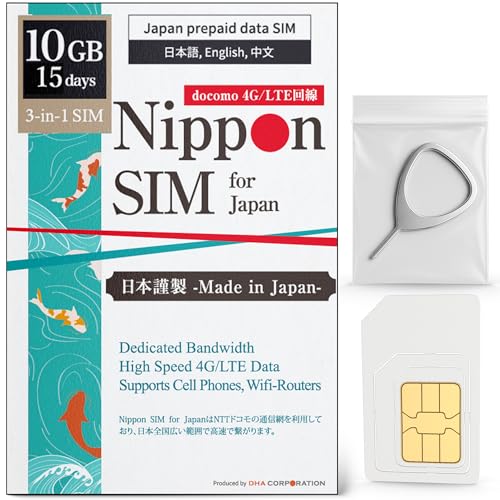
Best for: First-time visitors or budget-conscious travelers needing a short, predictable window. The 10 GB high-speed allotment on Docomo’s network supports everyday browsing, maps, and messaging with tethering included. Data slows to 128 kbps after the limit, but the 15-day validity aligns with typical travel itineraries. This card comes tri-cut for standard, micro, and nano slots and includes multilingual manuals.
Why chosen: It provides reliable coverage through Japan’s largest network and straightforward setup for Android and iPhone users, with clear data pacing during the stay. A potential limitation is the reduced speed after data is exhausted, which affects streaming and large downloads.
Nippon SIM 30 Days Data Only (50 GB)

Best for: Heavy data users or travelers who need longer connectivity without frequent swaps. The 50 GB data plan supports longer stays and frequent tethering for work on laptops. The Docomo network ensures broad coverage, including rural areas. After data is consumed, speeds throttle to 128 kbps for the remainder of the 30 days.
Why chosen: Higher data allotment makes this a solid pick for streaming, navigation, and remote work on the go. A limitation is the longer activation and the throttling threshold, which may be noticeable for high-bandwidth tasks after the cap.
SIM2ROAM – 15 Days Data Only

Best for: Travelers seeking a compact 2-week option with straightforward usage. This SIM card offers 10 GB of high-speed data, with hotspot tethering available for mobile devices and tablets. No activation is needed beyond inserting the SIM, making it easy for first-time travelers.
Why chosen: The convenience of an auto-activation style helps reduce setup friction. A caution is that, like other data-only cards, speeds drop after the initial data cap is reached, so plan downloads before long flights or commutes accordingly.
TSIM – 30 Days Data Only

Best for: Moderate-length trips needing a robust data plan with comfortable speeds. The 30 GB data allocation supports frequent social use and navigation across Japan with 5G/4G LTE access. The card auto-activates when connected to a network, and tethering is allowed, making it flexible for smartphones and tablets.
Why chosen: This option balances data volume with a longer validity window. A potential limitation is the reliance on unlocked devices; ensure your phone is compatible and unlocked prior to travel.
Hello Japan Travel eSIM – 15 GB / 20 Days

Best for: ESIM adopters and travelers who prefer quick setup without physical cards. The SoftBank-backed network offers broad national coverage, and the 15 GB data allotment suits moderate use for maps and messaging over a 20-day window. QR-based activation is typical for eSIMs.
Why chosen: ESIMs provide fast, device-level activation without swapping SIMs. A limitation is the QR code expiry and device compatibility; verify your phone supports eSIM with SoftBank’s infrastructure before purchase.
Buying Guide: Key Considerations
Network coverage and stability: Look for cards that rely on Japan’s largest networks (Docomo, SoftBank) for broader rural and urban connectivity. Coverage matters more for rural trips or off-the-beaten-path itineraries.
Duration and data volume: Match the plan length to your stay. Short trips benefit from 10–15 GB plans, while longer stays or heavy streaming may require 30–50 GB packages.
Activation and setup: Auto-activation and triple-cut SIMs simplify use with various devices. If using eSIM, check device compatibility and QR code validity before departure.
Device compatibility: Ensure your phone is unlocked and supports 4G/5G bands used in Japan. Some plans note restrictions on unlocked or older devices; verify before purchase.
Data throttling: Most data-only plans throttle after the data cap. Consider usage patterns for maps, cloud sync, and video streaming when selecting a cap.
Hotspot tethering: If you plan to share data with a laptop or tablet, confirm hotspot or tethering support on the chosen plan.
Ease of use for arrivals: Some buyers prioritize cards that require minimal setup on arrival, while others prefer the flexibility of a longer validity window or higher data allotment.
Frequently Asked Questions
- What is the difference between a SIM card and an eSIM for Japan? A physical SIM requires inserting a card into your phone, while an eSIM is activated digitally via a QR code. ESIMs offer quicker setup and no plastic card to carry.
- Do these SIMs work in all Japanese cities? Coverage depends on the network operator. Docomo and SoftBank provide broad national coverage, including many rural areas.
- Can I use these SIMs for tethering? Most data-only plans support hotspot tethering, but check specific terms to confirm for each model.
- Will speeds change after data is used? Yes, most plans throttle data after the high-speed allotment is exhausted, typically to 128 kbps.
- Do I need to activate the SIM before travel? Some models auto-activate once inserted or connected to a network; others may require minimal setup following the included instructions.
- Is it better to choose a larger data plan for a longer trip? For longer stays or frequent usage, a larger data pool reduces the need to renew or swap SIMs, providing continuity and convenience.