Looking for an indoor Freeview aerial that delivers reliable local channels without monthly fees? This guide highlights five top indoor options, each suited to different living spaces and viewing needs. Whether you’re in a small apartment, a large home, or a mobile setup, there’s a model here that optimizes reception, signal clarity, and ease of installation. Below, you’ll find clear comparisons, who each product is best for, and practical buying tips to help you choose confidently.
| Product | Best For | Why It Stands Out |
|---|---|---|
| Amazqi TV Antenna – 2026 Upgraded Indoor TV Antenna | Broad coverage, long-range reception | 250+ mile range, 360° reception, built-in amplifier, 16.4 ft cable |
| TV Antenna for Smart TV Indoor/Outdoor — QeeFant | Flexible placement, no-signal-noise enhancement | Smart IC chip, strong signal amplification, 14.5 ft cable, easy setup |
| Mercury Portable HD Freeview TV/DAB Aerial | Temporary or portable setups | Magnetic base, compact, versatile for vehicles and rooms |
| One For All Amplified Indoor Digital Aerial | Compact, budget-friendly with overload protection | Up to 15 miles, signal overload protection, easy HDTV reception |
| Tuimiyisou Indoor Aerial with Amplifier Booster | Budget option with strong local-channel reach | 800 miles claim with amplifier, slim profile |
Amazqi TV Antenna – 250+ Miles 4K Ready Indoor Aerial

This antenna targets long-range free local channels with 360° reception and an integrated amplifier. It’s best for viewers who want a single indoor unit capable of reaching distant stations and reducing interference. The 16.4-foot coax cable offers flexible placement in larger rooms or varied furniture layouts. Best for apartments or homes where channel availability is strong but indoors positioning matters.
Who it’s best for: Homes needing wide reception reach and reliable 4K/1080p HD local channels without subscriptions. Why selected: 250+ miles range, smart switch for adapting to signal strength, and a signal filter to reduce cellular interference. Caution: Large distances can still be sensitive to building materials; optimal placement is key for marginal signals.
QeeFant Indoor/Outdoor TV Antenna with IC Chip

Designed for flexibility, this antenna supports indoor and outdoor installations with a smart IC chip to filter interference and maximize free broadcast signals. It’s a strong pick for users who want to scan more channels and prefer flexible mounting options with a longer coax reach. It operates without a separate power supply in most setups, making it convenient for quick channel access.
Who it’s best for: Viewers who want easier setup and improved signal clarity with intelligent noise reduction. Why selected: Intelligent IC chip reduces noise, long 14.5 ft coax, easy channel scanning. Caution: Outdoor installation may require weatherproofing and secure mounting in windy areas.
Mercury Portable HD Freeview TV/DAB Aerial

This portable aerial emphasizes versatility and portability, with a magnetic base that helps affix the unit to metal surfaces for improved reception in bedrooms, caravans, or vehicles. It’s a practical option for travelers or anyone needing a compact approach to Freeview and DAB radio reception. Best for: Temporary setups or mobile use where space is limited. Caution: Performance may vary with vehicle motion or metal surface quality.
One For All Amplified Indoor Digital Aerial
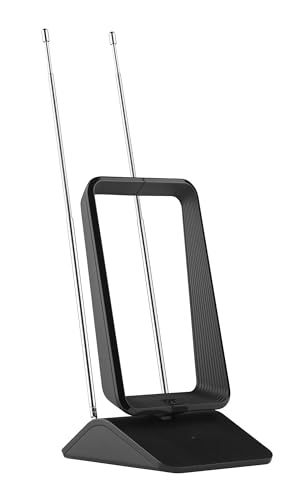
This compact antenna focuses on reliable Freeview reception within a shorter range, making it suitable for smaller living spaces where antenna placement is constrained. It includes an overload protection feature to prevent excessive signal amplification from causing picture distortion. Best for: Small apartments or rooms with limited space. Caution: Range is limited to around 15 miles, so distant stations may not come in clearly in all buildings.
Tuimiyisou Indoor Aerial with Amplifier Booster

This budget-friendly option markets a strong inline amplifier to help improve reception for more local channels. It’s best for readers seeking a cost-effective solution with a simple setup that still aims to deliver solid free-to-air HD content. Best for: Budget-conscious buyers who still want robust local-channel access. Caution: Claims of very long-range amplification may vary in practice based on building materials and location.
Buying Guide: Key Considerations For Indoor Freeview Aerials
Choosing the right indoor Freeview aerial involves evaluating your space, signal environment, and viewing goals. Consider these practical questions:
- What is my typical channel lineup and distance to broadcast towers?
- Is my living space prone to signal obstacles like thick walls or metal appliances?
- Do I need a flexible placement (indoor/outdoor) and a longer coax run?
- Is a built-in amplifier necessary, or can a passive antenna suffice?
- Do I prefer a compact design that fits a small room or a larger unit with long-range reach?
Signal Range and Coverage
Long-range antennas promise more local channels, but performance depends on building materials, height, and tower locations. Look for a model with a clear range specification and a signal-filtering feature to minimize interference.
Installation and Flexibility
Consider whether you need indoor-only use or an option for outdoor mounting. A longer coax cable can help you position the antenna away from electronics and structural obstructions for better reception.
Signal Quality vs. Convenience
Amplified antennas can improve reception in weak-signal environments but may over-amplify strong signals too. Indicates overload protections or adjustable gain help tailor performance to your space.
Portability and Use Case
For RVs, boats, or temporary setups, compact and magnetic-base designs offer practical advantages. Ensure the model supports your TV’s tuner standard (ATSC in the U.S.).
Compatibility and Cables
Check for a universal ANT/Cable setup and confirm the coax length meets your installation plan. Some models ship with sufficient length; others require an add-on extension.
Frequently Asked Questions
- Do indoor Freeview aerials require a power supply?
Most do not require external power; however, amplified models may use USB or wall power if needed for stronger signals. - Will an indoor antenna work with all TVs?
Indoor antennas with standard ANT or coax connections work with most modern Smart TVs and set-top boxes that support ATSC tuners. - How do I improve reception in a metal-filled room?
Try repositioning the antenna near a window, elevating it, or using a longer coax to place it away from metal surfaces. - Is longer coax better for reception?
Longer coax helps reach optimal placement but can introduce signal loss if the cable quality is poor. Use a high-quality coax and minimize unnecessary length. - Can I mount an indoor aerial outdoors?
Some models are designed for indoor/outdoor use, but ensure the product is rated for outdoor exposure and weather conditions before mounting outside. - Are there any maintenance tips?
Keep the antenna clean, avoid folding or bending delicate elements, and check connections if signal quality fluctuates.