Answer: A handheld VHF radio is essential for near-sh shore and offshore communication, personal safety, and quick vessel-to-vessel contact. This guide spotlights five top options and who they’re best for, so you can choose the right portable radio for your boat, kayak, or fishing trip. The top picks emphasize durability, water resistance, battery life, and user-friendly interfaces for skippers, anglers, and weekend boaters alike. Below is a quick at-a-glance table to compare core features and ideal use cases.
| Product | ||
|---|---|---|
| Standard Horizon HX210 | Serious boaters who need a reliable floating radio | IPX7 waterproof, large display, strobe light |
| Cobra BlueBound 350 (Orange) | Vessels requiring high-visibility and flexible power | High visibility buoyant core, 1/3/6 W power levels |
| Uniden Atlantis 275 | Rugged, feature-rich handheld with large screen | 6 W power, large dual-color display, emergency strobe |
| Uniden Atlantis 155 | Compact, all-American channels with strong display | Largest LCD in class, 10-hour battery, dual-color backlight |
| Retevis RM15 | Budget-conscious anglers and sea kayakers | IP68 waterproof, floating, 1 W speaker |
Standard Horizon HX210 6W Floating Handheld Marine VHF Transceiver
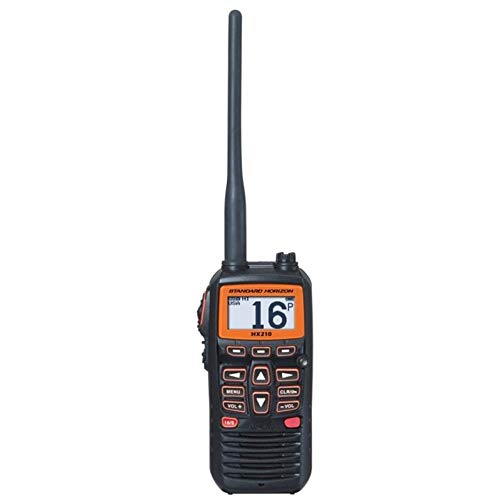
The Standard Horizon HX210 is a floating, submersible handheld VHF radio with a 3.3-foot (1 meter) IPX7 rating for 30 minutes. It features a water-activated emergency strobe, an oversized dot-matrix display, and an E20 Easy to Operate Menu System. Best for: boaters who need a reliable, user-friendly radio that stays operational after exposure to water.
Why selected: The combination of waterproof depth, floating design, and emergency signaling makes it well-suited for coastal or offshore use where quick recovery and visibility matter. Caution: The unit’s battery life varies with transmit power and display usage; plan for charging during long trips.
Cobra BlueBound 350 VHF Handheld Marine Radio (Orange)

The Cobra BlueBound 350 combines 6 W of VHF power with a high-visibility orange floating core for quick recovery if dropped. It offers a 1/3/6 W power switch for range management and battery efficiency, plus a Day/Night LCD display for readability in any light. Best for: anglers or day boats that need strong performance with easy retrieval in bright or dim conditions.
Why selected: Power flexibility and a floating, easy-to-find core help maintain contact distance across varying conditions. Caution: Some users may prefer larger screens on other models for readability in rough seas.
Cobra BlueBound 350 VHF Handheld Marine Radio – White

The White variant of the BlueBound 350 shares the same core features: 6 W power, a floating core for buoyancy, and a Day/Night display. Best for: users who want a color option that blends with certain vessel interiors or aesthetics while keeping core performance. Caution: Availability of color variants may vary by retailer.
Why selected: Color choice can matter for quick identification on deck in bright sun or low light, while performance remains similar to the Orange model.
Uniden Atlantis 275 Handheld Two-Way VHF Marine Radio
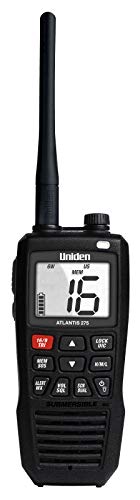
The Atlantis 275 operates at 6 W and includes an emergency strobe and a large 25 mm by 40 mm LCD display with dual color backlighting for day and night use. It targets anglers and coastal mariners who need robust features in a compact design. Best for: users who want a high-contrast display and strong transmission power for longer-range communication. Caution: The device’s weight is higher than ultra-compact models, which may affect handling on small boats.
Uniden Atlantis 155 Handheld VHF Marine Radio

The Atlantis 155 emphasizes a big, readable display with a dual-color backlight and 10-hour battery life, alongside IPX8 submersible rating. Best for: casual boaters who value a large display and long-day battery for routine coastal trips. Caution: While compact, it isn’t as feature-dense as the Atlantis 275, which could be a consideration for power users.
Retevis RM15 6W Marine Radio VHF IP68 Floating
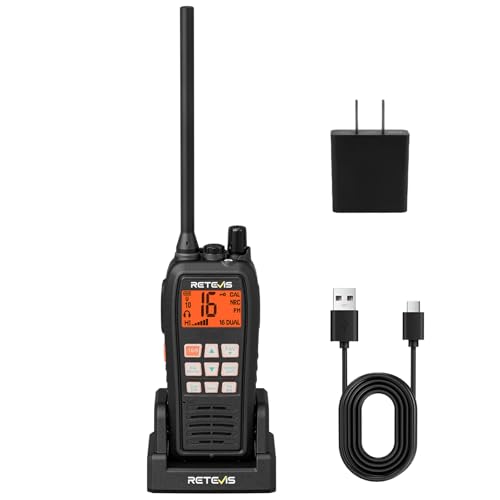
The RM15 offers IP68 waterproofing, 6 W power, and a floating design with water-activated alert. Best for: fishing and offshore outings where durability and quick location cues matter. Caution: As a more budget-friendly option, it may have fewer advanced features than higher-end models.
Buying Guide
What matters most when choosing a handheld VHF radio?
- Waterproofing and floating capability: IPX7/IP68 ratings and floating design protect against immersion and loss overboard.
- Transmit power: 1/3/6 W options extend range or save battery depending on proximity to shoreline stations.
- Display and readability: Large, high-contrast screens with day/night backlighting improve usability in sun or spray.
- Battery life and charging: Look for long-lasting batteries and easy charging options, including rapid chargers.
- Emergency features: Built-in strobe lights and flashlights can aid in signaling and locating devices.
- Channel coverage: Ensure devices support USA/International/Canadian channels and NOAA weather alerts if relevant.
- Size and weight: Compact radios are easier to carry, but some users may prefer larger displays and more rugged builds.
Practical buying considerations
- What environment will you use the radio in—coastal, offshore, or inland waterways?
- Do you need a color option for quick identification on deck?
- Is a loud, clear speaker and good microphone sensitivity important for your sea conditions?
- How important is a built-in flashlight or emergency signaling feature to your use-case?
FAQ
- What is a floating handheld VHF radio good for?
It stays buoyant if dropped and can continue to operate after water exposure, aiding recovery and communication on the water. - Do handheld VHF radios support NOAA weather alerts?
Many models include NOAA weather alert features, but confirm for each model you consider. - What power setting should I use for near-shore communication?
Typically 1 to 3 watts suffices for nearby stations; use higher power only if long-range contact is needed. - Are IPX ratings important for marine radios?
Yes. IPX7 or IP68 ratings indicate strong water protection against splashes, immersion, or submersion in brief intervals. - Is a larger display always better?
A larger display improves readability, especially in bright sun or rough seas, but may increase the device size.