Finding the right guitar volume pedal helps you sculpt dynamics on stage or in the studio without adding noise or sacrificing tone. This guide highlights five well-rounded options suited for different players—from compact board travelers to studio-focused purists. Whether you need passive operation, dual volume-or-expression control, or a trusted brand’s classic feel, these picks offer clear advantages for controlling volume swells, cueing effects, and mute transitions. Below is a quick comparison to help you choose the best fit for your setup.
| Product | Best For | Notes |
|---|---|---|
| Ernie Ball VP JR 250K | Passive signal players on compact boards | Mono control; taper switch for two swell rates |
| Ernie Ball 40th Anniversary | Collectors and players needing precise volume control | Limited edition finish; works with active or passive signals |
| Lefiko Volume & Expression Pedal | All-in-one volume and expression control | Passive design; silent tread; multi-application |
| SONICAKE Passive Volume & Expression EXP | Travel-friendly, versatile expression | Two functions in one; auto-detects function |
| Jim Dunlop Volume (X) Pedal | Full-size, reliable expression control | High cycle life; smooth action |
Ernie Ball VP JR 250K Volume Pedal

The Ernie Ball VP JR 250K is a compact, passive-volume pedal designed for smaller pedalboards. It provides a straightforward mono volume control and includes a taper switch to switch between two swell rates. This makes it well-suited for players who need precise swells without extra complexity. A key advantage is its compact footprint, which helps keep a tight rig arrangement. A potential limitation is that it focuses on mono volume control, so users seeking dual-function or expression control will want another option.
Ernie Ball 40th Anniversary Volume Pedal

The Ernie Ball 40th Anniversary Volume Pedal offers a limited edition black chassis with improved Kevlar cord for reliable, precise volume control. It is designed to work with both active and passive signals, making it a versatile choice for players who often switch between guitar setups or use pedals that require stable volume management. The anniversary edition emphasizes build quality, which can appeal to players who value a durable footswitch. Expect a compact footprint with a classic Ernie Ball feel, but note that availability may be limited due to its limited-edition status.
Lefiko Volume & Expression Pedal

The Lefiko Volume & Expression Pedal combines volume and expression control in one compact unit. It is fully passive, requiring no power supply, which simplifies setups and reduces noise. The smooth, silent tread movement is designed for quiet operation in studio sessions or live performances. This pedal is best for players who want a simple, dependable solution for both volume swells and effect parameter control and who appreciate a compact footprint. A limitation is that the functionality relies on a passive circuit, which some users prefer to supplement with a dedicated expression pedal in certain rigs.
SONICAKE Passive Volume & Expression EXP Pedal
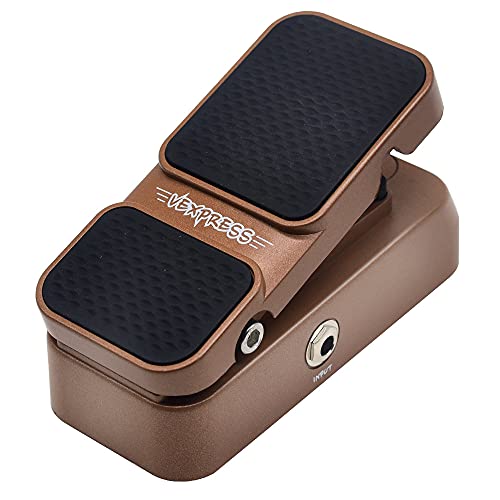
The SONICAKE EXP Pedal offers two functions in a single unit: passive volume control and expression control. It automatically detects which mode you’re using, simplifying setup for players who switch between volume swells and effect adjustments on the fly. It is a practical choice for players who employ ambient textures or space-saving pedalboard layouts. The dual-function design is convenient, though some players may prefer separate pedals for more precise control in highly complex rigs.
Jim Dunlop Volume (X) Pedal

The Volume (X) Pedal from Jim Dunlop provides full-size rocker control with dynamic volume and FX management. It enables expressive, real-time control over delays, modulation, and other effects, and it is built for a high cycle life—over one million cycles. This pedal is best for players who want robust, reliable performance for both live performances and studio sessions. A potential drawback is its larger footprint, which may not fit every compact board layout.
Ernie Ball VP JR 25K Volume Pedal

The Ernie Ball VP JR 25K is another compact option optimized for active signals. It features a 25K VPJR potentiometer and a tuner output, making it suitable for players who rely on active pickups and want a space-saving solution on smaller boards. Best for players seeking a compact, active-signal-specific pedal, while a limitation is that the 25K resistance may not suit all passive setups.
Buying Guide: Key Considerations for Choosing a Guitar Volume Pedal
- Passive vs. Active: Passive pedals require no power and are generally simpler, but some players prefer active controls for certain pickup configurations or effects chains.
- Volume vs. Expression: Decide whether you need pure volume control, real-time expression, or a combo pedal that covers both functions.
- Footprint and Build: Consider pedalboard space, weight, and durability. If you travel, compact designs may be preferable.
- Swell Rate and Taper: Some pedals offer multiple swell rates or taper options for more musical swells; this is important for dynamic playing styles.
- Compatibility: Check whether the pedal works with passive or active pickups, tuner outputs, or mute functions if you require silent transitions during performances.
- Reliability and Noise: Look for smooth, silent action and high-quality mechanical design to avoid unwanted noise during quiet passages.
FAQ
- What is a volume pedal best used for?
Volume pedals are used to shape dynamics, create swells, mute transitions, and control expression in a pedalboard setup.
- Should I choose passive or active for volume control?
Passive pedals are simpler and power-free, suitable for most setups. Active pedals can be advantageous with certain active pickups or complex rigs.
- Is a combined volume/expression pedal beneficial?
Yes, for players who want to save space and switch between volume and effect control without swapping pedals.
- Do volume pedals work with all guitar effects?
Most do, but ensure compatibility with your delays, reverbs, and modulation pedals, especially if you use a lot of DAW or amp-model effects.
- What should I consider for live use?
Choose a pedal with a reliable, silent action and a footprint that fits your board, plus a design that suits your power strategy (passive vs. active).