Looking for a guitar synth pedal that expands your sonic palette without breaking the workflow? This guide highlights five top options, showing who each pedal is best for, what makes them stand out, and any practical limitations. Ideal buyers include live performers seeking instant textures, studio players exploring experimental sound design, and beginners wanting expressive control.
| Top picks | Best use case |
|---|---|
| BOSS SY-1, SY-200, Electro-Harmonix options, and more | Guitarists and bass players seeking polyphonic synth textures for live use or studio work |
BOSS SY-1 Guitar/Bass Synthesizer Pedal

The BOSS SY-1 is a polyphonic synthesizer pedal designed specifically for guitar and bass. It provides a straightforward pathway to lush, analog-inspired tones with an integrated send/return loop for external effects and an expression or switch input for hands-free performance control. This pedal is best for players who want immediate, dependable polyphony with a compact form factor for pedalboards. A key limitation is that deeper, complex preset sculpting may require additional gear or familiarity with BOSS’s workflow to unlock nuanced textures.
- Best for: Players seeking a reliable, travel-friendly poly synth with seamless integration into standard pedalboards.
- Why chosen: Its polyphonic capability and straightforward controls make it a strong starter for synth textures on guitar or bass.
- Limitation: May require additional external controls for very nuanced sound shaping.
BOSS SY-200 Synthesizer Effects Pedal
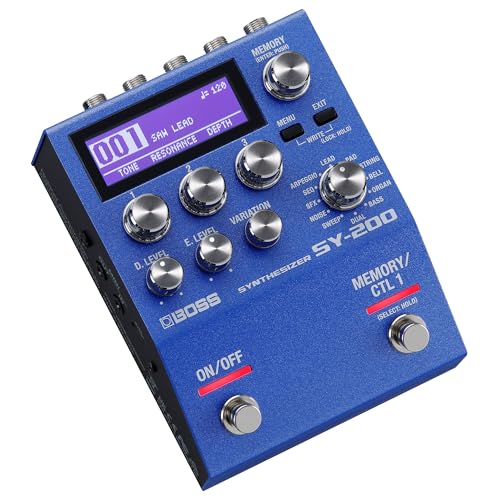
The SY-200 extends BOSS’s polyphonic guitar/bass synthesis into a compact 200-series format with a broader sound set. It features 128 memories for saving sonic creations, expanded tone-shaping options, and full MIDI I/O. Real-time control is enhanced by two onboard footswitches and compatibility with external footswitches, an expression pedal, and MIDI. This model is ideal for performers who want deep live control and a wide palette of presets in a small footprint. A potential drawback: the richer parameter set may require a longer learning curve for new users.
- Best for: Musicians needing a versatile, memory-rich poly synth with MIDI and external control options.
- Why chosen: Expanded sound set and practical real-time control suit versatile performances.
- Limitation: More features mean more parameters to learn for optimal use.
MXR Bass Synth

The MXR Bass Synth is designed for bass players seeking overt, sub-octave punch with a classic analog-inspired vibe. Collaboration with Ian Martin Allison helped shape a sound meant for heavy grooves and expressive envelope shaping. The pedal emphasizes thunderous sub-octave capabilities and lush modulation, making it a strong choice for bassists targeting big, immersive synth tones. It’s best for bass players who want strong low-end interaction and a bold, vintage character. Limitation: not optimized for guitar without adjustments or specialized settings.
- Best for: Bass players needing powerful sub-octave synth with a vintage feel.
- Why chosen: Delivers bold, groovy textures ideal for funk, fusion, and heavy styles.
- Limitation: Primarily intended for bass; guitar use may require experimentation.
Electro-Harmonix SYNTH9 Synthesizer Pedal

Electro-Harmonix SYNTH9 provides nine presets that emulate many classic synthesizer voices. It works on guitar or bass without modifications and does not require MIDI to function. The high tracking range covers most standard guitar registers, and it remains usable for bass as well. This option is best for players who want immediate access to a variety of iconic synth sounds with simple setup. Caution: some players may find the preset sounds less customizable than multi-parameter pedals.
- Best for: Players seeking a quick, no-fuss synthesis experience with classic tones.
- Why chosen: Nine emulated presets offer widely recognizable textures without extra hardware.
- Limitation: Limited parameter depth compared to broader-sound pedals.
Electro-Harmonix Mono Synth Guitar Synthesizer Pedal

The Mono Synth from Electro-Harmonix focuses on straightforward, guitar-ready synth tones with an expressive envelope and an optional expression pedal input for real-time control. It supports saving and recalling eleven user presets, one per synth voice, making it useful for performers who want a quick switch between distinct textures. Best for players who value simplicity and reliability over extreme deep-sound customization. Limitation: preset scope is limited to eleven voices, which may feel restrictive for advanced sound design.
- Best for: Guitarists who want quick, reliable synth voices with live-presence and preset recall.
- Why chosen: Clear interface and pedal-to-preset workflow suit stage needs.
- Limitation: Fewer customization options compared to multi-voice competitors.
Electro-Harmonix Bass Mono Synth Bass Synthesizer Pedal

This bass-focused Mono Synth offers easy control for bass players who want eleven synth voices with a real-time expressive pathway via an EXP pedal input. It mirrors the guitar Mono Synth experience but tailored for bass frequencies, enabling clean sub-octave and timbral shaping. Choose this if your priority is a simple, dependable bass synth with quick preset recall. Limitation: primarily designed for bass; guitar applications may require specific voicing choices.
- Best for: Bass players needing expressive, easy-to-use synth textures.
- Why chosen: Simple interface and fixed preset set are ideal for rapid tone changes.
- Limitation: Less suited for players seeking advanced synthesis control for guitar.
Buying Guide
- What’s your primary instrument? If you’re a guitarist, prioritize polyphonic options with guitar-friendly tracking (SY-1, SY-200). If you’re a bassist, look for sub-octave depth and strong low-end (MXR Bass Synth, Bass Mono Synth).
- How hands-on should controls be? If you want quick textures, choose presets you can save and recall (SYNTH9, Mono Synth). For deeper sound design, prefer models with expanded tone-shaping, envelopes, and MIDI (SY-200).
- Do you need MIDI or expression control? MIDI I/O and expression pedal support help live performances and complex rigs (SY-200). If not, simpler pedals (SYNTH9, Mono Synth) may suffice.
- How important is portability? Compact pedals with robust build fit small boards and quick setup (SY-1, SY-200). Larger, feature-rich units suit studio-focused rigs.
- What is your budget for tone? Multiple options cover a range from straightforward textures to expansive sound sets; balance features with expected use to avoid overpaying for unused capabilities.
FAQ
- Which pedal is best for live performance? The BOSS SY-200 and SY-1 are strong live options due to their real-time controls and reliable polyphony.
- Can these pedals work with bass guitars? Yes, several models are designed for bass, including the SY-1, SY-200, and MXR Bass Synth.
- Do these pedals require MIDI to function? Some models work well without MIDI (SYNTH9, Mono Synth), while others benefit from MIDI I/O for extended control (SY-200).
- Are there options with built-in memory? Yes, the SY-200 offers 128 memory slots for saving presets; the Mono Synth and SYNTH9 provide preset capabilities as well.
- Is analog-style tone possible? Many pedals emulate analog textures; choose based on the level of realism you desire and the versatility you need.