When you need a reliable PVC fabric glue, choose industrial-strength bonds that stay flexible and waterproof. This guide highlights top options for tarps, pool liners, inflatables, marine vinyl, and other PVC vinyl fabrics. The best picks are suited for professionals and DIYers who demand long-lasting repairs with underwater or challenging-weather performance. Below is a quick summary to help you compare key choices at a glance.
| Product | Best For | Key Benefit |
|---|---|---|
| HH-66 Vinyl Cement 4 oz | Tarps, pool liners, inflatables | Underwater bond, broad material compatibility |
| ARVYNE PVC Cement 4 oz | Heavy-duty PVC work | FAST-dry, high-strength flexible bond |
| HH-66 Toluene Free Vinyl Cement 1 oz | Environment-conscious projects | Safer formulation with same performance |
| Titebond PVC Trim Joint Adhesive | PVC trim and joint installations | High-strength permanent bond for trims |
| FITTDYHE Fabric Glue Permanent 60 ml | Fabric repairs and patches | Brush-on application, easy for fabrics |
HH-66 Vinyl Cement 4 oz

Product: HH-66 Vinyl Cement 4 oz by RH Adhesives. This industrial-strength vinyl adhesive bonds PVC and vinyl surfaces in temperatures from 35 °F to 95 °F (2 °C to 35 °C) and can be applied underwater. Once cured, it remains flexible from -30 °F to 150 °F (-34 °C to 66 °C). Best for tarps, pool liners, inflatable boats, and marine vinyl projects where a durable, flexible seam is essential.
- Best for: Heavy-duty PVC/vinyl repairs where submersion or wet conditions are likely.
- Why selected: Combines underwater applicability with long-lasting flexibility, reducing crack and seam brittleness over time.
- Caution: Requires proper surface prep for maximum adhesion; avoid environments outside specified temperature range during cure.
HH-66 Toluene Free Vinyl Cement 1 oz
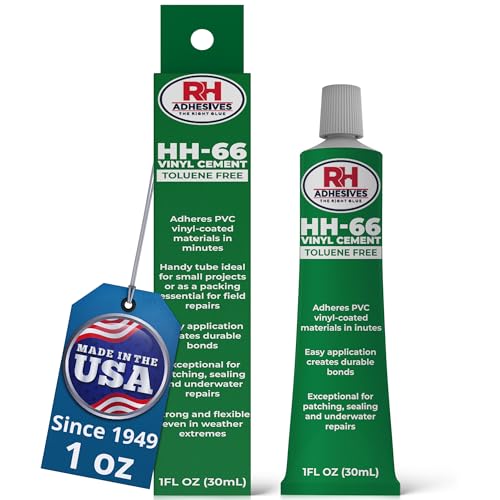
Product: HH-66 TF Toluene Free Vinyl Cement 1 oz by RH Adhesives. This safer variant omits toluene while preserving the same bond strength and underwater-capable performance. It remains flexible after curing and supports a wide range of PVC/vinyl fabrics.
- Best for: Projects requiring a safer solvent profile without sacrificing performance.
- Why selected: Safer for sensitive environments while delivering durable PVC/vinyl adhesion.
- Caution: Smaller quantity may require multiple applications for larger repairs.
Titebond 4 Oz. PVC Trim Joint Adhesive

Product: Titebond 4 Oz. PVC Trim Joint Adhesive. This adhesive is ideal for PVC joints, column wraps, miter joints, and shiplap installations. It provides a high-strength, permanent bond suitable for trim work and intricate PVC assemblies.
- Best for: PVC trim, miter joints, and column wraps where a discrete, lasting bond is needed.
- Why selected: Specifically formulated for PVC construction applications, offering reliable joint strength.
- Caution: Primarily designed for trim/rigid PVC; not optimized for flexible PVC fabric in all cases.
FITTDYHE Fabric Glue Permanent 60 Ml

Product: FITTDYHE Fabric Glue Permanent 60 ML. This fabric glue is washable, clear, and designed for a wide range of fabrics. It includes a brush-on applicator and clips to aid seam bonding, making it a practical choice for patches, hems, and repairs on cotton, denim, leather, polyester, and more.
- Best for: Fabric repairs where a needle-and-thread alternative is preferred, especially for hems and patches.
- Why selected: Easy-to-use brush-on application with a drying timeline suitable for household and craft use.
- Caution: Formulated for fabrics; not a dedicated PVC vinyl adhesive, so performance may vary on non-fabric PVC surfaces.
Buying Guide: PVC Fabric Glue Essentials
What to consider before buying
Surface type matters. For PVC vinyl fabrics, look for bonds designed to penetrate PVC and remain flexible after curing. If you expect submersion or exposure to water, choose waterproof or underwater-capable formulations. Temperature tolerance is important for outdoor projects or marine environments.
Bond strength vs. flexibility
Industrial vinyl cements like HH-66 deliver strong, flexible bonds that resist cracking. For fabric repairs, consider fabric-specific glues with brush applicators for precision, while PVC-focused adhesives prioritize bond to rigid or coated surfaces.
Application and cure considerations
Some products cure quickly while others require longer exposure to achieve full strength. If you’re repairing large patches or complex seams, a product with wider material compatibility and explicit cure times helps you plan effectively.
Safety and environmental impact
For projects sensitive to solvents, look for toluene-free options. Always follow ventilation and drying guidelines to minimize exposure during application and curing.
Compatibility and usage scenarios
Choose according to project type: tarps and pool liners benefit from underwater-bonding adhesives; trims and joints fit PVC-specific adhesives; fabric repairs favor brush-on fabric glues. If your project involves both PVC and fabric, a combination approach may be needed.
FAQ
- Q: Can these adhesives bond fabric to PVC surfaces?
- A: Yes, several products in this guide are designed to bond PVC and vinyl fabrics, with options like HH-66 and ARVYNE that specifically target PVC/vinyl substrates.
- Q: Are there safer, solvent-free options?
- A: Yes, toluene-free variants (such as HH-66 TF) provide comparable performance with a safer solvent profile.
- Q: Which glue is best for underwater repairs?
- A: HH-66 and HH-66 TF offer underwater bond capabilities, making them suitable for wet conditions.
- Q: Do fabric glues work for PVC trim projects?
- A: Fabric glues are designed for textiles; PVC trim joints typically benefit from PVC-specific adhesives like Titebond PVC Trim Joint Adhesive for structural joints.
- Q: Is a brush-on fabric glue better than a tube adhesive for PVC fabrics?
- A: Brush-on formats are convenient for fabric patches and seams; tube or nozzle applicators may be better for large PVC areas depending on surface.