Answering common buyer needs, these gas leak detectors identify methane, propane, natural gas, and other combustibles quickly to reduce risk. They’re suited for homeowners, RV enthusiasts, and DIYers who want fast alerts, easy probe access, and portable options for tight spaces. The top picks emphasize portable spot checks, indoor safety, and outdoor-friendly sensing. Below, compare five models that balance speed, sensitivity, and usability to help you choose the right tool for your situation.
| Product | Best For | Key Feature |
|---|---|---|
| TOPTES PT520A | Hard-to-reach spaces | 17-inch gooseneck probe |
| TOPTES PT199 | Budget portability | Ready-to-use with quick warm-up |
| KLEIN TOOLS ET120 | Residential and light commercial | Wide detection range |
| TOPTES PT177 | Compact RV and home use | Pocket-sized with auto-calibration |
| TopTes PT210S | Precise LEL readings | 4-inch probe and percent LEL display |
TOPTES PT520A Natural Gas Detector

Best for: users needing access to hard-to-reach leak sources. This detector has a 17-inch gooseneck probe that reaches tight spaces around pipelines, storage tanks, gas fireplaces, and basements. It detects methane, propane, natural gas, LPG, and butane, with a quick 0.5-second response and a 75dB alarm that intensifies with concentration. Detection range is 50-10,000 ppm for methane. A ready-to-use device with included batteries helps immediate safety checks.
Caution: Prolonged exposure to high concentrations may require additional ventilation before inspection is complete. Ensure the probe remains clean and free of debris to maintain accurate readings.
TOPTES PT199 Natural Gas Leak Detector
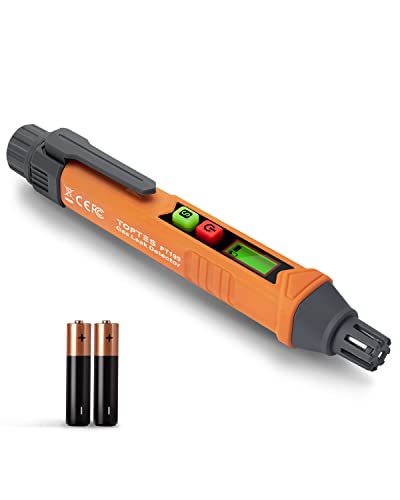
Best for: quick, portable sniffs in homes. The PT199 detects natural gas, methane, propane, butane, and LPG with a fast 0.5-second alarm. It includes 2x AAA batteries and shuts off after 5 minutes of inactivity. The LCD turns red at high gas levels, aiding quick decision-making. It’s a straightforward tool for routine checks around gas appliances and RV setups.
Caution: It requires a clean, gas-free start environment for accurate auto-calibration; warm-up and maintenance time should be factored into planning safety checks.
Klein Tools ET120 Gas Leak Detector

Best for: versatile detection with adjustable sensitivity. The ET120 covers a wide range from about 50 to 10,000 ppm (based on methane) and offers both High and Low sensitivity settings for precise readings in different environments. Five red LEDs provide visual alerts, and an 85dB audible alarm intensifies as gas concentration grows. It’s compact enough for pocket storage and field service use.
Limitation: The device’s performance depends on correct calibration and environment; ensure proper zeroing before measurements for consistent results.
TOPTES PT177 Gas Leak Detector

Best for: RV enthusiasts and homeowners seeking a compact detector. PT177 is pocket-sized with a 30-second warm-up and auto-calibration after powering on. It detects methane, propane, and other combustible gases with a 0.5–3 second alarm window and a 75 dB alert. LEDs intensify as gas concentration increases, making it easy to track leaks with minimal space.
Caution: The unit requires a clean environment for calibration; store in a bag to protect the sensor when not in use.
TopTes PT210S Gas Leak Detector

Best for: professionals and households needing precise readings with a fixed 4-inch probe. PT210S displays gas concentration in Percent LEL (two-digit) and uses a 75-dB audible alert with visual alarms. Detection ranges from 100 ppm to 5,000 ppm (1% LEL to 10% LEL). The portable pen design helps reach tight spaces and provides rapid 0.5-second detection.
Limitation: The device reports in LEL, which may require conversion familiarity for some users comparing to ppm readings across different gases.
Buying Guide
What should you consider when buying a gas leak detector?
- Detection targets: Ensure the model detects methane, propane, natural gas, LPG, and butane if you have multiple fuel sources.
- Probe length: Longer probes like 17 inches help reach recessed spaces; shorter models are more portable for quick checks.
- Response time and alarms: Look for sub-second detection and a loud audible alarm plus clear visual indicators for fast decision-making.
- Calibration and maintenance: Some units require auto-calibration after warm-up; others need manual calibration. Consider ease of calibration and battery life.
- Power and portability: Battery-powered detectors are ideal for RVs and remote areas; plug-in units suit home use with backup battery options.
- Display clarity: LCD readouts and color coding help users interpret gas levels quickly, especially under stress.
- Data logging: If you need records of alarm events, choose models with data logging features.
- Durability and environment: Consider weather resistance for outdoor use and rugged construction for job sites.
How to use a gas leak detector safely
- Power on, allow the device to warm up as specified, and calibrate if required.
- Probe toward suspected leak sources and move slowly to detect concentration changes.
- Follow local safety guidelines and evacuate if readings indicate high concentrations.
Frequently Asked Questions
- What is a typical detection range for home use? – Most detectors identify leaks from about 50 ppm to several thousand ppm, depending on the model and gas type.
- Can these detectors detect all types of gases? – They cover common combustible gases such as methane, propane, natural gas, and LPG, but check each model for exact gas coverage.
- Do I need calibration before first use? – Some units auto-calibrate after warm-up; others require manual zeroing to ensure accuracy.
- Are battery-powered detectors suitable for RVs? – Yes, many models include batteries and are designed for portable use in vehicles and homes.
- What should I do if a detector alarms? – Evacuate if necessary, ventilate the area if safe to do so, and contact a professional if leakage is suspected.
- How do I compare detectors quickly? – Compare gas type coverage, reaction time, probe length, alarm type, and whether it includes data logging or multiple sensitivity settings.