Flexible solar panels are a smart choice for travelers, boaters, and recreational campers who need lightweight, adaptable power. These panels bend to fit curved surfaces on RVs, boats, roof racks, and tents while delivering steady daily energy. The following picks are among the most relevant options for 12V and 24V systems, with a focus on portability, durability, and performance. This guide helps buyers decide which panel best suits their vehicle, climate, and charging needs.
| Product | Best For | Key Benefit | Limitations |
|---|---|---|---|
| DOKIO 400W Flexible Solar Panels, 4-Pack | Large off-grid setups | Scalable 400W set; flexible up to 30° | Requires ventilation; avoid mounting on combustible materials |
| BougeRV Arch Pro 200W | Low-light and shading environments | Bypass diodes for stable output | Open-circuit voltage may affect some power stations |
| Renogy Flexible Solar Panel 200W | Curved surfaces with high power needs | 240° bendability; high-efficiency PERC | Relative weight and cost considerations |
| Renogy Flexible Solar Panel 100W | Compact, lighter applications | All-black appearance; 240° bendability | Lower total output than larger panels |
| DOKIO 600W Flexible Solar Panels, 6-Pack | Expanded off-grid systems | Six 100W panels; flexible expansion | Heat management and ventilation are important |
Buyer type notes:
– If you need maximum output in a compact package, look at 100W–200W panels designed for curved surfaces.
– For larger vans, campers, or boats, consider 400W–600W configurations that can scale with series or parallel wiring.
– If shading is a frequent issue (partial sun, trees, or partial cloud cover), panels with bypass diodes or robust cell technology help maintain power delivery.
DOKIO 400W Flexible Solar Panels, 4-Pack

The DOKIO 400W four-panel set is designed for scalable 12V or 24V systems. Each panel is semi-flexible, bending up to 30° to fit curved van, boat, or camper surfaces. The set supports series or parallel connections depending on the charge controller and battery bank. This option is best for buyers building mid-to-large off-grid installations where weight and flexibility matter. A ventilation space is advised to prevent heat buildup, and mounting directly on combustible materials should be avoided. The main limitation is heat management and the need for appropriate mounting instructions on irregular surfaces.
- Best for: Mid-sized off-grid setups, RVs, or boats that require scalable power while maintaining flexibility.
- Why selected: Combines multiple panels to meet higher daily energy needs with adaptable wiring options.
- Caution: Ensure adequate ventilation and avoid placing cables under panels to prevent heat buildup.
BougeRV Arch Pro 200W Anti-Shading N-Type Fiberglass Flexible Solar Panel

The BougeRV Arch Pro 200W panel emphasizes stable output in challenging lighting. Its N-type design with advanced cell technology and bypass diodes helps maintain charge when portions of the panel are shaded. It supports wiring in series for higher voltages, which suits both 12V and 24/48V battery configurations. Potential buyers should note the open-circuit voltage range and confirm compatibility with their specific power station. This panel is best for users who encounter partial shading or variable sun.
- Best for: Shaded or inconsistent light environments where stable output matters.
- Why selected: Bypass diode technology improves energy capture in partial shade.
- Caution: Open-circuit voltage may impact compatibility with certain power stations; verify specs before purchase.
Renogy Flexible Solar Panel 200 Watt, 240° Ultra Flex Bendable

Renogy’s 200W flexible panel uses half-cut PERC cells to boost light capture and overall efficiency. Its 240° bendable design makes it suitable for curved rooftops on RVs or boats, with a lighter profile compared to rigid panels. This option is best for buyers needing substantial output from a single, flexible unit while maintaining a lower silhouette. The technology focus is on maximizing energy conversion, but users should account for installation surface flatness and mounting hardware compatibility.
- Best for: Larger curved surfaces where higher wattage from a single panel is desirable.
- Why selected: High-efficiency PERC cell technology improves daily energy yield.
- Caution: Weight and mounting hardware need careful planning on irregular surfaces.
Renogy Flexible Solar Panel 100 Watt, 240° Ultra Flex Bendable
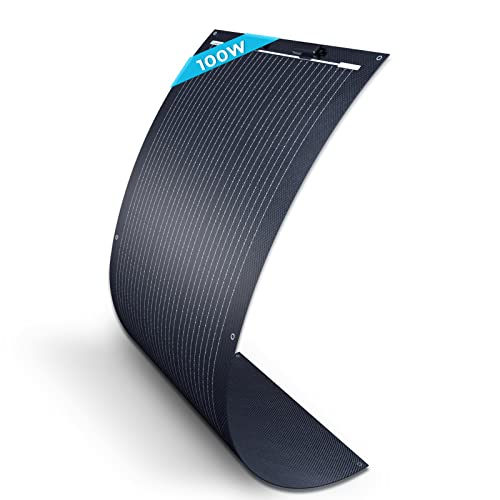
This 100W Renogy panel is a compact, all-black option designed for curved installations. Its 240° bendable range and light weight make it easy to install on boats, campers, or small RV sections. The panel utilizes half-cut PERC cells to sustain good performance in varied sunlight. It is best for buyers who want a lightweight, low-profile panel with decent daily output for smaller power needs. A trade-off is lower total wattage compared with higher-capacity panels.
- Best for: Lightweight, space-constrained applications needing steady 100W output.
- Why selected: Balance of portability and efficiency in a small footprint.
- Caution: Lower overall energy output than larger panels may require more surface area or additional panels for big loads.
DOKIO 600W Flexible Solar Panels, 6-Pack

The DOKIO 600W set comprises six 100W panels to maximize daily power input for larger off-grid needs. It supports series or parallel configurations, allowing flexible integration into existing systems. Ventilation and heat management remain essential considerations for any multi-panel array. Best used for expanding RV, camper, boat, or trailer solar capacity, this option suits buyers planning long-duration off-grid use. A limitation is the potential complexity of wiring multiple panels safely and efficiently.
- Best for: Expanding high-demand off-grid systems on RVs, boats, or trailers.
- Why selected: Scalable power with straightforward expansion paths.
- Caution: Proper wiring strategy and heat management are important for optimal performance.
Topunive 100W 12V Flexible Solar Panel (Single)

The Topunive 100W panel emphasizes extreme flexibility with a small bend radius to fit irregular surfaces. With 9BB monocrystalline cells, it offers higher efficiency and a compact footprint. This panel is best for buyers needing a single flexible unit that can conform to unusual shapes, such as boat decks, vehicle roofs, or tents. A caveat is that a single 100W unit may require additional panels for higher daily energy demands.
- Best for: Off-grid projects on highly irregular surfaces or where space is at a premium.
- Why selected: High efficiency in a compact, flexible form factor.
- Caution: May need supplementary panels for larger energy requirements.
Topunive 2-Pack 100W Flexible Solar Panels

This package provides two 100W flexible panels, offering a practical balance between portability and total output. The 9BB monocrystalline cells deliver solid conversion efficiency, with bendability suitable for numerous irregular surfaces. This pair is best for buyers who want more daily energy than a single 100W unit but still prefer a manageable, lightweight setup. A limitation is the total upfront footprint compared with larger single-panel options.
- Best for: Small-to-medium off-grid installations needing more wattage than a single panel.
- Why selected: Added output without overwhelming installation complexity.
- Caution: Monitor system voltage and wiring to maintain safe operation across multiple panels.
ECO-WORTHY 2 Pcs 130W Flexible Solar Panels (260W Total)

The ECO-WORTHY 130W panels are designed for curved surfaces with a focus on high efficiency and weather resistance. Each panel measures up to 270° flexibility, enabling deployment on many irregular surfaces on RVs, boats, cabins, or trailers. They are lightweight for easier handling and installation. Buyers should verify compatibility with their voltage requirements and ensure the mounting surface can accommodate the panel’s curvature. This option suits those needing substantial power while maintaining flexibility and weather resilience.
- Best for: Irregular surfaces and curved roofs requiring substantial 260W total output per pair.
- Why selected: High bending tolerance and robust efficiency for off-grid use.
- Caution: Ensure surface compatibility and proper mounting hardware for curved installations.
Buying Guide: Key Considerations For Flexible Solar Panels
- System voltage and configuration: Determine whether you are charging 12V, 24V, or 48V batteries and whether you need series or parallel wiring to reach the desired voltage and current.
- Flexibility vs. wattage: Higher wattage panels often have less bend radius flexibility. Match panel wattage to daily energy needs and available mounting space.
- Surface and mounting: Assess the surface curve, material, and mounting hardware. Avoid combustible surfaces and ensure ventilation to prevent heat buildup.
- Cell technology and efficiency: Panels with PERC cells or N-type technology tend to offer better efficiency, especially in partial shade or low-light conditions.
- Durability and weather resistance: Look for ETFE or tempered film, robust frames, and seals suitable for outdoor exposure and vibration.
- Portrayal of shading and light: For shaded or partially shaded environments, seek panels with bypass diodes or shading-tolerant design.
- Expansion potential: If future power needs may grow, choose panels that can be wired in series or parallel to scale capacity safely.
FAQ
- What is the advantage of flexible solar panels over rigid ones?
They conform to curved surfaces, are lighter, and easier to install on vehicles like campers and boats. - Do flexible panels require ventilation?
Yes, maintaining ventilation helps prevent heat buildup that can reduce efficiency and longevity. - Can I mix different brands of flexible panels in one system?
It is possible, but ensure similar voltage/current characteristics and proper controller compatibility. - How do I choose between 100W and 200W panels?
Consider daily energy needs, available mounting area, and whether you plan to expand with additional panels later. - Are there compatibility concerns with power stations or charge controllers?
Always verify open-circuit voltage and max input specs against your controller and battery bank. - What maintenance is required for flexible panels?
Keep surfaces clean, check for loose connections, and inspect seals to guard against water intrusion.