Having flexible solar panels means you can power RVs, boats, campers, and curved surfaces without sacrificing space or aesthetics. This guide highlights five top options, explaining who each is best for and why. Ideal buyers include: van lifers needing curved-surface performance, boaters seeking lightweight, weather-ready panels, and off-grid enthusiasts chasing durable, high-efficiency modules. A quick summary table below helps compare key points at a glance.
| Product | Powers (approx.) | Best For | Notes |
|---|---|---|---|
| BougeRV Arch Pro 200W | Up to 200W | Shaded or low-light conditions | N-type cells, bypass diodes |
| DOKIO 400W 4-Pack | 400W set | Curved surfaces, multi-panel installs | Series/parallel flexibility |
| Renogy 200W Ultra Flex | 200W | General off-grid use | 240° bend, half-cut PERC cells |
| Renogy 100W Ultra Flex | 100W | Lightweight, smaller spaces | High flexibility, 240° bend |
| Topunive 300W Flexible Bifacial | Up to 300W | Max output with light from both sides | 18BB cells, ETFE surface |
BougeRV Arch Pro 200W Anti-Shading N-Type Fiberglass Flexible Solar Panel

The BougeRV Arch Pro 200W uses N-Type 16BB cells and bypass diode technology to maintain stable output in partial shading or low-light conditions. Its higher conversion efficiency and robust construction aim at longer service life, making it suitable for frequent travelers and campers who face variable sun.
Best for: Off-grid users who encounter shading or inconsistent sun, and those who want reliable 12V or multi-battery setups when panels are wired in series. Choose this if you need steadier power in mixed lighting conditions.
Caution: The panel’s open-circuit voltage can vary (36V ± 5%), so verify compatibility with your power station before purchasing. Do not rely on it with systems outside that voltage range.
DOKIO 400W Flexible Solar Panels, 4-Pack

This 400W four-panel set is designed for scalable 12V systems. Its semi-flexible form supports up to 30° bending, making it a strong choice for vans, boats, and campers with curved roofs. Panels can be wired in series or parallel to suit different controllers and battery banks.
Best for: Buyers planning larger off-grid arrays on curved surfaces who want modular, expandable solar power. It’s especially suitable when you need a flexible kit that grows with your setup.
Caution: Ensure ventilation space to prevent heat buildup; avoid mounting directly on combustibles or trapping heat beneath the panels.
Renogy Flexible Solar Panel 200 Watt, 240° Ultra Flex Bendable

Renogy’s 200W panel combines high power with 240° bendability and a lightweight footprint, making it ideal for curved surfaces on RVs and boats. It uses half-cut PERC technology to improve light capture and efficiency while keeping installation simple and unobtrusive.
Best for: Those needing strong performance on curved surfaces without adding a lot of weight. This panel suits long, low-profile installations where glare-free appearance is preferred.
Caution: While flexible, ensure proper heat management; excessive bending or improper mounting can reduce lifespan over time.
Renogy Flexible Solar Panel 100 Watt, 240° Bendable
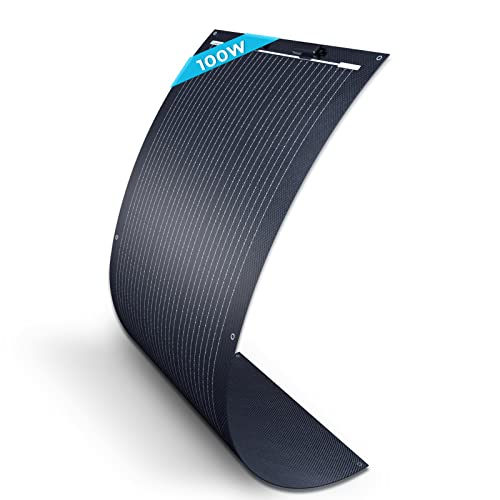
The 100W Renogy panel offers a compact, highly bendable solution for smaller spaces. It provides an average daily output around a practical range under good sun. The 240° flex design helps fit irregular surfaces on boats and RVs.
Best for: People with tight space or lower energy needs who still want the benefits of flexible, lightweight solar. It’s a good match for portable setups where full-size panels won’t fit.
Caution: Lower wattage means slower charging in cloudy days; plan for battery storage needs accordingly.
Topunive 300W Flexible Bifacial Solar Panel

This 300W panel uses bifacial 18BB monocrystalline cells and a dual fiberglass exterior with an ETFE surface, increasing durability and light capture. The transparent backsheet allows rear-side light collection, boosting output by up to 30% in optimal conditions.
Best for: Off-grid setups where maximizing sun exposure from multiple angles is important, such as RV roofs or boat decks with reflective surroundings. It is a fit for those prioritizing efficiency and long-term durability.
Caution: The higher efficiency comes with heavier construction; ensure mounting hardware supports the extra weight and wind loading.
Topunive 100W 12V Flexible Solar Panel

The 100W Topunive panel uses 9BB mono cells to deliver up to 23% efficiency in a very flexible form. It’s a reliable option for irregular surfaces and smaller off-grid projects, like vans or small campers. It includes pre-drilled holes for easy mounting.
Best for: Users needing a compact, flexible module with decent efficiency for modest energy budgets. It’s a practical choice for portable power on curved surfaces.
Caution: The long-term durability depends on proper mounting to avoid flex fatigue; avoid bending sharply near connectors or edges.
ALLPOWERS SF200 200W Flexible Solar Panel

ALLPOWERS SF200 delivers 200W with a 22–25% efficiency window, using ETFE-coated monocrystalline cells. At 3 mm thickness and around 4.1 kg, it bends up to 30 degrees for curved surfaces and mobile applications, including RVs and boats.
Best for: Buyers seeking a high-efficiency, ultra-thin option for complex roof profiles or portable setups where weight matters. It suits RVs and off-grid ventures requiring flexible installation without bulk.
Caution: While robust, ensure compatible mounting to accommodate its thin profile and maintain heat management in full sun exposure.
Buying Guide: Flexible Solar Panel Buyer’s Checklist
What should you consider for curved surfaces?
Look for panels with high bendability (up to 240° or 30°+) and a lightweight frame. Thin, flexible designs reduce wind load and installation complexity on RVs, boats, and trailers.
Which cell technology matters?
Monocrystalline cells generally offer higher efficiency. Half-cut or newer N-type cells can improve performance under shade and high temperature, but verify compatibility with your controller and battery bank.
What about durability in the outdoors?
ETFE coatings outperform PET in abrasion resistance and self-cleaning properties. Double fiberglass layers and anti-scratch surfaces extend panel life in rugged environments.
Do I need bifacial output?
Bifacial panels capture light from the front and back, boosting output in reflective environments. They are best when installation locations have strong rear lighting or photo-reflective surroundings.
How should you install and maintain?
Allow ventilation around panels to prevent heat buildup. Do not mount directly on combustibles. Ensure proper mounting hardware to withstand wind and movement. Use appropriate connectors and weatherproofing for reliability.
What is the right size for my system?
Match panel wattage to your battery capacity and expected daily runtime. For smaller setups, a 100W–200W panel may suffice; for larger van or RV systems, a 300W–400W configuration can be appropriate when combined with a robust charge controller.
Electrical compatibility: What to check?
Confirm open-circuit voltage and maximum power voltage align with your charge controller and battery bank. Some high-voltage panels may require compatible inverters or controllers.
Maintenance tips
Clean panels as needed with mild soap and water. Inspect for delamination, cracks, or loose wiring. Store spare connectors and ensure ETFE surfaces stay free of scratches or debris that could reduce performance.
Summary: quick decision guide
- Best for shading tolerance: BougeRV Arch Pro 200W
- Best for scalable multi-panel setups: DOKIO 400W 4-Pack
- Best for curved RV/boat surfaces: Renogy 200W Ultra Flex
- Best lightweight option: Renogy 100W Ultra Flex
- Best for maximum rear-light gain: Topunive 300W Flexible Bifacial
FAQ
- Can flexible panels power a portable power station? Yes, if the panel’s voltage and current match the station’s input specs.
- Are flexible panels more fragile than rigid ones? They are lighter and more adaptable but can be prone to cracking if bent too aggressively or mismounted.
- Is bifacial power worth it on a RV roof? It can offer higher output in reflective environments, but real-world gains depend on installation and lighting conditions.
- Do all flexible panels require ETFE? Not all, but ETFE coatings improve durability and self-cleaning properties for outdoor use.
- What is the best way to store flexible panels when not in use? Keep them in a cool, dry place and avoid heavy compression or bending beyond recommended radii.
- How do I verify compatibility with my controller? Check max input voltage, current rating, and whether the panel’s open-circuit voltage remains within your controller’s limits during full sun.