Answering the needs of cooks who want powerful, quiet ventilation, this guide spotlights five top kitchen extractor fans. These picks are ideal for apartment living, open-concept spaces, and home chefs who need strong odor and smoke removal without intrusive noise. Each option is suitable for either ducted or ductless setups, depending on your space. Below, compare who benefits most from each model and why it stands out.
Summary Table
| Product | Best For | Key Benefit | Installation |
|---|---|---|---|
| COMFEE’ Range Hood 30 Inch | Condos and apartments | 2-filter setup with ducted/ductless options | Ducted/Ductless |
| SNDOAS 30 Inch Under Cabinet Hood | Budget-conscious kitchens | Two-speed exhaust with LED lighting | Ducted/Ductless |
| AMZCHEF 30″ Under Cabinet | Home cooks needing power | 750 CFM, LED lights, remote control | Ducted/Ductless |
| Soonye 30 Inch Wall Mount | Open kitchens | 450 CFM with three speeds | Ducted/Ductless |
| Zomagas 30 Inch Under Cabinet | Slim spaces | Space-saving slim design with 280 CFM | Ducted/Ductless |
COMFEE’ Range Hood 30 Inch Under Cabinet

This 30-inch hood offers both ducted and ductless modes with two exhaust speeds. It utilizes a dual-filter system: an aluminum mesh and activated carbon filter for ductless use, plus a durable aluminum mesh filter for ducted setups. The stainless steel body is slim and easy to clean, suited for condo kitchens or apartments with limited space. Best for buyers needing flexible installation and improved air quality without heavy upfront cost.
Best for: small to mid-sized kitchens in apartments or condos where ductwork may be limited. Why selected: combines filter versatility with a compact form and quiet operation. Caution: replacement filters should be found and swapped about every 3–4 months for optimal performance.
Range Hood 30 Inch Under Cabinet, 280CFM

With a slim stainless steel profile, this 30-inch hood saves space while delivering up to 280 CFM. It includes a 3-layer grease filter comprising aluminum mesh and activated carbon, which helps purify air in ducted or ductless installations. The rocker switch control is straightforward, and the kit is designed for easy replacement of filters. Best for: smaller open kitchens where space is at a premium. Why selected: a good balance of performance and footprint. Caution: filter replacement parts may require separate purchase.
AMZCHEF 30″ Under Cabinet Range Hood

This 30-inch hood uses 430-grade stainless steel for durability and easy cleaning. It features a three-speed fan and bright LED lighting, with both touch and remote control options for convenient operation. The design aims to balance high suction with relatively quiet performance for busy kitchens. Best for: cooks who want strong extraction plus modern control options. Why selected: robust build and power make it suitable for larger cooking tasks. Caution: ensure proper wiring and clearance for remote control use.
Soonye 30 Inch Wall Mount Hood
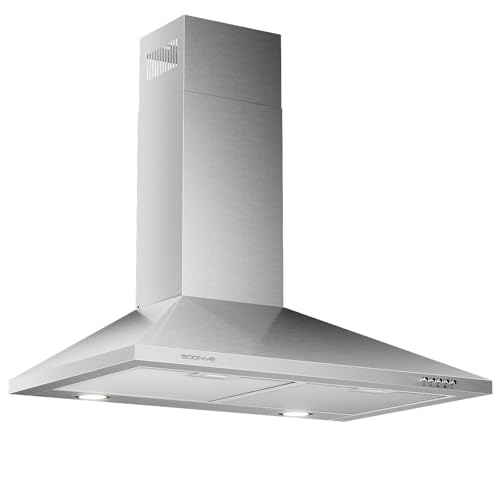
This wall-mount model delivers up to 450 CFM across three speeds, with LED lighting for clear cooking visibility. It supports both ducted and ductless installations, making it flexible for varying layouts. The combination of strong airflow and a relatively quiet operation makes it a practical option for open kitchens. Best for: homes needing a high-capacity hood without a full wall-rebuild. Why selected: strong ventilation in a compact footprint. Caution: noise levels can approach higher ranges at maximum speed.
Buying Guide: How To Choose The Right Kitchen Extractor Fan
- Installation Type: Decide between ducted versus ductless. Ducted offers stronger venting but requires ductwork; ductless is easier to install in older spaces but uses filters that need periodic replacement.
- CFM Requirements: Higher CFM suits high-heat cooking and larger spaces. For compact kitchens, 200–280 CFM is often sufficient, while open kitchens may benefit from 450 CFM or more.
- Filtration: Look for a combination of grease filters and carbon filters for odor control. If you have ductless use, carbon filters become essential.
- Noise Levels: Check dB ratings; quieter models are preferable for open living areas, though higher suction can increase noise.
- Controls And Lighting: Touch controls or remote options provide convenience. LED lighting improves visibility on the cooktop and energy efficiency.
- Space And Design: Measure cabinet depth and height. Slim or low-profile hoods save space in small kitchens and apartments.
- Maintenance: Aluminum mesh filters are common; carbon filters require replacement. Choose models with dishwasher-safe components when possible to simplify cleaning.
Frequently Asked Questions
- What is the difference between ducted and ductless range hoods?
Answer: Ducted hoods vent air outside, typically offering stronger extraction. Ductless hoods recirculate air through filters inside the kitchen, easier to install but require regular filter changes. - How many CFM do I need for a typical home kitchen?
Answer: For everyday cooking in a standard kitchen, 200–350 CFM is common. Larger spaces or heavy cooking may benefit from 450 CFM or more. - Are filter replacements necessary for ductless models?
Answer: Yes. Carbon and grease filters in ductless setups help remove odors and grease and should be replaced per the manufacturer’s schedule. - What maintenance helps prolong hood performance?
Answer: Regular cleaning of filters, wiping the hood surface, and ensuring ductwork (if used) remains clear of obstructions. - Is a remote control hood worth it?
Answer: Remote controls can offer convenience, especially when you cook with hands full. It’s a personal preference and depends on your kitchen setup. - Can these hoods be installed in apartments?
Answer: Yes, many models support ducted or ductless configurations and slim designs suitable for apartment kitchens.