Looking for an EV charging cable that fits your needs at home, on the road, or at a friend’s house? This guide highlights five portable, adjustable, and reliable Level 1 & 2 EV chargers. Each product is suited for different drivers—from weekend campers needing long cables to daily commuters requiring smart timing and wide outlet compatibility. The table below compares key specs to help you choose quickly.
| Product | Best For | Key Feature | Outlet Type |
|---|---|---|---|
| Bokman Portable Level 1&2 EV Charger | Travelers and apartment dwellers | 6/8/10/12/16A levels; 20 ft cable; LED display | NEMA 5-15 / 6-20 adapters |
| 2026 Upgraded Raylix Level 1&2 Charger | All SAE J1772 EVs; smart scheduling | 4-level current; 1–12 hr delay; fast 4× charging | J1772 outlets |
| EVDANCE Level 1&2 EV Charger | Compact, long reach; mixed outlet use | 25 ft cable; NEMA 6-20 and 5-15 adapters | 5-15/6-20 switches via adapters |
| Flexible home charging; travel | 4 current levels; dual plug compatibility | NEMA 6-20 / NEMA 5-15 | |
| Budget-friendly all-purpose charger | 0–12/16 A; LCD readout; 25 ft | NEMA 6-20 / 5-15 adapters |
Bokman Portable Level 1&2 EV Charger

The Bokman charger is designed for both home charging and travel. It includes a 20 ft heavy-duty cable and a NEMA 5-15 adapter for simple plug-and-play use. The device supports Level 2 charging with selectable 6/8/10/12/16A settings, allowing you to match your garage grid to your vehicle’s needs. Real-time data is shown on a tactile LED display, and the unit locks in a preferred setting to avoid reconfiguration.
Best for: Drivers who want a straightforward, app-free experience with a long cable for parking flexibility. Suitable for apartment dwellers and road trips where a simple, reliable charger is preferred. Caution: No app control means less automation for scheduling charging beyond the built-in timer.
Raylix 2026 Upgraded Level 1&2 EV Charger

The Raylix charger emphasizes smart scheduling with a 1–12 hour delay timer and four adjustable current levels (8A/10A/12A/16A). It’s compatible with all SAE J1772 EVs and plug-in hybrids, making it a versatile choice for home charging and travel. The advertised claim of up to four times faster charging compared to Level 1 is centered on 16A Level 2 capability, which shortens daily charging times.
Best for: Buyers seeking smart charging with schedule-based energy savings and broad vehicle compatibility. Limitation: Some users may need to ensure their vehicle supports the 16A Level 2 rate for maximum benefit.
EVDANCE Level 1&2 EV Charger

The EVDANCE model offers a 25 ft cable with both NEMA 6-20 (for 16A 240V) and a 5-15/5-20 adapter for 12A at 120V. It is compatible with standard J1772 vehicles and provides flexibility to operate from either 120V or 240V outlets. Its design supports traveling charging needs by covering common outlet configurations and reducing the need for multiple adapters.
Best for: Users who want a single, portable charger that covers both Level 1 and Level 2 scenarios and frequently moves between outlets. Caution: Tesla vehicles require a separate J1772 adapter for charging, which is not included.
BETUMODA Level 1 EV Charger (25 ft)

The BETUMODA charger features four adjustable current levels (8A/10A/13A/16A) with a 25 ft cable and dual plug compatibility. It supports NEMA 6-20 for Level 2 charging and NEMA 5-15 for Level 1 charging. A built-in delay timer (1–12 hours) helps optimize charging during off-peak hours, and the unit is designed for simple plug-in use without complex setup.
Best for: Home users who want flexible Level 1 and Level 2 charging in one compact unit. Limitation: The note about 5-15 adapter compatibility is specific; ensure you do not exceed rated currents on 5-15 outlets to protect the circuit.
BETUMODA Level 1 EV Charger, 25ft
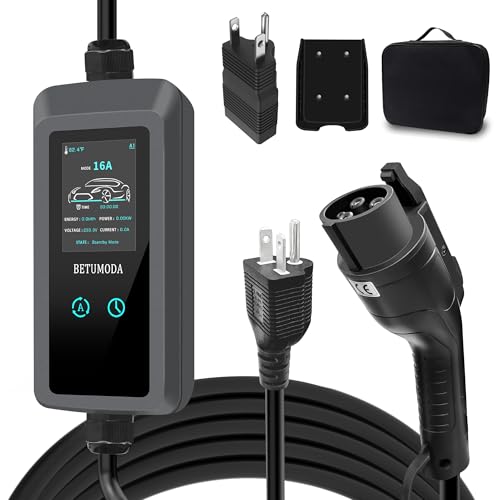
This BETUMODA model provides three levels of charging with four current settings (8A/10A/13A/16A) and a 25 ft cable for reach. It is designed to work with both SAE J1772 vehicles and plug-in hybrids, aiming to balance home charging flexibility with travel readiness. A 1–12 hour intelligent delay timer helps minimize energy costs at off-peak times.
Best for: Buyers who want a robust, travel-ready charger with long reach and smart timing. Caution: The adapter compatibility guidance should be reviewed to ensure the right plug configuration for your outlets.
Grasside 2026 Level 1&2 EV Charger
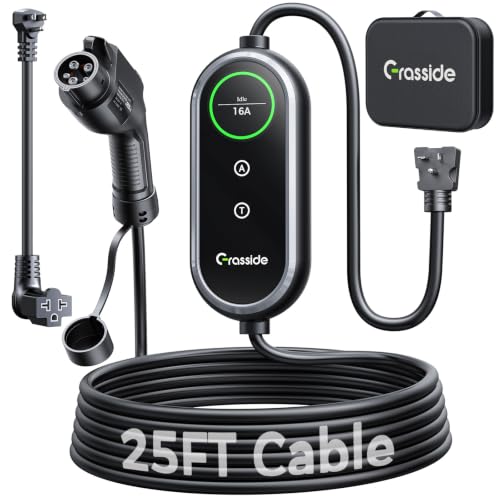
Grasside emphasizes universal J1772 compatibility with a 25 ft cable and LCD display for real-time voltage, current, and charging status. It supports Level 1 (8–12A) and Level 2 (16A), with a 0–12 hour delay timer for scheduling charging during off-peak hours. A NEMA 6-20 plug and NEMA 5-15/5-20 to 6-20 adapter expand outlet compatibility.
Best for: Budget-conscious buyers seeking a flexible, all-purpose charger for home and travel. Limitation: Some installations may require adapters for specific EV models beyond J1772 compatibility.
Buying Guide
What to consider when choosing an EV charging cable
- Outlets and compatibility: Ensure the charger supports your outlets (NEMA 5-15, NEMA 6-20, NEMA 14-50, etc.) and is compatible with your vehicle’s J1772 standard or requires an adapter for Tesla.
- Current and power: Look at adjustable current levels (8A–16A–40A) and the resulting charging speed. Higher amperage offers faster charging where allowed by your home circuit.
- Cable length: Choose a length that fits typical parking distances. Longer cables provide flexibility but add weight and storage considerations.
- Portability vs. fixed installation: Portable chargers are ideal for travel; fixed units suit a dedicated home charging corner.
- Smart features: Timers and scheduling can lower electric costs by charging during off-peak hours. Some models omit app controls for simplicity; others rely on smart scheduling.
- Display and usability: A clear LED/LCD readout helps monitor live voltage/current and status, especially in poor weather or low-light conditions.
- Safety and wiring: Ensure the charger is designed to work with your vehicle’s power needs and that installation adheres to local electrical codes.
Frequently Asked Questions
- What is the difference between Level 1 and Level 2 charging?
Level 1 uses 120V outlets at lower current; Level 2 uses 240V outlets with higher current for faster charging. - Do these chargers work with all EV models?
Most are SAE J1772 compatible; Teslas may require adapters. Check the product details for compatibility notes. - Is a long cable better for home use?
A longer cable offers flexibility in parking arrangements, but it can be heavier and harder to store. - Do I need a Wi‑Fi connection to use these chargers?
Most listed devices function without apps; some offer smart scheduling via built-in timers. - Can I use these chargers outdoors?
Check the product’s weather resistance or enclosure details to confirm outdoor suitability. - What should I do if my outlet is different from the charger’s plug?
Use the appropriate adapter that matches the outlet and charger rating, ensuring it maintains safety.