Finding the right camping power station means matching portable power with your gear. This guide highlights five compact, reliable options ideal for campers, hikers, and weekend explorers who need dependable off-grid electricity for laptops, cameras, CPAPs, and small appliances. Each product is evaluated for portability, output, battery life, and practical limits, so you can choose based on your typical camping setup and energy needs. The included summary table helps compare key specs at a glance.
| Product | Capacity | Output | Weight | |
|---|---|---|---|---|
| Jackery Explorer 300 Portable Power Station | 292 Wh | 300 W rated (600 W peak) | 7.5 lb | Laptops, drones, cameras; ultra-lightweight hikers |
| Jackery Explorer 1000 v2 | 1,070 Wh | 1,500 W | 23.8 lb | Home backup and multi-appliance camping |
| ALLWEI Portable Power Station 300W | 256 Wh | 300 W continuous, 600 W peak | Not stated | Budget-friendly power for multiple devices |
| EnginStar Portable Power Station 300W | 296 Wh | 300 W | 6.5 lb | Compact solar-ready power for CPAP and laptops |
| Jackery Solar Generator 300 | 292 Wh | 300 W | 7.5 lb | Solar-ready, lightweight camping power |
Jackery Explorer 300 Portable Power Station

The Explorer 300 uses LiFePO4 chemistry for durability and longevity. It provides 2 AC outlets, a 100W USB-C PD port, 2 USB-A ports, and a 120W car port, with a 300W rated output and 600W peak surge. Best for ultralight hikers and campers who need reliable off-grid power without added weight. The 7.5-pound design and integrated handle support easy transport. A potential limitation is the 292Wh capacity, which may require solar charging for extended off-grid adventures.
Jackery Explorer 1000 v2 Portable Power Station

The Explorer 1000 v2 delivers 1,500W continuous output and 3,000W surge with a 1,070Wh capacity. It weighs about 23.8 lb and includes a foldable handle for transport. It also supports rapid charging via the Jackery app for emergency situations and offers a long lifespan thanks to a durable LiFePO4 battery, maintaining substantial capacity after thousands of cycles. This model suits users who need more power for appliances like ACs and refrigerators during camping or emergencies, though it is heavier and bulkier than smaller options.
ALLWEI Portable Power Station 300W
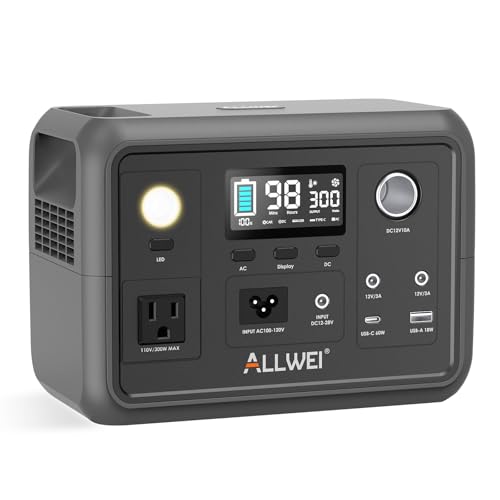
The ALLWEI unit provides 256Wh with 300W continuous and 600W peak, suitable for charging laptops, mini fridges, CPAP machines, and drones. Its LiFePO4 chemistry promises up to about 3,000 charge-discharge cycles, supported by a solid Battery Management System. It includes multiple outputs: AC, DC, USB-A, and USB-C, allowing six devices to run simultaneously. Choose this if you want better value with multiple charging options, but note the lack of weight specification for a precise portability comparison.
EnginStar Portable Power Station 300W

EnginStar emphasizes portability with a compact 9 x 5.5 x 7.5-inch design and 6.5-pound weight, yet it offers 296Wh and a 300W AC output. It includes two 110V pure sine wave outlets, two regulated DC outputs, and USB-C/USB-A ports. Its Battery Management System protects against short circuits and overcharging, making it suitable for travelers who need dependable backup power for phones, laptops, cameras, and CPAP devices. Best for those who want a versatile, travel-friendly option with strong safety features, but check availability of panels for solar charging compatibility.
Jackery Solar Generator 300 and 40W Panel

This option combines a 292Wh Explorer 300 with a 40W solar panel, creating a lightweight solar-powered camping solution. It offers the same 2 AC outlets, 100W USB-C PD, USB-A ports, and 120W car port, plus LiFePO4 durability for long service life. Best for campers who want an all-in-one solar kit and enjoy charging devices directly via solar panels. Caution: solar charging performance depends on sunlight, panel orientation, and environmental conditions, which may limit charging speed in shaded or overcast conditions.
Buying Guide
Key purchase considerations help match a power station to your camping style.
- Power needs: List essential devices and their wattage. Prioritize higher-output stations for fridges or CPAP devices.
- Portability: Weigh options to fit your hiking or backpacking plans. Lighter units are easier to carry but may offer less capacity.
- Battery chemistry: LiFePO4 chemistry offers longer life and safer operation. Consider cycles and expected lifespan.
- Output versatility: Look for multiple AC outlets, USB-C PD, USB-A, and car ports to cover laptops, cameras, and small appliances.
- Charging options: Availability of fast charging, solar input, and pass-through charging matters for extended trips.
- Durability and safety: A robust Battery Management System reduces risk during charging and use in varying temperatures.
FAQ
- What capacity is best for weekend camping? A unit around 250–700 Wh suits most weekend trips for phones, lights, and small devices.
- Is LiFePO4 better than other chemistries? Yes, for longevity and safety; it typically lasts longer with more charge cycles.
- Can I use solar panels with these stations? Most models support solar input; panel compatibility varies by model, so check panel wattage and connectors.
- Will a heavy power station be worth it? For multi-day trips with fridge or CPAP use, a higher-capacity model reduces recharging frequency.
- Do these stations power high-watt appliances? Some models can handle up to 1,500 W or more; verify continuous and surge ratings for each device.
- Do I need a separate solar panel? A dedicated solar panel kit simplifies charging, especially when outlets are not available.