Answering the buyer’s search, this guide highlights top camera sensor cleaning kits that balance safety, effectiveness, and ease of use for both beginners and enthusiasts. These kits are best for photographers who frequently change lenses, travel with gear, or shoot in dusty environments. The selections emphasize full-frame and APS-C sensor compatibility, non-irritating cleaners, and careful swab designs to minimize risk to sensor coatings. Below is a quick buyer’s table, followed by in-depth product sections and a practical buying guide.
| Product | Best For | Sensor Type |
|---|---|---|
| K&F CONCEPT 24mm Full Frame Sensor Cleaning Kit | Full-frame photographers needing 24mm swabs | Full-Frame |
| K&F CONCEPT APS-C Sensor Cleaning Kit | APS-C cameras, budget-friendly | APS-C |
| UES Full-Frame Sensor Cleaning Kit | Long-trusted, multi-piece set | Full-Frame |
| VSGO DKL-20F Sensor Cleaning Kit | Comprehensive tools for careful cleaning | Full-Frame |
| Altura Photo Cleaning Kit | All-in-one kit with protective case | Full-Frame |
K&F CONCEPT 24mm Full Frame Sensor Cleaning Kit
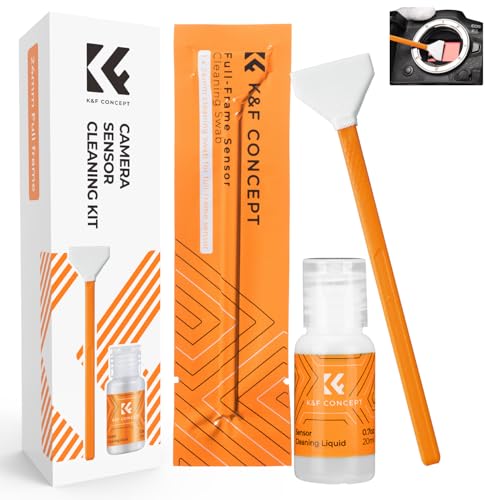
This kit targets full-frame sensors with 24mm swabs, designed for precise, safe cleaning. The 6 pieces of 24mm swabs are vacuum-packaged, lint-free, and feature a flexible grip that keeps the head close to the sensor without risk. The included cleaning liquid is colorless, ammonia-free, and low-VOC, protecting coatings while removing dust and smudges. Use 1–2 drops on the swab edge and sweep carefully at an angle, then reverse for a final pass. Best for: full-frame shooters who want a compact, sensor-specific solution and a gentle cleaner for sensitive coatings.
Best for: photographers who routinely work with full-frame bodies and need precise swabs sized to 24mm. Caution: follow the “edge of the swab” application guidance to avoid excess liquid near sensor edges.
K&F CONCEPT APS-C Sensor Cleaning Kit

Designed for APS-C cameras, this kit includes 6 pieces of 16mm sensor cleaning swabs, laser-cut for clean, lint-free performance. The cleaning fluid is colorless, non-irritating, and ammonia-free, suitable for various sensor types. The swabs are vacuum-packaged to minimize dust exposure before use. How to use mirrors the 24mm version: apply 1–2 drops to the swab edge, sweep the sensor carefully, then reverse. Best for: APS-C shooters seeking a compact, sensor-specific option at a reasonable price.
Best for: APS-C users who want a dedicated 16mm swab set with a safe cleaner. Caution: ensure you use the correct swab size to avoid oversizing the sensor area.
UES Full-Frame Sensor Cleaning Kit

UES provides a long-standing, trusted option with 14 pieces of swabs and a 15ml sensor cleaner. The kit emphasizes safety for CMOS/CCD sensors and IBIS systems, with individually vacuum-sealed swabs to prevent contamination. The cleaner is designed to lift dust and smudges without harming coatings, and the flexible swab handle supports controlled pressure for full-frame cleaning. Best for: photographers who value a proven, safe method with a decently sized cleaning set. Caution: practice gentle, even pressure to avoid streaks on delicate coatings.
VSGO DKL-20F Sensor Cleaning Kit for Full Frame

VSGO’s DKL-20F kit features a mini air blower for dust removal, a dual-tip lens cleaning pen (carbon tip for fingerprints and a filament brush for crevices), and two cleaners (lens and sensor) with a microfiber cloth. The kit emphasizes careful, gentle cleaning without scratching. Best for: photographers who want a multi-tool kit that covers both lens and sensor cleaning with portable tools. Caution: ensure the carbon tip and brush are fully dry before reuse to prevent smearing.
Altura Photo Cleaning Kit

Altura Photo’s kit provides a complete, all-in-one solution with dry sensor swabs, a natural cleaning solution, air blower, lens pen, brush, tissues, and microfiber cloths, all in a protective hard case. The solution is alcohol- and ammonia-free and formulated to reduce static. Best for: users seeking an organized, full-package kit that minimizes the need to buy add-ons separately. Caution: verify the solution’s all-natural claim and its compatibility with your camera coatings before use.
Buying Guide
What should you consider when choosing a camera sensor cleaning kit?
- Sensor size compatibility: Full-frame kits use larger swabs (24mm) while APS-C kits use smaller swabs (often 16mm). Choose according to your camera’s sensor.
- Cleaning fluid safety: Look for ammonia-free, low-VOC formulas to minimize coating risk and user exposure. Fluid quality affects residue, streaks, and static.
- Swab design: Flexible handles and lint-free swabs reduce the chance of scratches and ensure even pressure across the sensor.
- All-in-one vs. modular: All-in-one kits offer convenience; modular kits let you replace individual components as needed.
- Storage and portability: A hard case or vacuum-sealed components help protect parts from dust between shoots or trips.
- Ease of use for beginners: Kits with clear instructions and simple steps reduce the risk of user error.
FAQ
- Q: Can I use any lens cleaning solution on sensor swabs? A: Use dedicated sensor cleaners that are advised for sensor coatings; avoid household cleaners as they may damage the sensor.
- Q: Should I clean the sensor myself or hire a professional? A: For light dust, sensor swabs with proper technique can suffice; for stubborn smudges or coatings concerns, professional service is recommended.
- Q: How often should I clean the sensor? A: Frequency depends on environment and usage; perform a cleaning if you notice dust spots in images or after lens changes.
- Q: Are all-in-one kits better than individual tools? A: All-in-one kits offer convenience and organization, while individual tools allow you to replace only what you need.
- Q: Can sensor cleaning harm my camera? A: When used correctly with proper technique and suitable cleaning fluid, the risk is minimized; always follow manufacturer guidelines.
- Q: Do these kits work on mirrorless cameras? A: Yes, most kits are designed for both DSLRs and mirrorless cameras with appropriate sensor sizes.