Answer: For budget-conscious buyers, these budget-friendly studio headphones deliver reliable sound, comfort, and isolation for home studios, podcasting, and DJing. They’re best suited for entry-level producers, podcasters, and music enthusiasts who want accurate monitoring without breaking the bank. The top five options below balance price with performance and include versatile options for tracking, mixing, and casual listening.
| Product | Best For | Notable Benefit |
|---|---|---|
| OneOdio Wired DJ Hi-Res Over-Ear Headphones for PC | Budget DJs and home studios | Single-side monitoring and comfortable fit |
| Audio-Technica ATH-M20x | Entry-level tracking and mixing | Solid build and typical studio balance |
| Sony MDR7506 Professional | Critical listening and mastering | Detailed highs and separation |
| OneOdio A71D Wired Over-Ear Headphones | DJing and monitoring | Hi-Res sound with comfortable design |
| FIFINE HD8 Wired Studio Monitor Headphones | Long sessions and monitoring | Balanced sound with passive isolation |
OneOdio Wired DJ Hi-Res Over-Ear Headphones

Best for: Budget DJs and home studio users who need single-side monitoring. These headphones feature large 50mm drivers with neodymium magnets to deliver powerful bass, clear vocals, and crisp highs for a balanced stereo sound. The 90° swiveling ear cups support convenient one-ear monitoring during mixing or cueing, which can improve workflow in tight sessions. The soft, padded cushions and adjustable headband prioritize comfort for long practice or recording blocks.
Why chosen: The combination of single-side monitoring and a comfortable fit makes them versatile for entry-level producers who require practical monitoring without added complexity. A potential caveat is the bulkier design, which may be less ideal for ultra-compact travel.
Audio-Technica ATH-M20x Professional Studio Headphones

Best for: Entry-level tracking and mixing in a studio setting. These headphones emphasize solid build quality and a balanced low-frequency response for accurate monitoring during recording sessions. With 40 mm drivers and rare earth magnets, they provide dependable clarity across the frequency range without excessive bass boost that can color critical mixes.
Why chosen: They offer reliable performance and a familiar studio sound profile for beginners building essential monitoring skills. Limitation: They may lack some modern comfort features found on higher-end models, and the cord is not detachable on this model, which can affect portability.
Sony MDR7506 Professional Headphones

Best for: Critical listening and mastering in budget-friendly setups. The Sony MDR7506 uses neodymium magnets and 40 mm drivers to produce detailed audio with good separation. It has a closed-ear design for strong external noise isolation, which helps during tracking in busier environments or home studios.
Why chosen: A long-standing staple for many budget-conscious studios due to its reliable detail and recognizable sound signature. Caution: The cord length is long, and the 3.5 mm plug is non-detachable, which may be less convenient for portable use compared to modern detachable cables.
OneOdio A71D Wired Over-Ear Headphones
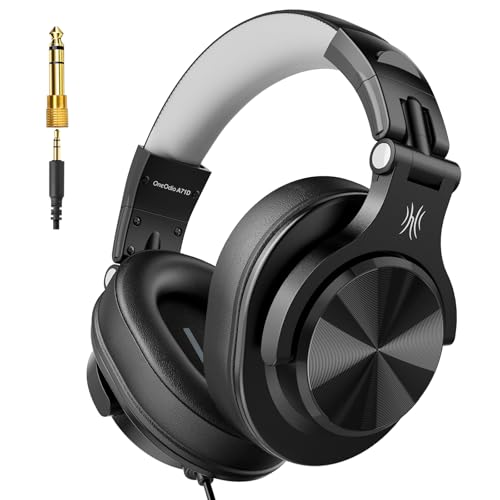
Best for: DJing, studio monitoring, and on-the-go practice. The A71D provides 40 mm drivers delivering deep bass and clear mids with a comfortable headband and ultra-soft ear cushions. The single-sided monitoring feature supports cueing and live mixing. Foldable design improves portability for gigs or travel.
Why chosen: It combines a comfortable fit with a robust monitoring capability and portability. Limitation: Some users may prefer a lighter clamp or smaller ear cups for extended sessions, depending on head shape.
FIFINE HD8 Wired Studio Monitor Headphones

Best for: Long study sessions and detailed monitoring. The FIFINE HD8 uses a large 50 mm driver unit to deliver dynamic bass, balanced mids, and clear treble across a wide 20 Hz to 20 kHz range. The circumaural, closed-back design helps reduce external noise, aiding focus during recording and mixing.
Why chosen: The combination of passive isolation and comfortable padding makes it suitable for extended sessions without fatigue. Limitation: On some builds, cable management could be improved to prevent tangling during movement.
Buying Guide
What to consider when choosing budget studio headphones:
- Closed-back vs open-back: Closed-back headphones offer better isolation for tracking and noisy environments; open-back models provide more natural imaging for mixing. For home studios, closed-back is often preferred.
- Driver size and type: 40–50 mm drivers are common in budget models and balance bass response with clear mids and highs. Neodymium magnets generally enhance efficiency and detail.
- Impedance and sensitivity: Lower impedance (below 40 ohms) is easier to drive with portable gear; higher impedance needs an audio interface or headphone amp for optimal volume.
- Comfort and weight: Look for soft padding, adjustable headbands, and lightweight designs for long sessions. Clamp force affects comfort over time.
- Detachable cables and adapters: Removable cables and included adapters (1/4″ or 1/8″) improve versatility with mixers, audio interfaces, and portable devices.
- Build quality and durability: Metal or reinforced plastic housings tend to last longer in budget ranges. Consider foldability for travel.
- Use case alignment: For tracking, choose headphones with tight low-end response and good channel separation. For mixing, prioritize balanced frequency response and clarity across the spectrum.
Frequently Asked Questions
- What is the difference between budget and pro studio headphones?
Budget models offer solid monitoring for home studios, but may lack ultra-precise response, durability, and comfort found in higher-end models. - Are closed-back headphones better for recording?
Yes, closed-back designs help prevent sound from leaking into microphones and provide better isolation for tracking. - Should I choose detachable cables?
Detachable cables are beneficial for portability and replacing worn cables without buying new headphones. - Do these headphones require an external amp?
Most budget models work well with standard audio interfaces and devices; an amp is only needed if you need higher volume or drive high-impedance models. - Can I use these for gaming or streaming?
Yes, they can work for gaming and streaming, especially if you need a closed-back design and good mic-less monitoring for in-game audio.