Answering the question “which budget delay pedal should I buy?” this guide highlights five affordable, easy-to-use options that suit beginners and budget-conscious players. Each pedal offers distinct delay textures, from warm analog echoes to flexible digital and multi-mode capabilities. The top picks are best for practicing at home, small gigs, or pedalboard setups on a tight budget. Use the quick table below to compare core ideas at a glance.
| Product | |||
|---|---|---|---|
| Donner Delay Pedal for Pedal Boards | Analog Delay | Warm vintage tones on a budget | Analog style, limited modern features |
| SONICAKE Delay Reverb 2 in 1 | Digital Delay / Plate Reverb | Versatile tones, live use | Digital effects may feel generic to some players |
| Pogolab Delay Pedal | Analog Delay | Warm, natural echo onset | Basic controls; fewer features than multi-modes |
| Donner Echo Square Delay Pedal | Multi-Mode Digital/Analog | Diverse delays including tape and reverse | Some users prefer dedicated single-mode pedals |
| JOYO Digital Delay Pedal (JF-08) | Digital with Analog-Voiced Circuit | Warm digital-analog blend | Three-knob layout; not a full-featured multi-pedal unit |
Donner Delay Pedal for Pedal Boards

Type: analog delay with a warm vintage character. Key controls include delay time from 20ms to 620ms, adjustable delay level, and feedback. The pedal uses aluminum alloy construction and is compact for pedalboards, making it a strong choice for players seeking classic echo tones on a budget. Best for players who want authentic analog warmth without a high price tag. Caution: analog circuitry may require careful gain staging on active pickups to avoid noise.
SONICAKE Delay Reverb 2 in 1

Type: digital delay with plate reverb in one compact unit. Maximum delay time reaches 2000ms. Reverb section includes a large, schedulable Decay parameter, and it offers Trail and Tap Tempo for live performances. Best for players who want a versatile stage-ready pedal without carrying multiple units. Caution: digital tones can sound less “organic” to players chasing strictly analog textures.
Pogolab Delay Pedal

Type: analog delay with a compact build and true bypass. Features include TIME knob to adjust repeat duration, a Mix control to blend wet/dry signals, and solid aluminum construction with an indicator light for state visibility. Best for players who want a warm, simple analog delay on a budget. Caution: lacks built-in modern presets; changes are manual and immediate.
Donner Echo Square Delay Pedal
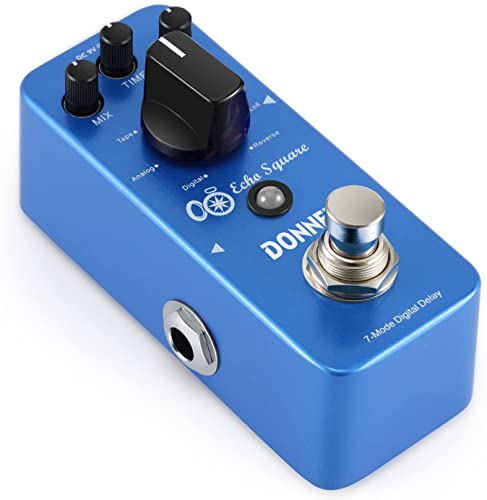
Type: multi-delay pedal with seven modes including digital, analog, tape, mod, sweep, lofi, and reverse. Features three knobs (MIX, TIME, FBACK) for precise sound shaping, and a true bypass circuit to preserve your tone. Best for players who want a wide palette of delay textures in one affordable unit. Caution: the broad feature set may require a learning curve to dial in preferred sounds.
JOYO Digital Delay Pedal (JF-08)

Type: digital delay with an analog-voiced circuit for a warm character. Controls include TIME, REPEAT, and LEVEL, offering a range from 25ms to 600ms. True bypass preserves tone when the pedal is off. Best for players who want a budget-friendly digital delay with an organic feel. Caution: compact three-knob layout may require repeated tweakings to dial exact tones during live sets.
JOYO Digital Delay Effect Pedal Mild and Mellow
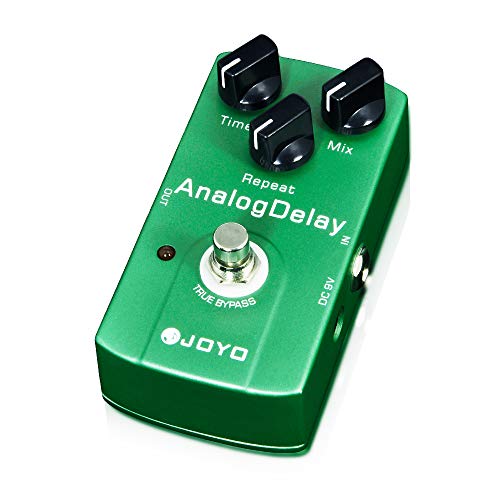
Type: digital delay with a mellow, analog-flavored tone and true bypass. Featuring a simple three-knob control layout, it aims to deliver a subtle, reverb-like ambiance with minimal tone loss when disengaged. Best for players who want a gentle, unobtrusive delay for practice and small gigs. Caution: tone depth may be lighter compared to heavier delay styles.
Donner White Tape Stereo Delay Pedal

Type: analog tape-style stereo delay with true bypass and two independent channels. Features independent Time, Feedback, and Level for each channel, enabling wide stereo spreads and complex textures. Best for players seeking a classic tape-echo vibe with stereo potential on a budget. Caution: stereo setup requires proper wiring to achieve true stereo effect.
Buying Guide: Key Purchase Considerations
- Delay Type: Analog delays typically deliver warmer, darker repeats; digital delays offer longer times and more precision. Choose based on preferred tone and use case.
- Delay Time Range: For casual practice, 20–600ms is sufficient; for ambient leads and solos, look for pedals offering 1,000ms+ or tap tempo features.
- Routing and Bypass: True bypass preserves your signal when off. This is especially important on pedalboards with multiple effects.
- Controls: Simple three-knob pedals are quick to dial in; multi-mode pedals provide texture variety but can require more learning.
- Build and Size: Compact pedals save space on crowded boards; aluminum housings tend to be durable for road use.
- Studio vs. Stage: For home setups, a versatile pedal that covers multiple textures may be ideal; for live use, reliability and easy editing via pedal controls are key.
Frequently Asked Questions
- What is the difference between analog and digital delay?
Analog delay uses bucket-brigade or similar circuits to create warmer repeats; digital delay uses digital processing for accurate repeats and longer times. - Do budget delay pedals affect my guitar signal?
True bypass and high-quality wiring help preserve core tone when the effect is off; choose true bypass models to minimize signal loss. - Is tap tempo important on a delay pedal?
Tap tempo helps synchronize delay time with tempo during live playing, which is useful for performances and jam sessions. - Can I use a delay pedal with bass guitars?
Many delay pedals work with bass, but some are voiced for guitar; check input/output levels and low-end handling if bass use is planned. - Should I buy one multi-mode delay or a few singles?
Multi-mode units offer variety in one pedal; singles give focused tones and simpler control. Choose based on preferred workflow. - Do I need a power supply for these pedals?
Most run on 9V power; a reliable power supply with adequate current and proper voltage is recommended to avoid noise and hum.