Answering the quest for premium sound in a compact form, these bookshelf speakers are ideal for audio enthusiasts seeking rich detail, precise imaging, and engaging dynamics in smaller rooms. The top picks below are best for listeners who want high-fidelity sound without a wall of speakers. Each product suits different setups—from near-field desktop listening to compact home theater configurations—so you can pick the best match for your room and gear.
| Product | Best For |
|---|---|
| Klipsch R-51M | Bright, energetic sound; compact near-field listening |
| Polk Signature Elite ES20 | Dynamic listening with cinematic depth and easy pairing |
| Sony SS-CS5M2 | Small spaces and budget-conscious audiophiles |
| Klipsch RP-600M | Reference-level detail and versatility |
| Edifier S1000MKII | Active, plug-and-play hi-res desktop listening |
Klipsch R-51M Bookshelf Speaker Pair

Best for bright, dynamic sound with a lively top end. The 1″ Aluminum LTS tweeters and 90×90 Square Tractrix Horns deliver detailed highs, while dual 5.25″ spun-copper IMG woofers provide forward, engaging midbass. This pair suits near-field listening and small to medium rooms where a lively sound signature is preferred. A potential limitation is the boosted high-end presence, which may become fatiguing for long listening sessions at high volumes. Best for listeners who value clarity and punch in compact spaces.
Polk Audio Signature Elite ES20 Bookshelf Speakers

Best for cinematic listening with strong bass response from the Power Port design. The 1″ Terylene tweeter and 6.5″ woofer paired with Dynamic Balanced Acoustic Array and precision crossovers offer a wide soundstage suitable for music and movies. The ES20 is well-suited for homes with AV receivers that support multi-channel audio. A limitation is that larger rooms or very critical stereo setups may benefit from higher-end models for ultimate imaging.
Sony SS-CS5M2 3-Way Hi-Res Compact Speakers

Best for compact spaces needing multi-driver support with a combination of small footprint and wider frequency response. The 3-way, 3-driver design helps deliver a balanced sound with improved low-end extension for its size. A caveat is that, in very demanding bass-heavy setups, these compact speakers may lack the depth of larger floorstanding or high-end bookshelf models.
Klipsch RP-600M Reference Premiere Bookshelf Speakers

Best for audiophiles seeking high-fidelity, detailed, and dynamic sound. The 1” titanium LTS vented tweeter with a hybrid tractrix Horn, plus 6.5″ spun copper cerametallic woofers, delivers clear highs and potent midrange. The rear-firing tractrix port provides efficient bass. This model is well-suited for critical listening rooms and stereo setups where precision and scale matter. A potential limitation is the need for a suitable amplifier and room placement to realize its full potential.
Edifier S1000MKII Active Bookshelf Speakers
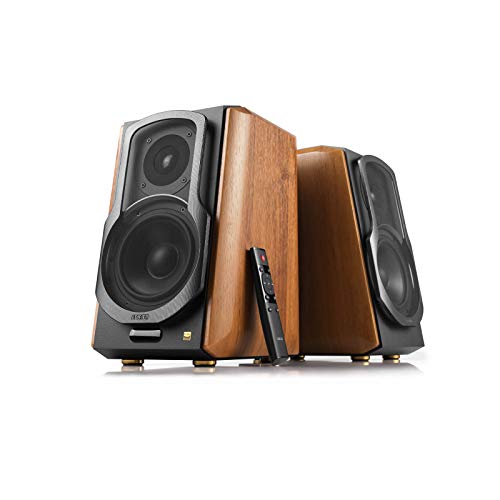
Best for plug-and-play hi-res desktop listening with built-in amplification. The 60W x 2 Class D amps and Bluetooth 5.0 with aptX HD enable easy streaming, while a wide frequency range supports detailed music playback. This pair is ideal for computer desks, small studios, or rooms where simplicity and active amplification are priorities. A drawback is that the bass may surpass near-field needs for some desk setups if not room-equalized.
Buying Guide
What should you consider when choosing bookshelf speakers for audiophile listening?
- Sound signature: Do you prefer a forward, bright top end or a balanced, neutral profile? Tweeter design and horn loading influence brightness and imaging.
- Driver configuration: Two-way vs three-way, and woofer size, affect bass extension and midrange clarity. Larger drivers typically deliver deeper bass with less strain at higher levels.
- Room size and placement: Smaller rooms benefit from energy-efficient designs; larger rooms may reveal more from higher-end models with better dispersion and cabinet design.
- Amplification and compatibility: Some models are passive and require an amplifier/AV receiver; others are active with built-in amps. Match impedance and sensitivity to your source.
- Connectivity: Analog inputs, Bluetooth, AirPlay 2, and multi-room support cater to different setups. Consider future expansion if you plan a larger system.
- Build and finish: Aesthetic fit with your furniture and room decor matters for longer listening sessions and placement.
How to compare effectively
- Benchmark with the same recordings across models to hear differences in imaging, soundstage, and bass extension.
- Check room placement guidelines from the manufacturer to optimize performance.
- Consider paired components (amplifier, subwoofers) to reach the desired low-end impact without overloading the speakers.
Placement tips for best results
- Keep speakers away from walls to reduce bass build-up, and toe-in slightly toward the listening position for tighter imaging.
- Use isolation pads or stands to minimize cabinet vibrations and improve midrange clarity.
- Avoid placing directly on a hard surface; a cabinet with some damping can improve overall response.
FAQ
- What is the difference between bookshelf and floorstanding speakers?
- Do I need an amplifier for bookshelf speakers?
- Is Bluetooth enough for audiophile-grade sound?
- Which speaker should I choose for home theater?
- How much room do bookshelf speakers need?
- Can I use any bookshelf speaker with any amplifier?
Bookshelf speakers are compact and designed for near-field listening, while floorstanding speakers are larger and provide deeper bass and higher overall output in bigger rooms.
Passive bookshelf speakers require an amplifier or AV receiver. Active models have built-in amplification and do not require a separate amp.
Bluetooth can be convenient but may introduce compression. For optimal fidelity, connect to a high-quality DAC or use wired analog/optical connections when possible.
For home theater, consider speakers with strong bass extension and integration with your AV receiver, such as models with power ports and robust crossovers designed for dynamic movie soundtracks.
Smaller rooms benefit from compact designs; larger rooms may benefit from higher-end models with better dispersion and power handling. Placement distance from walls also influences bass response.
Most bookshelf speakers have standard impedance ratings, but confirm compatibility with your amplifier’s power output and impedance to avoid underpowering or overdriving the drivers.