The top picks below are ideal for bathrooms where humidity protection, air freshness, and quiet operation matter. If you need automatic humidity-controlled ventilation, start with products that include a built-in humidistat or smart humidity sensor. This guide highlights five options, detailing who they’re best for, why they stand out, and any notable limitations.
Buyer summary table (at a glance):
| Product | Best For | Key Humidity Feature | Notes |
|---|---|---|---|
| VIVOHOME EC Motor Bathroom Exhaust Fan with Humidity Sensor | Small-to-mid bathrooms; energy-conscious homes | Three auto-speed modes based on humidity | EC motor; remote control available |
| VIVOHOME Bathroom Exhaust Fan with Light & Humidity Sensor | Bathrooms needing lighting plus ventilation | Three humidity-based speeds; tri-color light | UL safety tested; multiple light options |
| OREiN 3-in-1 Bathroom Exhaust Fan with Light & Humidity Sensor | Medium to large baths; energy efficiency | Automatic humidity control; 160 CFM | HVI/ETL listed; 1500 lm light output |
| AUPU Bathroom Exhaust Fan with Humidity Sensor | New installs; easy room-side replacement | Humidity sensing with automatic control | HVI & Energy Star certified |
| JOEAONZ Bathroom Exhaust Fan 110 CFM | Quiet operation; flush-integration | Low noise 1.0 sones | Hidden grille design; no humidity sensor listed |
VIVOHOME EC Motor Bathroom Exhaust Fan With Humidity Sensor
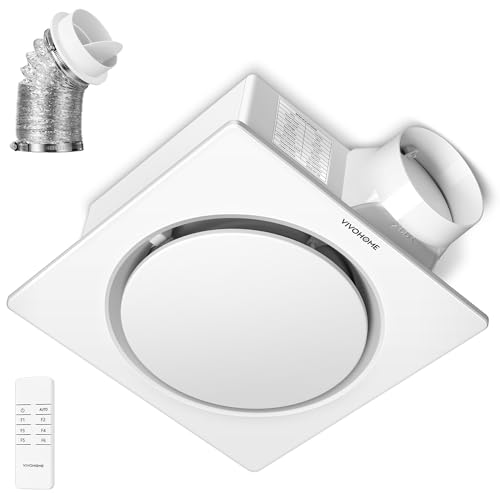
Best for energy-conscious homes that want consistent airflow without a traditional fixed-speed limitation. The brushless EC motor delivers 110 CFM at 12.5W, saving roughly 50% energy compared with typical AC motors. It self-adjusts speed to maintain steady airflow, improving performance when duct restrictions or dust buildup occur. The included remote offers manual 6-speed control. A caution: ensure compatible ducting and access for the remote setup. This model suits mid-sized bathrooms and spaces where automatic humidity response is valued.
VIVOHOME Bathroom Exhaust Fan With Light & Humidity Sensor

Best for bathrooms needing both lighting and automatic humidity control. This unit uses a brushless EC motor to deliver 160 CFM while saving energy and features a three-color lighting system (2700K, 4000K, 5700K) with adjustable brightness. It automatically adjusts ventilation based on humidity levels and offers manual 6-speed control. Potential limitation: lighting and fan performance are coupled, so you might want to verify wiring and room lighting compatibility before install.
OREiN 3-in-1 Bathroom Exhaust Fan With Light & Humidity Sensor

Best for larger baths up to 160 sq ft that need rapid moisture control and bright lighting. This 160 CFM, 1.0 sone unit offers automatic humidity activation at 60% RH and above with a night-light option and three color temperatures (CCT). It is ENERGY STAR-rated and designed for room-side installation, reducing attic access requirements. A note: ensure the ceiling opening matches the 11.81″ x 11.02″ cutout for a proper seal and airflow.
AUPU Bathroom Exhaust Fan With Humidity Sensor

Best for new installs and room-side replacements needing automatic moisture control. The AUPU unit is certified by HVI, Energy Star, UL, and FCC, and includes a humidity sensor that activates ventilation after a shower and continues until humidity drops to a preset level. It supports a slim housing and 4″ ducting, with easy installation and a retractable mounting bracket. Caution: verify ceiling space and duct compatibility before purchase to ensure a clean fit.
JOEAONZ Bathroom Exhaust Fan With Hidden Grille

Best for users prioritizing a flush, unobtrusive ceiling finish and quiet operation. The JOEAONZ fan delivers 110 CFM at a low noise level of 1.0 sones, suitable for smaller to mid-sized bathrooms. It features a hidden grille design for a seamless ceiling look. Note that this model does not advertise a built-in humidity sensor, so it’s best for those who primarily want quiet ventilation or who will pair it with a separate moisture-control solution.
Buying Guide: Key Considerations For Picking The Right Humidity-Sensing Bath Fan
- Humidity sensing performance: Look for models with automatic activation around a specific RH threshold (commonly 60–80%). The sensor should adjust ventilation without user intervention for consistent moisture control.
- Airflow and room size: CFM should match bathroom square footage. Larger bathrooms typically require higher CFM (e.g., 110–160 CFM) for quick moisture removal.
- Noise level: Sones or decibel ratings indicate quiet operation. For powder rooms and bedrooms adjacent to bathrooms, 1.0–2.0 sones is typical.
- Energy efficiency: Brushless EC motors offer better efficiency and longer life than traditional AC motors. ENERGY STAR-certified units meet efficiency standards.
- Lighting integration: Some models combine LED lighting with ventilation. Check color temperature options and brightness levels to fit your space.
- Installation approach: Some models support room-side installation with no attic access. Ensure duct size (4″ or 6″) and ceiling cutouts fit your space.
- Warranties and certifications: HVI, UL, FCC, and ETL listings indicate safety and performance standards. Energy Star certification reflects energy efficiency.
- Remote control vs. wall switch: Remote options offer convenient manual control; confirm battery or charging needs are included or accounted for.
FAQ: Quick Answers For Buyers
- What is a humidistat in a bathroom fan?
A humidistat is a sensor that detects humidity levels and automatically turns the fan on or adjusts speed to control moisture and condensation.
- Do all humidity-sensing fans require attic access for installation?
No. Some models are designed for room-side installation, avoiding attic work, while others still require attic access for wiring or duct routing.
- What size bathroom requires higher CFM?
Bathrooms up to about 100 square feet typically need 50–110 CFM; larger baths or high-moisture spaces benefit from 160 CFM or more.
- Is it better to choose a fan with a light and humidity sensor?
For convenience, a combined unit reduces clutter and simplifies installation, but ensure the lighting doesn’t interfere with ventilation performance.
- What should I consider before replacing an existing fan?
Measure the ceiling opening, duct size, and mounting space. Ensure the new fan fits the existing cutout or plan for a compatible replacement kit.
- Are humidity-sensing fans energy efficient?
Yes. Many use brushless EC motors and ENERGY STAR certification, offering lower energy use and longer lifespans than traditional AC-motor models.