Analogue delay pedals offer warm, natural repeats that many players still love for vintage vibe and lush ambience. This guide highlights five strong options and explains who each is best for. Whether you’re chasing classic slapback, thick ambient wash, or precise analog warmth on a pedalboard, there’s a choice here for you.
| Product | Best For | Why It Stands Out |
|---|---|---|
| Donner Guitar Delay Pedal (Yellow Fall, Mini) | Budget players and pedalboard-first setups | Compact, true bypass, adjustable 20–620 ms, warm analog delay |
| MXR Carbon Copy Analog Delay | Classic, studio-friendly analog tone | Rich, all-analog signal with up to 600 ms and tape-like modulation |
| Donner Tap Delay Guitar Effect Pedal | Live looping and performers needing tempo sync | Three delay modes (analog, digital, reverse) with Tap Tempo |
| POGOLAB Delay Pedal | Compact rigs seeking simple, warm analog tone | Mini Analog Delay with Mix control and solid aluminum build |
| JHS Pedals 3 Series Delay | Professional tone with versatile voicing | 80–800 ms range and clearly different digital/analog flavors |
Donner Analog Delay Mini Pedal For Pedalboards

Best for budget-conscious players building a compact board. This Donner pedal delivers warm, vintage-inspired analog delay with 20 ms to 620 ms of delay time. The level and feedback controls let you shape repeats, from subtle slapback to more pronounced echoes. The aluminium-alloy chassis keeps weight down while maintaining durability. Its compact size makes it pedalboard-friendly, ideal for beginners or players who want a simple, reliable analog tone without extra features.
Who it’s for: guitarists starting out, players with limited pedalboard space, and those who want a classic analog voice at a low price. Limitation: lacks advanced tap tempo or multi-voicing options found on higher-end units.
MXR Carbon Copy Analog Delay

Best for players seeking a classic, studio-friendly analog tone. The MXR Carbon Copy delivers all-analog signal with up to 600 milliseconds of delay time and subtle modulation to mimic tape echo. It’s known for a clean, warm repeat and a straightforward interface that favors players who want reliable, repeatable tones in sessions or live settings.
Who it’s for: rhythm players, lead players chasing a dependable, warm analog echo, and those who value a straightforward, no-fruss experience. Limitation: modulation is gentle but can be less pronounced than some newer pedals with deeper tape-style modulation options.
Donner Tap Delay Guitar Effect Pedal

Choose this if you want versatile delay modes and hands-on tempo control. The pedal includes analog, digital, and reverse delay modes, plus a Tap Tempo function for immediate delay time changes. Level, Feedback, and Delay knobs let you dial exact repeats, while Tap Tempo helps lock your effect to a groove or live performance timing. It’s a flexible option for expanding tonal options without clutter.
Best for: performers who value tempo-synced delays, experimental players exploring different echo textures, and those who prefer a single pedal with multiple delay flavors. Caution: the general feature set is broad, which means it may require a moment to dial in just the right setting for a given song.
POGOLAB Delay Pedal — Analog Mini

Best for players who want a warm analog delay in a compact form with easy control. The POGOLAB pedal emphasizes analog warmth with a Time control for delay length and a Mix control to blend wet and dry signals. It’s well-constructed in an aluminum alloy case and includes a visible indicator for operating status. This is a good choice for simple boards or practice rigs needing a dependable analogue voice with straightforward operation.
Who it’s for: players prioritizing simplicity, tight build, and a natural analog tone without extra modes. Limitation: it lacks the broader modulation or reverse options found on higher-tier units.
JHS Pedals 3 Series Delay
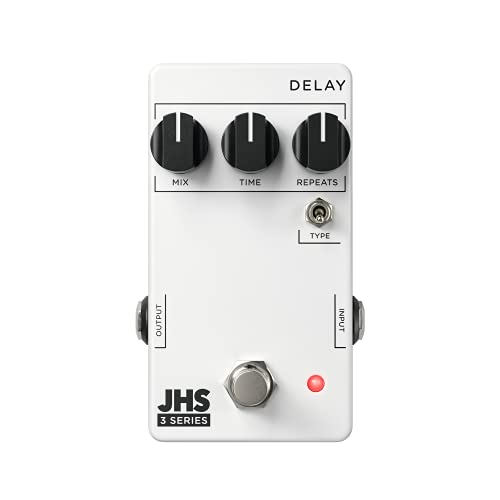
Best for professionals seeking tonal versatility. The JHS 3 Series Delay covers a broad range from 80 ms to 800 ms and includes a Type toggle to switch between clearer digital-voiced delay and darker analog-voiced delay. Made in Kansas City, USA, this pedal targets players who want nuanced control and high-quality sound for studio work or stage use. Clear, predictable behavior helps when balancing multiple effects on a pedalboard.
Who it’s for: players who want a dual-voicing delay with robust construction and premium feel. Limitation: higher price and more functions may be more than what a casual player needs.
Buying Guide: How to Choose Your Analogue Delay Pedal
- Delays and tone: Decide how warm you want the repeats to sound. Do you prefer a vintage, tape-like character or a more clean analog tone?
- Delay time range: Check minimum and maximum delay times. Short delays (slapback) suit rhythm and punchy parts; longer delays suit ambient pads or solos.
- Controls you’ll use: Time, Feedback, and Mix are common. Some pedals include Tap Tempo for tempo locking; others add modulation or reverse circuits for texture.
- Mode variety: If you play a lot of different genres, a pedal with multiple modes (analog, digital, reverse) offers flexibility. If you mostly want warmth, a single-mode analog pedal may be enough.
- Build and footprint: aluminum chassis and compact form factor are beneficial for touring rigs. Consider the pedal’s size in relation to your board’s layout.
- Connection and bypass: True bypass helps preserve your tone when the pedal is off. Check input/output compatibility with your existing chain.
- Price vs features: Higher-priced models typically offer richer tone and more features. Match features to your playing style and live requirements.
Frequently Asked Questions
- What is an analogue delay pedal? An analog delay pedal creates repeats using analog circuitry, delivering warm, natural echoes without digital processing.
- What makes a delay pedal good for live use? Responsiveness, reliable true bypass, clear repeat trails, and a straightforward control layout for quick adjustments on stage.
- How long should delay times be for different styles? Slapback and short echoes are common for rock and pop; longer delays (hundreds of milliseconds) suit ambient or spacey sections.
- Is modulation important in analogue delays? Some analog delays include subtle modulation to imitate tape wobble. If you want that texture, look for a pedal with modulation options.
- Should I choose a multi-mode delay or a dedicated analogue pedal? If you frequently explore different textures, a multi-mode pedal provides versatility. For a focused warm analogue tone, a dedicated analog pedal is often simpler.
- Do these pedals work well with other effects? Yes, placing a delay after your gain or modulation pedals can create wide, musical echoes. Experiment with placement to taste.