Answer: The top picks include smart, multi-chemistry chargers that handle AGM, Gel, SLA, and LiFePO4 batteries, with automatic maintenance, temperature compensation, and built-in desulfation. These units are best for serious car, boat, and power-sport owners who want reliable charging with protection features. The buyers most likely seek versatile, compact, and safe chargers that prevent overcharging, restore older batteries, and support winter storage. The following five products are selected for strong performance, broad compatibility, and clear consumer guidance.
Summary of top picks
| Product | Best For | Key Benefit | Limitations |
|---|---|---|---|
| NoCo GENIUS10 | All-in-one maintenance for high-power applications | 115% more power, 6V/12V, LiFePO4 support | Higher price than basic chargers |
| NoCo GENIUS1 | Compact, on-the-go maintenance | 35% smaller, solid for small batteries | Lower current for larger packs |
| TowerTop 12V | All-in-one with fast charging | 25A max, auto restart, memory settings | Display may dim in bright light |
| NoCo GENIUS5 | Mid-range, multi-chemistry maintenance | 5A per unit, temp-compensated charging | Limited to 1 bank |
| NoCo GEN5X2 | Two-bank onboard charging | 10A total, independent banks | More complex wiring for multi-battery setups |
NOCO GENIUS10: 10A Smart Charger
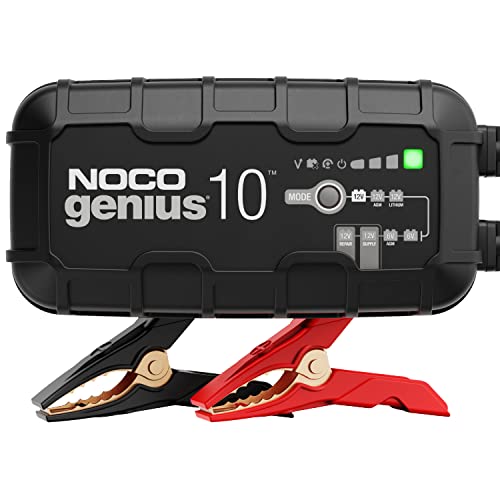
The GENIUS10 is designed as an all-in-one charging solution. It acts as a battery charger, maintainer, trickle charger, and desulfator. It supports 6V and 12V lead-acid types (AGM, Gel, SLA, VRLA) and LiFePO4. An integrated thermal sensor adjusts charging based on ambient temperature to prevent overcharging in heat or undercharging in cold. Best for owners with larger battery banks, marine applications, or frequent seasonal storage where robust protection matters. Caution: higher output means a larger footprint and higher upfront cost compared with basic models.
NOCO GENIUS1: 1A Smart Charger

The GENIUS1 offers a compact charging solution with 6V/12V compatibility for lead-acid and LiFePO4 batteries. It is designed for everyday maintenance and trickle charging with temperature compensation. Best for small batteries, motorcycles, and riders who want a lightweight, space-saving option. A limitation is its lower current output, which may not suit larger deep-cycle or high-capacity setups.
YONHAN 20A Battery Charger

The YONHAN charger provides 12V/24V operation with 20A (and 7-stage charging) and is designed for LiFePO4 and various lead-acid chemistries. It includes winter mode, smart temperature adaptation, and protection features such as reverse polarity and overcurrent protection. Best for users needing faster charging and winter storage support for larger fleets. Caution: It is not a jump starter and must be plugged into an outlet.
TowerTop 2/10/25 Amp 12V Smart Charger

The TowerTop charger offers four current settings (2A/10A/25A/AUTO) with a 25A max output for rapid charging of larger batteries. It includes auto-detection, pulse repair mode after full charge, and memory of last settings. Best for RVs, boats, and heavy-use vehicles. Limitation: Smart features depend on steady power and may be less straightforward for beginners.
NOCO GENIUS5: 5A Smart Charger

The GENIUS5 is a mid-range, multi-chemistry charger that provides 5A charging and advanced desulfation. It supports 6V/12V batteries, including AGM, Gel, SLA, and LiFePO4. Best for mid-sized batteries, frequent maintenance, and users wanting a balance of capacity and price. A potential limitation is less current than higher-output models for large deep-cycle packs.
NOCO GEN5X2: 2-Bank Onboard Charger
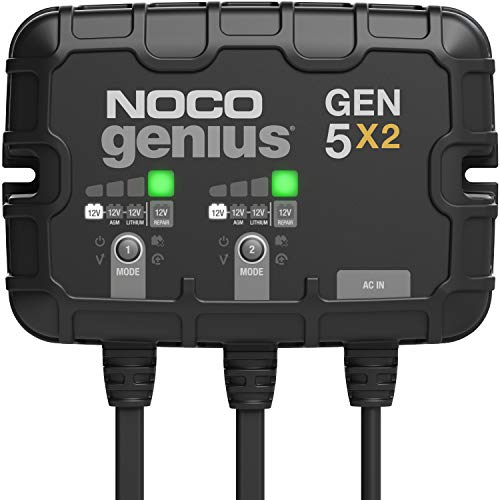
The GEN5X2 provides two independent 5A banks (total 10A) for simultaneous charging of separate batteries. It features selectable modes for 12V, AGM, Lithium, and a Repair Mode. Best for boaters or fleet owners who manage multiple batteries. Limitation: Installation complexity increases with wiring for dual banks.
Buying Guide — Key Considerations for AGM Battery Chargers
What should you look for when selecting an AGM-compatible charger?
- Battery types supported: Ensure the charger handles AGM, Gel, SLA, and LiFePO4 if you use mixed chemistries.
- Charging current: Higher amperage charges faster but may be overkill for small batteries. Match current to battery size and usage.
- Temperature compensation: A thermal sensor helps prevent overcharge in heat and undercharge in cold.
- Desulfation and repair modes: Useful for extending old batteries, especially in cars and boats.
- Multiple banks: If you manage more than one battery, consider a multi-bank model for independent charging.
- Auto-maintain/float mode: Keeps batteries topped off during storage without damage.
- Safety features: Look for reverse polarity protection, short-circuit protection, and fire-retardant housings.
How to choose by use case
- Occasional maintenance for small batteries: A compact unit like GENIUS1 or GENIUS2.
- Marine or RV fleets needing multiple batteries: GEN5X2 or TowerTop with higher current.
- Frequent winter storage and battery revival: YONHAN or NOCO with winter mode and repair features.
- Budget-conscious buyers with one or two batteries: GENIUS5 or standard TowerTop setups.
Maintenance tips
- Keep chargers dry and away from direct sunlight when not in use.
- Disconnect batteries if charging in a damp or corrosive environment.
- Regularly check battery terminals for corrosion and clean as needed.
FAQ
- What is the advantage of a charger with temperature compensation? It adjusts charging based on ambient temperature to prevent overcharging in heat and undercharging in cold, extending battery life.
- Can these chargers revive a dead battery? Some models offer a repair or desulfation mode, but results vary. Extremely dead or damaged batteries may not recover.
- Is a multi-bank charger better than a single-bank charger? For fleets or vehicles with multiple batteries, multi-bank provides independent charging, avoiding cross-charge issues.
- Do these chargers work with LiFePO4 cells? Yes, many models explicitly support LiFePO4 alongside lead-acid chemistries.
- Are these chargers safe for stored batteries? Yes, most include float or maintenance modes to prevent self-discharge during storage.
- Should I choose a higher amperage charger for a small battery? Not necessary; match current to battery capacity to avoid excessive heat and wear.