Answering the need for reliable acoustic amplification, these preamps help players shape tone, control feedback, and stay connected to live or recording setups. Whether you’re a beginner seeking simple EQ, a gigging musician needing robust DI outputs, or a studio player chasing studio-grade tone, the right preamp matters. This guide highlights five top picks and who they’re best for, with practical comparisons to help you choose confidently.
Summary table of chosen products
| Product | Best For | Key Benefit |
|---|---|---|
| SONICAKE Acoustic Guitar Effects Pedal with Analog Preamp and Digital Reverb | Small-setup players seeking integrated effects | Analog preamp with digital reverb and notch filter |
| Fishman AFX Pro EQ Mini Acoustic Preamp and EQ | Live performers needing precise EQ | 5-band EQ tailored for acoustic signals |
| Fishman Platinum Pro EQ/DI Analog Preamp Pedal | Stage players requiring balanced DI and boost | Balanced XLR with pre/post EQ switch |
| LR Baggs Venue DI Acoustic Guitar Preamp and DI | Active or passive setups with strong feedback control | Garret Null notch filter and adjustable gain |
| Homeswitch Plastic 301 Acoustic Guitar Preamp | Budget-friendly install-and-play setup | Solder-free installation and quick controls |
SONICAKE Acoustic Guitar Preamp with Analog Preamp and Reverb

Product overview: This unit combines an analog preamp with built-in digital reverb, plus a notch filter and mute. It accepts high-impedance inputs and outputs balanced XLR, making it suitable for stage or studio use. Best for players who want on-board effects and reliable signal integrity without extra gear.
Who it’s best for: Ideal for solo performers or small-duo setups that benefit from a compact pedal with built-in effects and a strong DI option. The mute and filter features help manage feedback in live rooms or rehearsal spaces.
Why selected: The combination of analog preamp behavior with digital reverb offers a classic guitar amp feel in a compact package. The XLR balanced output supports clean FOH connections, and the notch filter helps reduce feedback quicky.
Caution or limitation: If you need extensive onboard effects beyond reverb, you might outgrow the built-in options and seek more dedicated multi-effects gear.
Fishman AFX Pro EQ Mini Acoustic Preamp and EQ

Product overview: A compact, five-band EQ tailored for acoustic instruments, with true bypass options and a phase control to fight feedback. This preamp focuses on precise tone shaping for live or studio use.
Who it’s best for: Players who want precise tone control for acoustic guitars, with reliable signal routing options and the ability to mute or bypass effects during performance.
Why selected: The dedicated acoustic EQ and phase control help maintain clarity on stage, especially in venues with challenging feedback environments.
Caution or limitation: The unit emphasizes EQ and bypass options; if you need built-in compression or more extensive effects, consider a larger multi-effect or DI unit.
Fishman Platinum Pro EQ/DI Analog Preamp Pedal

Product overview: This preamp offers a balanced XLR output with a pre/post EQ switch, plus a footswitchable boost and onboard compression through the DI. It’s designed for players who need robust stage DI performance.
Who it’s best for: Ideal for gigging musicians who require a dependable DI with tone control, boost options, and compression for a consistent stage mix.
Why selected: The combination of balanced XLR, EQ control, and boost makes it versatile for live sound engineers and performers seeking consistency from show to show.
Caution or limitation: The feature set centers on DI and stage tone; those seeking built-in effects beyond EQ and compression might prefer other models with more effects blocks.
LR Baggs Venue DI Acoustic Guitar Preamp and DI
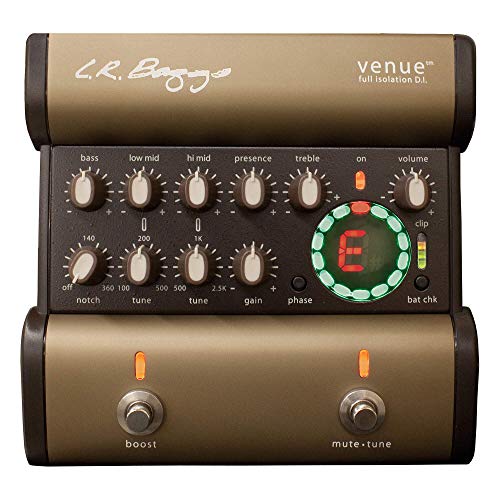
Product overview: This DI/preamp combo provides adjustable gain for both passive and active pickups, a five-band EQ with tunable low-mid and high-mid bands, and a Garret Null notch filter for effective feedback control.
Who it’s best for: Musicians with both passive and active pickups who need flexible EQ and strong feedback suppression for live performance or rehearsal rooms.
Why selected: The dedicated notch filter and flexible EQ make it a reliable choice for managing feedback in difficult acoustics while preserving natural tone.
Caution or limitation: Some users may prefer models with built-in compression or effects, depending on the performer’s workflow and gear beyond the preamp DI.
Homeswitch Plastic 301 Acoustic Guitar Preamp Pickup

Product overview: An affordable preamp with a simple control set including volume, bass, midrange, treble, brilliance, and notch filter, plus a phase switch and easy battery access.
Who it’s best for: Beginners or budget-conscious players who want quick setup and basic tone shaping without investing in premium gear.
Why selected: The solder-free installation and straightforward controls enable rapid setup for practice rooms or casual performances.
Caution or limitation: It may lack advanced features found in higher-end models, so consider future upgrades if tone customization becomes a priority.
TUOREN Acoustic Guitar Preamp with 5-Band EQ and Tuner

Product overview: Includes a built-in tuner and a full 5-band EQ with gain controls. Designed for easy installation in standard acoustic guitars, with a 9V battery holder for independent power.
Who it’s best for: Players who want an all-in-one preamp with tuning capability and solid EQ for both stage and studio use.
Why selected: The built-in tuner and straightforward controls provide reliable on-the-fly tuning and tone shaping, especially for performers who rely on quick adjustments.
Caution or limitation: The included power source is a common 9V battery; users should plan for battery life during long gigs or sessions.
Tbest Guitar Preamp with 5-Band EQ and Tuner

Product overview: This preamp includes a 5-band equalizer and a built-in LCD tuner, plus a tuned gain structure for acoustic-electric guitars. It aims for strong tuning accuracy in varied environments.
Who it’s best for: Players who perform in noisy venues and need a clear, visible tuner readout along with flexible tone control.
Why selected: The auto-tuning assistance and visible display help players maintain accurate pitch during live performances.
Caution or limitation: Some users may prefer models with more compact packaging or fewer components if they want minimal setup time on stage.
SONICAKE Acoustic Pedal with Preamp, Chorus, Delay, and Reverb

Product overview: A one-stop gig solution with an analog preamp and a two-band EQ, plus chorus, delay, and reverb. It aims to recreate the feel of a classic acoustic amplifier in a compact pedal format.
Who it’s best for: Players who want a versatile onboard effects suite and a warm, natural guitar tone in a single unit for live performances or quick studio mockups.
Why selected: The integrated effects chain reduces gear footprint while offering a range of textures suitable for various playing styles.
Caution or limitation: Effects depth and quality can be subjective; in a large PA system, you may still prefer dedicated outboard effects or a separate DI for optimal signal integrity.
Buying Guide for Acoustic Guitar Preamps
- Output needs: Choose a unit with a balanced XLR DI output for direct-to-PA compatibility. If you primarily record, ensure DI performance is clean and low-noise.
- Power and battery life: Some models are battery-powered; plan for reliability on long gigs with easy battery access or USB power where available.
- EQ and feedback control: Five-band EQ helps tailor tone, but a notch filter or phase control is essential for reducing feedback in loud rooms.
- Onboard effects: If you want chorus, delay, or reverb, ensure the effects meet your needs and don’t overly color your core guitar signal.
- Installation: Solder-free or easy-install preamps are ideal for beginners or players who upgrade their guitar periodically.
- Best use case: For solo performers, DI-friendly preamps with robust gain control are valuable. For ensemble gigs, models with reliable mute or bypass modes help manage live transitions.
- Budget versus features: Entry-level options emphasize ease of use; premium models emphasize precise tone control and additional routing options.
FAQ
- What is a guitar preamp’s main purpose?
A preamp boosts a piezo or magnetic pickup signal and shapes tone before sending it to a DI or amplifier.
- Do I need a notch filter on stage?
Notch filters help reduce feedback by attenuating specific frequencies that cause squeal in loud venues.
- Is an external DI better than an onboard DI?
External DI can offer more control and flexibility, but onboard DI is convenient for compact setups.
- Should I choose analog or digital preamps?
Analog preamps often provide a warm, musical response; digital units add effects and precise recall of settings.
- Can a preamp replace a guitar amplifier?
For direct-to-PA performance, a good preamp with DI can replace an amp on stage, though some players still prefer mic’ing an amp for tone.
- What installation considerations matter?
Consider control layout, battery access, and the ability to remove or upgrade the unit without hardware changes.