The best acoustic guitar amps deliver clear, natural tones for guitar and voice, with enough power to cut through a room. This guide highlights five reliable options suited to different players—from beginners practicing at home to performers on small stages. If you need a portable, battery-powered unit, or a studio-ready combo, there’s a pick here for you. Below you’ll find quick-fit notes and a buyer’s table to compare core features at a glance.
| Product | Best For |
|---|---|
| Fender Acoustasonic 15 | Beginner to intermediate players; small gigs |
| Flatsons Crush20 | Singer-Songwriters; street or outdoor performance |
| Fender Acoustasonic 40-Watt | Small venues; practice with reverb |
| Fishman Loudbox Micro | Studio-to-small stage, versatile channels |
| YUER BA-10Pro | Travel practice, learners needing built-in effects |
Fender Acoustasonic 15 Acoustic Guitar Amplifier
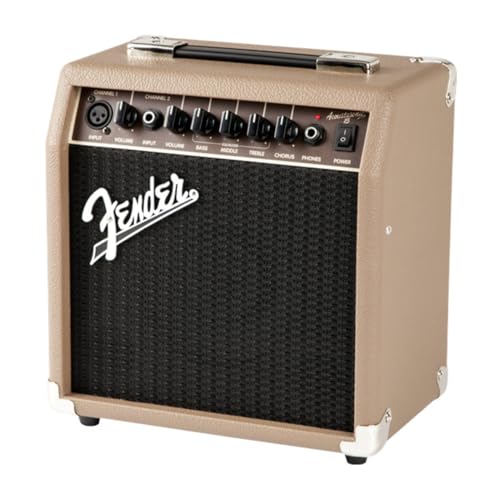
The Fender Acoustasonic 15 delivers 15 watts through a 6-inch speaker with a whizzer cone for enhanced midrange. It includes dual front-panel inputs: a standard instrument jack and an XLR mic input, enabling simple plug-and-play for small acoustic performances. Best for beginner players or practice rooms where simple, reliable tone is valued. A potential limitation is its compact power; it may struggle in larger venues without raising volume or adding a PA.
Why this pick?
- Compact, portable design supports easy transport.
- Dual inputs accommodate guitar and vocal use in one unit.
- Whizzer cone helps deliver fuller acoustic voice from a small cabinet.
Flatsons Crush20 20W Rechargeable Acoustic Guitar Amp

This amp targets singer-songwriters who need two independent channels for guitar and vocals, plus built-in reverb across both channels. It runs on a rechargeable battery for up to eight hours, with a 5.5-inch full-range speaker and Class-D amplifier delivering 20W RMS. It is best for open-air performances, busking, or practice in rooms without reliable power. A limitation is that battery life can vary with high volume or effect usage.
Why this pick?
- Dual-channel design supports live singing alongside guitar.
- Rechargeable battery adds true portability for outdoor use.
- LED power indicator helps manage runtime on the go.
Fender Acoustasonic 40-Watt Acoustic Guitar Amplifier

The 40-watt Acoustasonic combines a larger 6-inch speaker with a whizzer cone for broader audience coverage. It adds built-in reverb on the instrument channel for ambient warmth, making it suitable for practice rooms or small venues where enhanced ambiance improves performance. This unit is better for players who need a bit more presence than a 15-watt model but don’t require a full-size stage amp. A note of caution: more power means larger dimensions and weight.
Why this pick?
- Higher power output supports modest performance spaces.
- Built-in reverb adds depth to instrument tone.
- Whizzer cone maintains Fender tonal character in a compact package.
Fishman Loudbox Micro 40-Watt Acoustic Amp

The Fishman Loudbox Micro provides two channels (instrument and microphone) with digital reverb and chorus, plus master volume control. At 40 watts, it is well-suited for small gigs and studio work where balanced, faithful acoustic amplification is essential. This model is chosen for players who value versatile effects and simple, clear sound replication. A potential limitation is its size and weight relative to smaller practice amps.
Why this pick?
- Two-channel layout supports live singing with amplification clarity.
- Digital reverb and chorus offer ready-to-use depth for performances.
- Fishman’s reputation for acoustic amplification is a plus for tone accuracy.
YUER BA-10Pro 10W Portable Acoustic Amp

The 10W BA-10Pro is designed for daily practice and small-scale performances. It supports 6.35mm dynamic microphones and guitars with built-in delay and reverb effects, making it a compact option for beginners and travelers. Rechargeable with a long-lasting battery, the BA-10Pro is best for practice, casual jams, or street performances where weight and size matter. It may lack the headroom needed for louder rooms or larger audiences.
Why this pick?
- Ultra-portable with built-in effects and a practical practice setup.
- Rechargeable battery supports true portability for travel and street gigs.
- Integrated vocal capabilities simplify solo performance setups.
Buying Guide: How To Choose The Right Acoustic Guitar Amp
How much power do you actually need?
For small rooms and home practice, 10–20W models are usually sufficient. For small venues or outdoor settings, 20–40W provides more headroom without requiring a full PA system.
Do you need battery power or regular AC?
Battery-powered amps enable true portability for street performance and travel. If you primarily play indoors, AC-powered models are typically lighter and simpler to operate.
Two channels or more?
If you sing and play, a two-channel design with instrument and microphone inputs helps keep your workflow simple. Built-in reverb or chorus can add ambience without external effects.
Is the tone natural or colorfully enhanced?
Look for units with good acoustic reproduction and only essential effects if you want a natural sound. Built-in reverb is common and can enhance performances without extra gear.
Portability and durability
Consider weight, size, and build quality if you travel often or perform in non-studio settings. Durable cabinets and reliable power management improve long-term use.
Compatibility and inputs
Check input options to match your guitar’s pickups or microphones. A dedicated instrument input, a microphone/line input, and line-out for passive PA integration are helpful.
Maintenance and future upgrades
Choose models with updates or service support in your region. Units with widely available spare parts and easy-to-find replacements are preferable for long-term use.
FAQ: Acoustic Guitar Amps
- What’s the difference between a guitar amp and an acoustic amp? An acoustic amp is designed to enhance acoustic tones and voices with feedback-controlled, clear fidelity, while a standard guitar amp emphasizes electric guitar distortion and shaping. Acoustic amps typically offer more natural sound and vocal-friendly features.
- Can I use a microphone with an acoustic guitar amp? Yes, many acoustic amps include dedicated microphone inputs or combo channels for guitar and vocal use. Check the inputs before buying.
- Is a built-in reverb necessary? Reverb adds space and ambience and is convenient for small setups, but it’s not essential if you prefer a dry, direct tone for recording or PA integration.
- Should I choose a battery-powered model? Battery-powered amps are ideal for street performances, busking, or places without reliable power. For studio or home use, AC-powered units are generally more practical.
- How important is speaker size? A larger speaker can produce fuller lows and louder output, which matters in bigger spaces. For practice rooms or small gigs, a 6–8 inch speaker is typically sufficient.
- Can I connect to a PA system? Many acoustic amps provide line-out or DI options to feed a PA. If you plan to perform with a full sound system, verify the available outputs.