Looking for a 61-key keyboard that’s beginner-friendly and great for learning? The top picks here blend learning tools, built-in rhythms, and portable design to suit students, kids, and adult learners. Each model offers practical features like lesson modes, recording, and adjustable stands or benches. This guide highlights five solid options, explains who they’re best for, and notes any limitations to consider when shopping.
The following table summarizes the five selected models, helping you compare key factors at a glance.
| Product | Best For | Notable Features | Why It Stands Out |
|---|---|---|---|
| RockJam RJ5061 61 Key Keyboard Piano Kit | Beginners who want a complete starter kit | Stand, bench, headphones, note stickers; 200 rhythms and tones; learning with Simply Piano | All-in-one bundle for quick setup and learning |
| Yamaha PSRE283 61-Key Portable Keyboard | Young learners and mobile players | Quiz Mode; portable grand piano sound; learning tools | Renowned Yamaha education features in a compact form |
| Donner DEK-610S 61-Key Keyboard Kit | Home players who want a bundled kit | 249 voices; 249 rhythms; LCD display; teaching functions | High value kit with broad sonic options |
| Alesis Melody 61 MK4 Bundle | Beginners seeking built-in accompaniment and accessories | 300 sounds; 300 rhythms; complete bundle with stand and bench | Extensive sound library and included accessories |
| JIKADA 61 Key Portable Keyboard | Travelers and practice anywhere | Three teaching modes; LCD status display; recording; headphone/mic | Versatile teaching modes in a portable package |
RockJam RJ5061 61 Key Keyboard Kit

Best for beginners who want a complete learning setup without sourcing extras. This kit includes a stand, bench, headphones, and note stickers for quick practice sessions. Its 61 full-sized keys offer a familiar piano feel, while the pitch bend wheel and LED panel provide expressive control during play. The product emphasizes guided learning through Simply Piano lessons and note-by-note stickers, helping new players build technique efficiently.
Best for: aspiring students and kids who benefit from a ready-to-use bundle and guided lessons. Limitation: as a bundled kit, it may be larger and heavier than compact learners’ models, making transport less convenient.
RockJam RJ361 61 Key Compact Keyboard
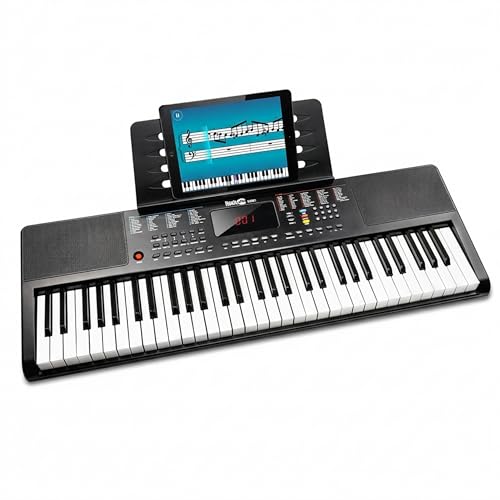
Best for space-saving setups without sacrificing learning features. This compact 61-key keyboard maintains a full learning suite, including 200 sounds and rhythms, ideal for practice in small rooms or shared spaces. It also offers sustain and vibrato effects, plus recording and playback to track progress over time.
Best for: beginners who need a smaller footprint or who study in tight spaces. Limitation: compact size may feel less comfortable for taller players or those who prefer a larger keybed.
Yamaha PSRE283 61-Key Portable Keyboard

Best for learners who value recognized learning tools and portability. The PSRE283 includes Quiz Mode to boost ear training and a portable grand piano button for a rich, expressive Yamaha sound. The 61 keys provide a standard feel for beginners developing technique. It’s well-suited for students who want a balanced mix of education features and mobility.
Caution: Yamaha’s learning tools are helpful, but the keyboard may lack some advanced features found on higher-end models, which could limit expansion for advanced players.
61 Keys Piano Keyboard By MIZAYI

Best for budget-conscious beginners who want a feature-rich 61-key keyboard with built-in microphones and recording. The MIZAYI model emphasizes multifunctionality, including an LCD display, speaker system, and a wide range of rhythms and tones. It’s a practical choice for kids and adults starting out who also want basic recording and playback.
Limitation: built-in power options rely on USB or adapters not included in the package, which could add setup considerations for some buyers.
JIKADA 61 Key Keyboard

Best for learners who want multiple teaching modes and memory features. JIKADA provides three teaching modes, an LCD display for status updates, and a dedicated microphone/headphone jack to practice singing while playing. The device supports audio input/output and USB disk storage for recording and practice notes.
Limitation: feature depth is strong for beginners, but some users may outgrow basic functions as skills progress, so consider future upgrade needs.
Buying Guide
What to consider when choosing a 61-key beginner keyboard
- Learning features: Look for built-in lessons, quiz modes, tempo control, and LCD displays that simplify instruction and practice tracking.
- Included accessories: Bundles with stands, benches, headphones, and music stands save time and money. Assess whether you already own compatible accessories or need a full kit.
- Sound and voices: A broad library of tones and rhythms supports creative exploration. Consider the number of voices and accompaniment options if you plan to play in different styles.
- Portability and size: If you travel or practice in small spaces, a compact design with light weight can be advantageous, but ensure the keybed still feels comfortable.
- Output options: Audio quality matters for practice and playback. Check if the keyboard has built-in speakers or relies on external amplification, and whether a headphone output is available for silent practice.
- Power options: Confirm the included power supply and battery compatibility if you need portable use without a wall outlet.
- Upgrade path: If you anticipate needing more features later, choose a model with expansion potential like more voices, better polyphony, or USB/MIDI connectivity.
FAQ
- Q: Are 61-key keyboards suitable for beginners? A: Yes. They provide a full-size key feel without the width of a 88-key piano, making them approachable for early learners.
- Q: Do bundled kits offer better value? A: Bundles provide convenience and cost savings by including stands, benches, and headphones, which reduces shopping time.
- Q: What is polyphony and why does it matter? A: Polyphony is the number of notes the keyboard can play simultaneously. Higher polyphony supports complex chords and layering without note dropouts.
- Q: Should I choose a model with teaching modes? A: Teaching modes help reinforce skills and ear-training, which is beneficial for beginners and kids.
- Q: Is USB or MIDI connectivity important for beginners? A: It’s helpful for accessing online lessons and recording software as skills grow, but not essential for initial learning.
- Q: How important are built-in rhythms and accompaniments? A: They support practical play-along practice and can motivate beginners to explore different styles.