Looking for reliable 12V heaters to keep a campervan cozy year-round? This guide highlights five practical options that suit different travelers—from budget-minded solo campers to full-time RV enthusiasts. Each product is evaluated for heating performance, ease of use, and suitability for small spaces. Use the buying table below to compare key features at a glance.
| Product | Best For | Key Benefit |
|---|---|---|
| Spwkr 12V Car Heater | Daily drivers and quick defrost | Fast defrosting, 360° swivel airflow |
| Mieligo RV Rooftop AC Unit | Van dwellers needing both heat and AC | 10000 BTU cooling, 3500 BTU heating |
| Blytra 12V Car Heater | Compact, portable use | 360° rotation, fast warming |
| Saycker 12V 100W Heater | Small space heating | Energy efficient, long service life |
| Xximuim 12V 200W Car Heater | Versatile car applications | 2-in-1 heater and cooler, adjustable airflow |
Note: Each product listed is evaluated for typical campervan scenarios. When choosing, consider space size, power availability from your battery, and whether you need supplemental heating or a combined cooling option for summer comfort.
Spwkr 12V Car Heater — Upgraded 150-200W Climate Helper
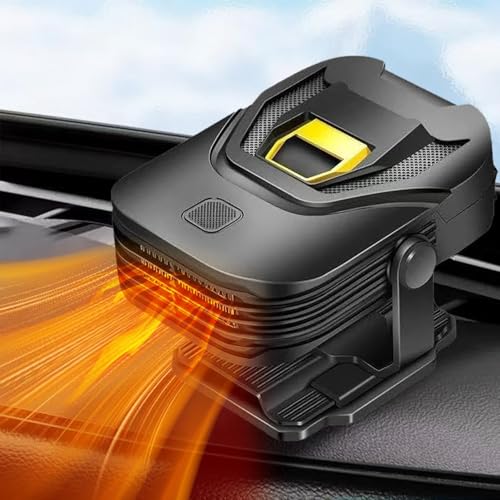
Best for quick defrosting and cabin warming, this 12V portable heater delivers 150W-200W, aiding windshield defogging and cold-weather warmth. A built-in fuse offers automatic power-off protection for safer operation, while a 360° swivel base lets you direct airflow exactly where it’s needed. Choose this if you want fast visibility improvements on winter mornings and year-round utility with a simple cigarette-lighter plug.
Best for: daily drivers and campers needing quick defrost. Limitation: airflow direction is limited to the swivel range, and high-demand heating may depend on battery capacity.
Mieligo RV Rooftop AC Unit With Heat 12V — 10000 BTU Cooling

Designed for van life, this rooftop unit provides both heating (3500 BTU) and cooling (10000 BTU). It’s installed at the skylight and supports roof sizes around standard dimensions. The unit can help maintain comfort in both warm and cool seasons, and it can draw power from the vehicle’s engine or an external battery when the engine is off. Best for campers who want an integrated climate solution on a roof-top platform.
Best for: van dwellers needing an all-season climate system. Limitation: installation requires roof space planning and electrical setup; energy use is higher during peak cooling.
Blytra Portable Car Heater With Fast Heating

Engineered for portability, Blytra offers rapid heating with a 12V design and a 360° rotatable outlet. Its ABS construction and copper wiring support durability, and the built-in fuse provides auto power-off protection. Choose this if you need a compact heater that can be repositioned easily to target windshield defogging or cabin warming.
Best for: small spaces and flexible placement. Limitation: may require close proximity to a power source for sustained heating in very cold conditions.
Saycker 12V 100W Heater — Small but Steady

A compact 100W heat source suitable for small spaces, Saycker uses quality materials and a long service life. It’s designed for warmth and dehumidification in tight campervan corners. Best for: space-constrained setups and energy-conscious travelers who want reliable, low-power heating. Caution: its heating capacity is modest—not ideal for very cold climates or larger vans.
Best for: small-space heating with energy efficiency. Limitation: limited heating power for larger interiors or very cold environments.
Kairueics 12V 200W Car Heater — Dual-Mode Comfort

This 12V unit delivers 200W of heating and also functions as a cooler, offering a practical 2-in-1 experience. Its large airflow outlet and 360° rotation enable broad coverage for defrosting and interior warming. Best for: users who want both heating and cooling options in one device. Limitation: higher power draw than smaller 100W models.
Best for: 2-in-1 climate control with flexible airflow. Choose this if you want seasonal versatility without carrying separate heater and fan units.
Buying Guide: Key Considerations For Campervan 12V Heaters
- Power availability: Assess your battery capacity and alternator or shore power options. Higher-watt models (like 200W) demand more electrical supply, which impacts runtime.
- Space and airflow: Measure the target area. A 360° adjustable outlet helps direct warmth where needed, especially near windows or seating zones.
- Heating vs. defrosting: Distinguish between defrost-focused units and full-cabin heaters. For winter driving, defrost performance is crucial for visibility.
- Portability vs. installed systems: Portable 12V heaters are easy to move but may provide less uniform heating than rooftop or built-in units.
- Safety features: Look for built-in fuses, automatic power-off protection, and durable construction to reduce risk in mobile environments.
- Noise and vibration: Especially for sleeping areas, consider units with quiet operation or sleep-friendly modes.
- Installation requirements: Roof-mounted or hard-wired units may require professional installation and electrical compatibility checks.
- Maintenance and durability: Materials like ABS plastic and copper wiring generally withstand mobile conditions better than cheaper plastics.
Frequently Asked Questions
- What 12V heater is best for small campervans?
A compact 100W or 150W model is often best for small spaces, prioritizing energy efficiency and easy placement.
- Can a 12V heater run off a camper’s battery overnight?
Yes, but it depends on battery capacity and draw. Higher-watt heaters consume more energy, so plan with battery capacity (Ah) and potential supplemental power sources.
- Is a roof-mounted 12V heater/cooler unit worth it?
For year-round comfort, roof-mounted units offer greater climate control, but require proper roof compatibility and installation planning.
- Do 12V heaters defog windshields effectively?
Yes, many models integrate rapid airflow and defrost-focused operation to restore visibility quickly.
- What safety features should I look for?
Automatic power-off, built-in fuses, and robust housings reduce overheating risks in mobile setups.
- Can I use a 12V heater with a portable power station?
Many 12V heaters can operate from a portable battery or power station, depending on the unit’s required wattage and the station’s output.